
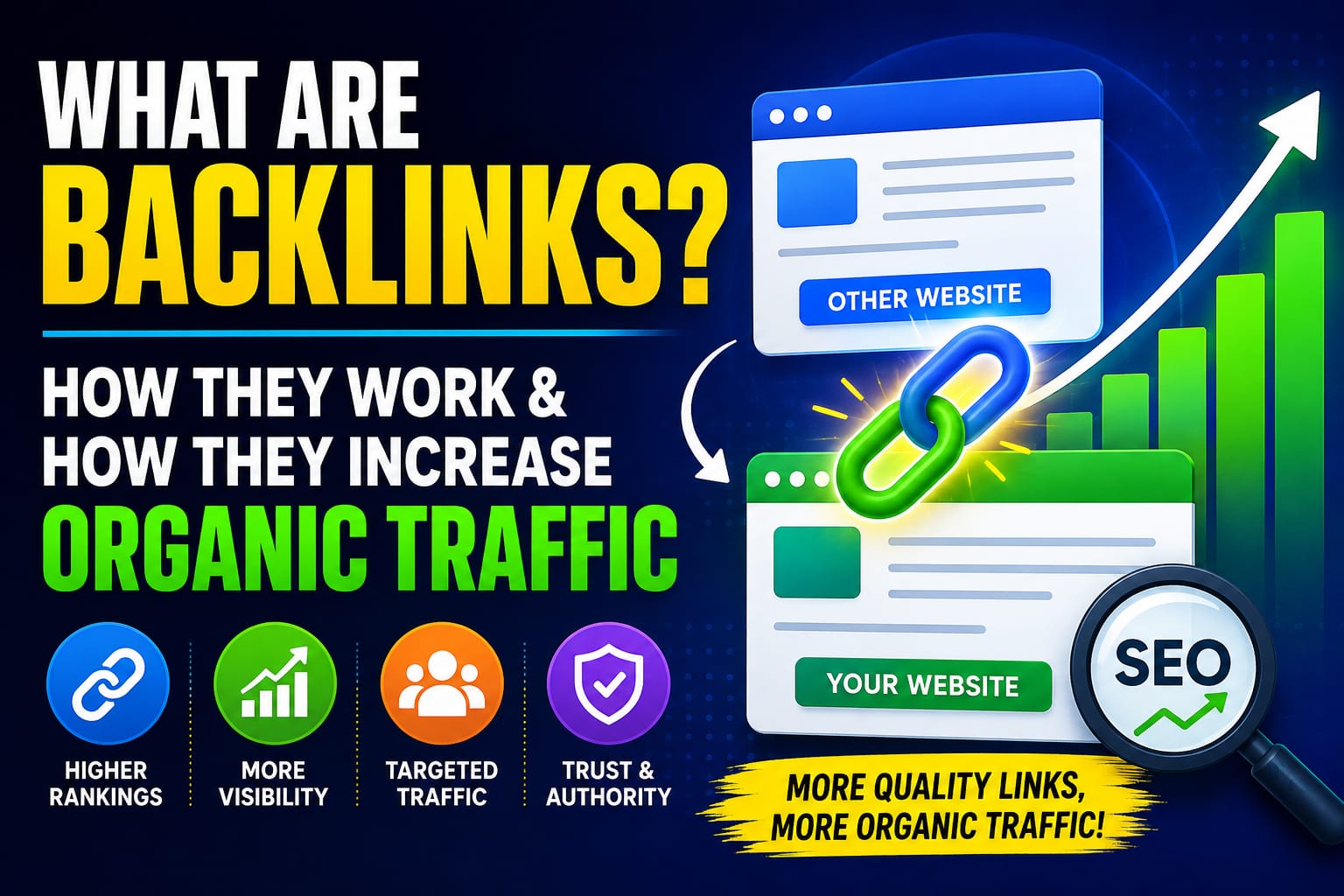
A backlink is a link from another website to your website. Backlinks are an important part of SEO because they can help search engines discover your pages, understand your website’s authority, and potentially improve your rankings.

1. What Is a Backlink?
For example, if another website publishes an article and links to:
“Learn more about SEO strategies at yourwebsite.com.”
That link to your website is a backlink.
In simple terms:
Other website → Link → Your website
Backlinks can come from blogs, news websites, business directories, industry websites, educational resources, forums, and other relevant sites.
2. How Do Backlinks Work?
Search engines can use links as signals when evaluating websites. A backlink can potentially help in several ways:
- Discovery: Search engines can find new pages through links.
- Authority: Links from reputable websites can contribute to your site’s perceived authority.
- Relevance: A link from a website covering a topic related to yours can provide useful contextual signals.
- Referral traffic: People can click the backlink and visit your website.
- SEO visibility: A strong backlink profile can support better search visibility when combined with high-quality content and good technical SEO.
However, more backlinks does not automatically mean higher rankings. Quality, relevance, trust, and the overall quality of your website matter.
3. Different Types of Backlinks
Editorial backlinks
These are links naturally included by another website because your content is useful.
For example, you publish an excellent guide about technical SEO, and another SEO website references it.
These are generally among the most valuable types of backlinks.
Guest-post backlinks
You write an article for another relevant website and receive a link to an appropriate page on your site.
The primary goal should be providing useful content, not simply obtaining links.
Business/profile backlinks
Business directories and legitimate industry profiles may link to your website.
These can be particularly useful for local businesses.
Resource-page backlinks
A website may maintain a page containing useful resources and link to your guide.
Creating genuinely useful research, statistics, tools, templates, and guides can help attract these links.
4. How to Get More High-Quality Backlinks
Don’t focus on getting hundreds of random links. Focus on earning links that are relevant and trustworthy.
Create link-worthy content
Publish resources that other websites have a reason to reference:
- Original research
- Statistics and data
- Detailed tutorials
- Industry guides
- Free tools
- Checklists
- Templates
- Case studies
- Original graphics
- Expert interviews
- Comprehensive comparison articles
For example, instead of writing another generic article called “What Is SEO?”, create:
“SEO Ranking Factors: A Data-Driven Guide for 2026”
Include original examples, diagrams, data, and practical recommendations.
Promote your content
Publishing an article isn’t enough.
You can promote it through:
- Relevant communities
- Email newsletters
- Industry groups
- Social media
- Partnerships
- Outreach to websites that already cover the topic
The objective is to put your content in front of people who may genuinely find it useful.
Build relationships with relevant websites
Find websites that publish content related to your subject.
Instead of sending:
“Please give me a backlink.”
Send something useful:
“I noticed your article discusses X. We recently published original research about Y that may provide additional information for your readers.”
This is much more effective than mass backlink requests.
5. How Backlinks Help Generate Organic Traffic
Think of SEO as a combination of several factors:
High-quality content + Search intent + Technical SEO + Internal links + Backlinks + User experience
For example:
- You publish a comprehensive article.
- Google discovers and indexes it.
- Other relevant websites link to the article.
- Those links can strengthen the page’s authority and visibility.
- Your page begins appearing for relevant searches.
- Higher rankings can produce more impressions and clicks.
- Those clicks become organic traffic.
But backlinks alone cannot guarantee rankings.
6. How to Get More Organic Traffic
If your goal is more Google organic traffic, use a complete SEO strategy rather than focusing only on backlinks.
Step 1: Find the right keywords
Look for keywords that your target audience actually searches for.
Consider:
- Search intent
- Search volume
- Competition
- Long-tail keywords
- Commercial intent
- Location-specific searches
For example:
Instead of targeting only:
SEO
You could target:
- SEO for small businesses
- How to improve Google rankings
- Local SEO strategies
- How to build website backlinks
- SEO tools for beginners
- How to increase organic website traffic
Long-tail keywords can be easier to target and often have clearer search intent.
Step 2: Create comprehensive content
Don’t write content just to reach a particular word count.
Make the page genuinely useful.
Include:
- Clear introduction
- Direct answer
- Examples
- Step-by-step instructions
- Relevant statistics
- Images
- FAQs
- Internal links
- Helpful external references
- Clear conclusion
Step 3: Build topical authority
Create multiple related articles around an important topic.
For example, if your main topic is SEO, you could create a content cluster:
Main guide:
SEO Complete Guide
Supporting articles:
- Keyword Research
- On-Page SEO
- Technical SEO
- Local SEO
- Link Building
- Internal Linking
- Image SEO
- Schema Markup
- SEO Audit
- Google Search Console
- SEO Analytics
Then connect these articles using internal links.
This helps users navigate your site and helps search engines understand the relationship between your pages.
Step 4: Improve internal linking
Internal links are links between pages on your own website.
For example:
SEO Guide → Keyword Research Guide → On-Page SEO Guide → Technical SEO Guide
Use descriptive anchor text rather than repeatedly using phrases such as “click here.”
Step 5: Earn relevant backlinks
A strong backlink strategy could include:
Useful content → Promotion → Outreach → Relationships → Editorial mentions
Avoid building links from unrelated or low-quality websites simply because they offer links.
7. Backlinks You Should Avoid
Be careful with:
- Paid links intended to manipulate rankings
- Link farms
- Automated backlink software
- Spammy directories
- Unrelated websites
- Large-scale guest-post networks created primarily for links
- Comment spam
- Private blog networks
- Excessive exact-match anchor text
The goal should be natural, relevant, editorially useful links, not an artificially large backlink count.
8. A Simple Backlink Strategy for a New Website
If your website is relatively new, try this approach:
Month 1 — Foundation
- Fix technical SEO problems
- Create important website pages
- Research keywords
- Publish 5–10 high-quality articles
- Start internal linking
Month 2 — Authority
- Publish supporting content
- Create original resources
- Promote your best articles
- Start relevant outreach
- Submit legitimate business profiles/directories where appropriate
Month 3 — Link earning
- Create link-worthy assets
- Contact relevant publishers
- Build industry relationships
- Promote original research
- Update existing content
- Analyze which pages are gaining impressions and links
9. The Most Important Principle
Don’t ask:
“How can I get 1,000 backlinks?”
Ask:
“What can I publish that other websites genuinely want to reference?”
That’s the foundation of sustainable link building.
Simple SEO Formula
Useful Content
↓
Keyword + Search Intent
↓
Strong On-Page SEO
↓
Internal Linking
↓
Content Promotion
↓
Relevant Backlinks
↓
Higher Search Visibility
↓
More Organic Traffic
For a website such as AI Landmark Solution, a particularly strong strategy would be to build topical authority around SEO, AI, digital marketing, website development, Google tools, and practical technology tutorials, then earn backlinks to the strongest guides and original resources.