
Absolutely. Below is a comprehensive, original, SEO-focused article designed for a professional website and suitable for WordPress publishing.
A Complete Guide to Building Local Search Authority in 2026
Local SEO is no longer simply about adding a city name to a webpage, creating a Google Business Profile, and collecting a few backlinks.
Search engines have become significantly better at understanding topics, entities, relationships, search intent, locations, services, and businesses. As a result, businesses that consistently demonstrate expertise around an entire subject area can have an advantage over websites that publish isolated pages targeting individual keywords.

This is where topical authority and semantic SEO become especially important.
For law firms, restaurants, medical practices, home-service companies, marketing agencies, financial businesses, real estate companies, and other local organizations, the objective should not be to create hundreds of pages simply because keywords exist. Instead, businesses should build a useful network of content that answers the questions customers ask before, during, and after choosing a local service.
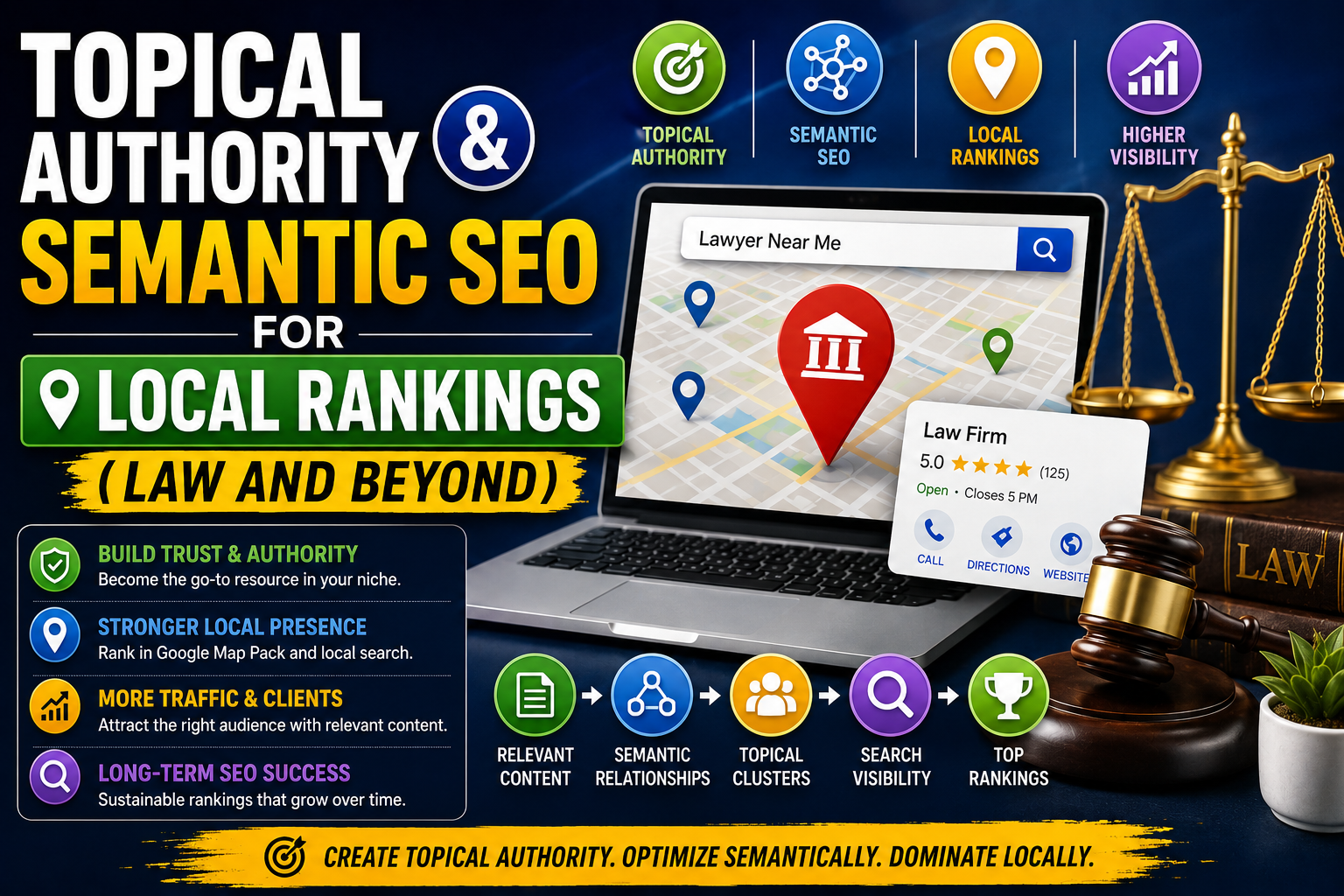
This guide explains how to combine topical authority, semantic SEO, local SEO, content architecture, internal linking, entities, structured information, and search intent to create a stronger local search presence.
What Is Topical Authority?
Topical authority is the perceived depth and breadth of knowledge a website demonstrates about a particular subject.
Imagine two websites.
Website A
A law firm’s website contains:
- Home page
- Personal injury page
- Contact page
- About page
Website B
Another law firm’s website contains:
- Personal injury overview
- Car accident claims
- Motorcycle accidents
- Truck accidents
- Pedestrian accidents
- Wrongful death
- Insurance negotiations
- Medical expenses
- Lost wages
- Comparative negligence
- Settlement calculations
- Filing deadlines
- Evidence collection
- Frequently asked questions
- Local legal information
- Case preparation guides
Website B provides a much broader information environment around personal injury law.
That does not automatically guarantee higher rankings, but it gives search engines and users much more context about the organization’s expertise.
Topical authority is not keyword stuffing
A common misunderstanding is that topical authority means publishing as many articles as possible.
It does not.
Publishing 500 low-quality articles can be less useful than publishing 50 genuinely helpful resources that are logically connected.
The goal is:
Depth + relevance + usefulness + coverage + relationships + trust
What Is Semantic SEO?
Semantic SEO focuses on the meaning and relationships behind search queries, rather than concentrating exclusively on exact keyword phrases.
Traditional keyword targeting might focus on:
“personal injury lawyer Riyadh”
Semantic SEO considers a much larger concept:
- personal injury
- accident
- compensation
- legal consultation
- insurance
- damages
- evidence
- medical records
- liability
- settlement
- court
- legal procedure
- local regulations
- attorney
- law firm
- client
- claim
The exact vocabulary will vary by jurisdiction and industry, but the principle remains the same.
Search engines increasingly attempt to understand what a page is actually about rather than simply matching an exact phrase.
Topical Authority vs. Semantic SEO
These concepts are related but different.
| Concept | Primary Purpose |
|---|---|
| Topical Authority | Demonstrates comprehensive expertise |
| Semantic SEO | Helps search engines understand meaning and relationships |
| Local SEO | Connects a business with geographic relevance |
| Keyword Research | Identifies what people search for |
| Search Intent | Identifies why people search |
| Internal Linking | Connects related information |
| Entity SEO | Clarifies people, organizations, places, services and concepts |
A strong local SEO strategy combines all of them.
Why Topical Authority Matters for Local Businesses
Local businesses operate within specific geographic and commercial environments.
A customer searching for a service is usually trying to solve a real problem.
For example:
“Best personal injury lawyer near me”
may represent a much deeper journey.
The person may also search:
- What should I do after an accident?
- How do I document an injury?
- Can I claim medical expenses?
- How long does a legal claim take?
- What evidence should I collect?
- Should I speak to an insurance company?
- How much could compensation be?
- When should I contact a lawyer?
- What happens during a consultation?
A website that answers these questions can become a much more useful resource than a website that only has one commercial service page.
The Local Topical Authority Model
A practical local topical authority strategy can be divided into six layers:
Layer 1: Business
Who are you?
Example:
ABC Law Firm
Layer 2: Location
Where do you operate?
Example:
Riyadh
Layer 3: Core Service
What do you provide?
Example:
Personal injury legal services
Layer 4: Subservices
What specific problems do you solve?
Examples:
- Car accidents
- Workplace injuries
- Wrongful death
- Insurance disputes
Layer 5: Questions
What do potential customers need to know?
Examples:
- How claims work
- Required documents
- Costs
- timelines
- eligibility
- procedures
Layer 6: Supporting Topics
What related concepts demonstrate depth?
Examples:
- Liability
- Evidence
- Damages
- Insurance
- Negotiation
- Legal documentation
These layers create a topical ecosystem.
Build Topic Clusters Instead of Random Blog Posts
One of the strongest approaches to topical authority is the topic cluster model.
Instead of publishing unrelated posts, organize content around a central subject.
For example:
Main Topic
Personal Injury Law
Supporting topics:
- What Is Personal Injury Law?
- Types of Personal Injury Claims
- Car Accident Claims
- Motorcycle Accident Claims
- Workplace Injury Claims
- Medical Expense Claims
- Lost Wage Claims
- Insurance Claims
- Evidence for Injury Claims
- Settlement Process
- Legal Consultation
- Frequently Asked Questions
These pages can connect to one another through contextual internal links.
Pillar Pages and Supporting Pages
A pillar page provides a broad overview of a major topic.
For example:
Complete Guide to Personal Injury Claims
Supporting pages can provide detailed answers.
For example:
How to Document Medical Expenses After an Accident
The supporting page links back to the pillar page.
The pillar page also links to relevant supporting resources.
This creates a structured content ecosystem.
Example of a Local Law Topic Cluster
Suppose a law firm targets personal injury clients in a particular city.
A possible architecture could look like this:
Pillar Page
Personal Injury Lawyer in [City]
Supporting Service Pages
- Car Accident Lawyer
- Truck Accident Lawyer
- Motorcycle Accident Lawyer
- Workplace Injury Lawyer
- Wrongful Death Lawyer
Educational Content
- What to Do After a Car Accident
- How Personal Injury Claims Work
- What Evidence Should You Keep?
- How Insurance Claims Work
- Common Personal Injury Questions
Local Content
- Personal Injury Legal Resources in [City]
- Local Accident Reporting Information
- Local Court and Legal Process Guide
- Common Questions From Clients in [City]
The result is a much stronger topical structure than dozens of pages targeting slightly different versions of the same keyword.
Semantic Keyword Research
Keyword research should evolve beyond search volume.
Instead of asking only:
“What keyword has the highest volume?”
ask:
“What concepts, questions, entities, and problems are connected to this topic?”
For a restaurant, semantic research could include:
- cuisine
- menu
- dining
- reservations
- takeaway
- delivery
- opening hours
- location
- dietary options
- parking
- family dining
- private events
For a law firm:
- legal consultation
- claims
- evidence
- liability
- compensation
- court
- settlement
- insurance
- documentation
- legal deadlines
For an SEO agency:
- keyword research
- technical SEO
- content strategy
- local SEO
- Google Business Profile
- link building
- structured data
- analytics
- conversion optimization
The exact terms should naturally appear where useful rather than being artificially inserted.
Search Intent Is More Important Than Exact-Match Keywords
Search intent explains what the user wants to accomplish.
Four common intent categories are:
1. Informational Intent
The user wants information.
Examples:
What is semantic SEO?
How does personal injury law work?
2. Commercial Investigation
The user is comparing options.
Examples:
Best SEO agency in Riyadh
Best restaurant for family dining
3. Transactional Intent
The user is ready to take action.
Examples:
Hire personal injury lawyer
Book restaurant reservation
4. Navigational Intent
The user wants a particular organization or location.
Examples:
ABC Law Firm
XYZ Restaurant Riyadh
A good topical strategy covers multiple stages of the customer journey.
Create Content for the Entire Customer Journey
Local SEO content should not focus exclusively on bottom-of-funnel keywords.
Consider the journey:
Problem → Research → Comparison → Decision → Action → Follow-up
For a law firm:
Problem
“I was involved in an accident.”
Research
“What should I do after an accident?”
Comparison
“How do I choose a personal injury lawyer?”
Decision
“Personal injury lawyer near me.”
Action
“Schedule legal consultation.”
Follow-up
“What documents should I bring to my consultation?”
A comprehensive website can address each stage.
Local Relevance Without Keyword Stuffing
Adding the same city name to every paragraph is not a good SEO strategy.
Instead, establish geographic relevance naturally.
Useful local signals can include:
- Business address
- Service areas
- Local landmarks
- Neighborhoods served
- Local regulations
- Local customer questions
- Local case considerations
- Directions
- Contact information
- Local business listings
- Relevant local entities
For example, instead of repeatedly writing:
Best lawyer in Riyadh | Riyadh lawyer | Riyadh legal services | lawyer Riyadh
write naturally:
Our legal team assists clients throughout Riyadh with consultations, documentation, claims, and other legal matters relevant to their circumstances.
The second approach communicates location without making the content unreadable.
Entity-Based SEO
Semantic search is strongly connected to entities.
An entity can be:
- Person
- Organization
- Business
- Place
- Product
- Service
- Legal concept
- Medical concept
- Event
- Geographic location
A local business website should clearly establish important entities.
For example:
Business Entity
ABC Law Firm
Location Entity
Riyadh
Service Entity
Personal Injury Law
Professional Entity
Attorney / Legal Professional
Supporting Entities
Insurance, accident, compensation, medical records, court, claim, settlement.
The clearer the relationships between these entities, the easier it can be for systems to interpret the business and its content.
Build a Strong Internal Linking System
Internal linking is one of the most practical ways to build topical relationships.
Suppose you publish:
Personal Injury Lawyer Guide
Within that article, you might naturally link to:
- Car accident claims
- Insurance claims
- Evidence collection
- Medical expenses
- Legal consultation
Those pages can link back to the broader guide where appropriate.
Example structure
Personal Injury Lawyer
│
├── Car Accident Claims
│   ├── Accident Evidence
│   ├── Insurance Claims
│   └── Medical Expenses
│
├── Workplace Injuries
│   ├── Injury Documentation
│   └── Compensation Questions
│
├── Wrongful Death
│   ├── Legal Process
│   └── Family Claims
│
└── Personal Injury FAQs
This creates a logical information architecture.
Avoid Orphan Pages
An orphan page is a page that has little or no meaningful internal connection to the rest of the website.
For example, imagine publishing:
“How to Calculate Medical Expenses After an Accident”
but no other page links to it.
The content may be useful, but its role within the website is unclear.
Every important page should have a logical place within the site’s architecture.
Local Landing Pages: Quality Over Quantity
Many businesses create dozens of location pages:
- Lawyer Riyadh
- Lawyer Jeddah
- Lawyer Dammam
- Lawyer Mecca
- Lawyer Medina
But if each page contains almost identical text with only the city name changed, those pages may provide little additional value.
A useful location page should contain genuinely relevant information about that market.
Possible components include:
- Services available
- Actual service area
- Local customer needs
- Relevant local information
- Office details, where applicable
- Local directions
- Frequently asked questions
- Unique examples
- Local contact information
The objective is to make each page useful independently.
Topical Authority for Law Firms
Legal websites are especially dependent on accuracy, clarity, and trust.
A legal content strategy might include:
Core Practice Area
Personal Injury Law
Subtopics
- Auto accidents
- Workplace injuries
- Wrongful death
- Insurance disputes
- Medical expenses
- Property damage
- Liability
- Compensation
- Settlement procedures
Educational Questions
- What should I do after an accident?
- What documents are useful?
- What information should I provide to a lawyer?
- How does the claims process work?
- What factors can affect a claim?
Legal content should be reviewed carefully and adapted to the applicable jurisdiction.
Never use generic legal information as a substitute for jurisdiction-specific professional advice.
Topical Authority for Restaurants
Topical authority isn’t only for lawyers.
A restaurant can build semantic relevance around its cuisine and customer experience.
For example, an Italian restaurant could cover:
- Italian cuisine
- Pizza
- Pasta
- Traditional dishes
- Vegetarian options
- Family dining
- Private dining
- Catering
- Takeaway
- Delivery
- Reservations
- Local dining guides
The website can connect these topics with its menu, location, services, and customer questions.
Topical Authority for Home-Service Businesses
Consider a plumbing company.
Its topical map could include:
Core Topic
Plumbing Services
Services
- Emergency plumbing
- Drain cleaning
- Water heater services
- Pipe repair
- Leak detection
- Bathroom plumbing
Educational Content
- Signs of a water leak
- Causes of low water pressure
- How to prevent blocked drains
- When to replace a water heater
- Common plumbing emergencies
This helps create comprehensive subject coverage.
Topical Authority for SEO Agencies
An SEO agency could create a content ecosystem around:
SEO
- Technical SEO
- On-page SEO
- Local SEO
- Semantic SEO
- Keyword research
- Content strategy
- Link building
- Enterprise SEO
- E-commerce SEO
Local SEO
- Google Business Profile
- Local citations
- Reviews
- Local landing pages
- Local keyword research
- Local link building
- Map visibility
Semantic SEO
- Entities
- Topic clusters
- Search intent
- Knowledge graphs
- Internal linking
- Content relationships
This approach creates a recognizable topical footprint.
Content Depth Does Not Mean Making Every Article Extremely Long
Long-form content can be useful, but word count itself is not a ranking strategy.
A 1,500-word article can be better than a 5,000-word article if it answers the user’s question more clearly.
Focus on:
- Completeness
- Accuracy
- Original information
- Readability
- Helpful examples
- Logical structure
- Relevant internal links
- Appropriate media
- Clear answers
Do not add unnecessary paragraphs simply to reach a word-count target.
Originality: How to Create Truly Unique Content
Creating original content does not mean changing a few words from competitors.
Instead, develop your own information.
Examples include:
Original explanations
Explain complex concepts in a way your audience can understand.
Original frameworks
Create your own process or methodology.
Original examples
Use realistic scenarios relevant to your customers.
Original research
Analyze your own data where available.
Expert commentary
Add insights from qualified professionals.
Local knowledge
Provide genuinely useful local information.
Frequently Asked Questions
Answer questions your actual customers ask.
This produces substantially more valuable content than rewriting competitors.
The E-E-A-T Connection
Google’s quality guidance emphasizes concepts commonly discussed as Experience, Expertise, Authoritativeness, and Trustworthiness (E-E-A-T).
For local businesses, these principles can be reflected through:
- Clear business information
- Author identification
- Professional credentials
- Accurate contact information
- Real-world experience
- Original content
- Transparent policies
- References where appropriate
- Updated information
- Customer reviews
- Demonstrated expertise
For sensitive subjects such as law, medicine, finance, and safety, accuracy and trustworthy sourcing are especially important.
Create Authoritative Author Pages
If your website publishes expert content, consider creating author profiles.
An author page can include:
- Name
- Professional role
- Areas of expertise
- Qualifications
- Experience
- Published content
- Professional affiliations where relevant
This gives readers additional context about who created the information.
Keep Important Information Updated
Topical authority is not something you build once and forget.
Information can become outdated.
Review important content regularly for:
- Changed regulations
- New services
- Updated business information
- Broken links
- Outdated statistics
- Old screenshots
- Incorrect pricing
- Changed procedures
- New developments
An updated resource can remain useful for much longer than a neglected article.
Semantic SEO and Structured Data
Structured data can help communicate information about a page to search engines.
Depending on the business and content, relevant structured data may include:
- Organization
- LocalBusiness
- Article
- Breadcrumb
- Product
- Event
- FAQ-related structured information where eligible and appropriate
Structured data should accurately represent visible page content and follow current search-engine guidelines.
It should not be treated as a shortcut to rankings.
Breadcrumbs and Information Architecture
Breadcrumb navigation helps users understand where they are within a website.
Example:
Home → Legal Services → Personal Injury → Car Accident Claims
This hierarchy communicates relationships between pages.
It can also make large websites easier to navigate.
Images Can Support Semantic Relevance
Images are not merely decoration.
Useful images can improve understanding and user experience.
For example:
Law Firm
- Legal consultation process infographic
- Accident documentation checklist
- Claim process diagram
Restaurant
- Menu photography
- Restaurant interior
- Signature dishes
- Location photos
SEO Agency
- SEO architecture diagrams
- Topic cluster illustrations
- Analytics screenshots
- Content workflow diagrams
Use descriptive filenames and meaningful alt text.
For example:
personal-injury-claim-process.png
Alt text:
Diagram showing the general stages of a personal injury claim
Avoid stuffing keywords into every image.
Content Silos vs. Topic Clusters
Traditional SEO often uses content silos to organize pages by categories.
Modern semantic strategies can be more flexible.
Instead of forcing every page into one rigid category, think about relationships.
A legal article about insurance may connect to:
- Car accidents
- Personal injury
- Claims
- Compensation
- Evidence
The same concept can naturally belong to multiple topical relationships.
This is closer to how users actually explore information.
Build a Semantic Content Map
Before writing dozens of articles, create a content map.
Example:
| Main Topic | Supporting Topic | Search Intent |
|---|---|---|
| Local SEO | Google Business Profile | Informational |
| Local SEO | Local citations | Informational |
| Local SEO | Local rankings | Informational |
| SEO Services | Technical SEO | Commercial |
| SEO Services | Local SEO | Commercial |
| SEO Services | SEO audit | Transactional |
| Local Business | Reviews | Informational |
| Local Business | Reputation management | Commercial |
This helps prevent random publishing.
Use Search Results as a Research Tool
When researching a topic, examine the types of questions appearing in search results.
Look for:
- Related searches
- Frequently asked questions
- Common subtopics
- Competing page structures
- Search intent
- Local modifiers
- Different interpretations of the query
However, do not simply copy competitor structures.
Use search results to identify information gaps.
Then create something more useful.
Find Content Gaps
A content gap exists when users need information that existing websites do not explain well.
For example, competitors might all publish:
“What is Local SEO?”
But very few might explain:
“How should a local business organize its website into a semantic topic cluster?”
That represents an opportunity.
Content gaps can be found through:
- Customer questions
- Sales calls
- Support conversations
- Search suggestions
- Competitor analysis
- Industry forums
- Reviews
- Existing analytics
- Search Console data
Customer Questions Are a Gold Mine
Your customers already tell you what content you should create.
Collect questions such as:
- How much does this service cost?
- How long does it take?
- What documents do I need?
- What happens next?
- Do you serve my area?
- What should I prepare?
- What are common mistakes?
- What should I expect?
Turn recurring questions into useful content.
This creates content based on real-world demand rather than assumptions.
Local Reviews Can Inspire Content
Customer reviews can reveal language people naturally use when describing your service.
For example, restaurant reviews may mention:
- Family-friendly atmosphere
- Fast service
- Breakfast
- Outdoor seating
- Parking
- Spicy food
- Large portions
These concepts can inform useful website content.
However, do not manipulate or fabricate reviews.
Build Local Authority Through Community Relevance
Local authority is not purely an SEO concept.
Businesses become known locally by participating in their communities.
Potential examples include:
- Local events
- Community organizations
- Educational resources
- Sponsorships
- Partnerships
- Local publications
- Industry organizations
- Community initiatives
Where appropriate, these activities may also create legitimate opportunities for mentions and links.
The emphasis should be genuine involvement rather than artificial link acquisition.
Backlinks Still Matter, But Context Matters
Links can provide authority and discovery signals, but acquiring hundreds of irrelevant links is not a sustainable strategy.
A relevant link from a respected local or industry source can be more meaningful than a large number of unrelated links.
Potential sources include:
- Local organizations
- Industry associations
- Professional directories
- Chambers of commerce
- Local publications
- Educational institutions
- Relevant partners
Avoid manipulative link schemes.
Local Citations and Business Consistency
Business information should be consistent across important platforms.
Pay attention to:
- Business name
- Address
- Phone number
- Website
- Opening hours
- Categories
- Service information
Inconsistent information can create confusion for customers and search systems.
Google Business Profile and Website Strategy
Your website and business profile should support each other.
Your website should clearly explain:
- Who you are
- What you offer
- Where you operate
- How customers can contact you
- Why your business is qualified
- What customers can expect
Your business profile should accurately represent the real business.
Do not treat the business profile as a replacement for a comprehensive website.
Local SEO Is About Relevance, Not Just Location
A common misconception is:
“If my business is physically near the searcher, I will rank.”
Local visibility involves more than physical proximity.
Search systems can consider multiple factors, including relevance and prominence, alongside location-dependent considerations.
Therefore, a business should work on both:
Geographic relevance
and
Topical relevance
A business needs to be understood as both:
“A real business in this area”
and:
“A relevant provider for this specific need.”
Common Topical Authority Mistakes
Mistake 1: Publishing Random Articles
A blog full of unrelated topics does not necessarily create authority.
Better approach
Organize content around core business topics.
Mistake 2: Keyword Stuffing
Repeating a city and keyword unnaturally can damage readability.
Better approach
Write naturally and cover related concepts.
Mistake 3: Creating Hundreds of Doorway Pages
Location pages with nearly identical content provide little value.
Better approach
Create genuinely useful location-specific resources.
Mistake 4: Copying Competitors
Changing words while keeping the same structure and information produces weak differentiation.
Better approach
Add original examples, research, expertise, and practical information.
Mistake 5: Ignoring Search Intent
A commercial keyword does not always require a 4,000-word educational article.
Better approach
Match content format to user intent.
Mistake 6: Ignoring Internal Links
Publishing excellent content without connecting it to related pages wastes an important organizational opportunity.
Better approach
Create contextual links between related resources.
Mistake 7: Focusing Only on Rankings
Traffic without conversions is not necessarily successful SEO.
Better approach
Connect SEO with business outcomes.
Measuring Topical Authority
There is no single universal “topical authority score” that determines whether Google considers a website authoritative.
Instead, monitor a combination of signals.
Organic Visibility
Track:
- Keyword impressions
- Rankings
- Clicks
- Organic traffic
Topic Coverage
Measure:
- Number of core topics
- Supporting topics
- Question coverage
- Content gaps
Engagement
Consider:
- Engagement rate
- Time spent where meaningful
- Page depth
- Returning visitors
Business Results
Ultimately measure:
- Leads
- Calls
- Bookings
- Consultations
- Purchases
- Contact forms
- Revenue
The purpose of SEO is not simply to collect rankings.
Google Search Console for Topic Analysis
Search Console can reveal queries that bring impressions and clicks.
Look for unexpected queries.
Suppose you published an article about:
Local SEO
but it begins receiving impressions for:
semantic SEO local businesses
That may indicate an opportunity to create a dedicated resource around the emerging topic.
Search data can therefore help you expand your content architecture.
Build Content Based on Performance
Your content strategy should evolve.
A simple process is:
Publish → Measure → Analyze → Improve → Expand
For example:
- Publish a pillar article.
- Monitor queries.
- Identify related search terms.
- Find missing subtopics.
- Create supporting articles.
- Add internal links.
- Update the pillar article.
This creates a continuous topical development cycle.
A Practical 90-Day Topical Authority Strategy
Days 1–30: Research and Architecture
Start by identifying:
- Main services
- Main locations
- Customer questions
- Competitors
- Search intent
- Existing content
- Content gaps
Then create your topical map.
Days 31–60: Create Core Content
Develop:
- Main service pages
- Pillar guides
- Supporting articles
- FAQ resources
- Location pages where genuinely useful
Connect them with internal links.
Days 61–90: Expand and Optimize
Review:
- Search Console queries
- Ranking changes
- Traffic
- Engagement
- Leads
- Content gaps
Improve existing pages and create additional resources based on real search behavior.
Example Local SEO Content Calendar
A local business could publish:
Week 1
What Is [Core Service]?
Week 2
Complete Guide to [Core Service] in [City]
Week 3
Common Problems Related to [Service]
Week 4
How to Choose the Right [Service Provider]
Week 5
Frequently Asked Questions About [Service]
Week 6
Common Mistakes Customers Make
Week 7
Cost and Pricing Guide
Week 8
Local Guide to [Service]
The exact schedule should depend on the business and available resources.
A Better Local SEO Content Formula
A useful formula is:
Business + Service + Location + Intent + Entity + Supporting Topics
For example:
Personal Injury Lawyer + Car Accident + Riyadh + “What should I do?” + Insurance + Evidence + Compensation
This produces much richer content opportunities than simply:
“Riyadh personal injury lawyer”
How Semantic SEO Supports AI Search
Search is increasingly becoming conversational.
Users may ask:
“I had a car accident yesterday. What should I do before contacting a lawyer?”
This is fundamentally different from typing:
“car accident lawyer”
A website with comprehensive, well-organized information has more opportunities to answer nuanced questions.
Semantic content therefore becomes increasingly important as search interfaces become more conversational and context-aware.
Optimize for People First
The strongest semantic SEO strategy is often surprisingly simple:
Understand your customer deeply.
Ask:
- What problem are they experiencing?
- What terminology do they use?
- What questions do they ask?
- What information prevents them from making a decision?
- What concerns do they have?
- What information do they need before contacting you?
- What happens after they become a customer?
Then build content around those needs.
The Topical Authority Flywheel
A successful local content strategy can become a flywheel:
Useful Content
↓
Better User Experience
↓
More Search Visibility
↓
More Visitors
↓
More Brand Awareness
↓
More Mentions and Engagement
↓
More Data and Customer Questions
↓
Better Content
↓
Stronger Topical Coverage
The process continues over time.
Final Topical Authority Checklist
Before publishing a major local SEO article, ask:
Topic
- Does this page address an important business topic?
Intent
- Does it satisfy the user’s actual purpose?
Depth
- Does it answer the important questions?
Semantics
- Does it naturally cover related concepts?
Local Relevance
- Is geographic information genuinely useful?
Expertise
- Is the information accurate and credible?
Originality
- Does the page provide something competitors do not?
Internal Linking
- Does it connect to relevant pages?
User Experience
- Is the content easy to scan?
Media
- Would images, diagrams, or examples improve understanding?
Conversion
- Is the next step clear?
Maintenance
- Will this page need periodic updates?
If the answer to most of these questions is yes, you are building something much more valuable than a keyword-focused article.
Conclusion
Topical authority and semantic SEO are powerful components of a modern local search strategy.
Instead of creating isolated pages for individual keywords, businesses should develop interconnected information ecosystems around their services, customers, locations, and industries.
For law firms, this can mean comprehensive coverage of legal practice areas and customer questions.
For restaurants, it can mean building meaningful content around cuisine, dining experiences, services, and local relevance.
For SEO agencies, it can mean demonstrating expertise across technical SEO, content, local search, semantic optimization, analytics, and digital marketing.
For home-service companies, it can mean covering services, problems, maintenance questions, costs, and emergency situations.
The common principle is simple:
Do not create content merely because a keyword exists. Create content because your audience needs the information.
When your website clearly explains what your business does, whom it serves, where it operates, what problems it solves, and how its services relate to a broader subject, you create a stronger foundation for search visibility and user trust.
Local SEO is moving beyond simple keyword matching.
The future belongs to websites that demonstrate depth, relevance, context, expertise, usefulness, and genuine local value.
Build the topic.
Connect the concepts.
Answer the questions.
Demonstrate expertise.
Serve the local audience.
Then let search visibility become the result of a genuinely useful website rather than the sole objective.