

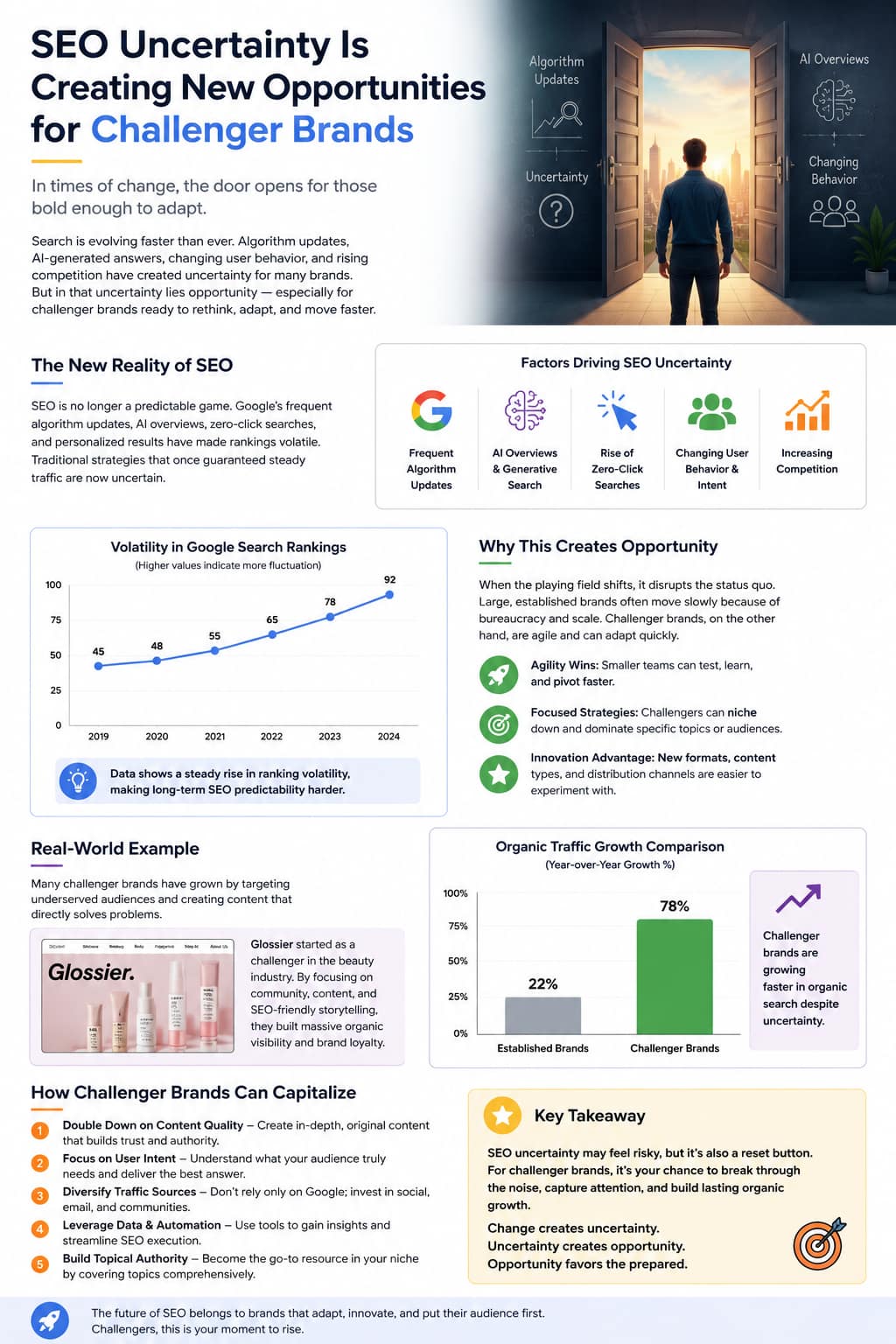
Search engine optimization is entering a period of major change. AI-generated answers, zero-click searches, evolving ranking systems, changing user behavior and increasingly sophisticated search experiences are making organic visibility less predictable than it once was.
For many businesses, that uncertainty feels like a threat. But for challenger brands—smaller companies competing against established players—it can also be an opening.
When the rules of a market change, the advantages of size and history can become less powerful. Companies that can experiment quickly, understand their audiences and create genuinely useful content may be able to gain visibility without following the traditional path to SEO success.
Recent research and industry analysis point toward a search environment where traditional rankings are only part of the visibility equation. Google’s expanding candidate sets, AI search experiences and answer-driven interfaces are increasing the importance of information quality, verification, context and authority.
The New Reality of SEO
For years, SEO was often treated as a relatively straightforward formula:
Find keywords → create content → earn links → rank → receive traffic.
That model still matters, but it is no longer enough.
Search engines increasingly interpret context, entities, intent and relationships between pieces of information. AI-powered search can summarize information rather than simply presenting a list of links. This means a brand can potentially gain visibility through citations, mentions, recommendations and answers—not just a traditional blue-link ranking.
A recent study examining Google AI Overviews found that clicks to sources cited within those AI-generated summaries occurred in only about 1% of AI Overview visits in the researchers’ sample. The study also associated AI Overviews with fewer clicks and more browsing sessions ending after the search. (arXiv)
That creates an important strategic question:
If fewer users are clicking traditional results, how can a brand still become visible and influential?
The answer is to stop thinking about SEO as simply a ranking exercise.
Why SEO Uncertainty Creates Opportunity
Uncertainty disrupts established advantages.
Large companies often have strong domains, extensive backlink profiles and recognizable brands. However, they can also have complex approval processes, large content operations and slower decision-making.
A challenger brand can sometimes move differently.
It can:
- Test new topics quickly.
- Publish content around emerging questions.
- Build authority in a narrow niche.
- Respond rapidly to algorithmic and market changes.
- Experiment with different formats.
- Develop a recognizable point of view.
- Build communities outside traditional search.
- Use AI tools to accelerate research and production while keeping human expertise at the center.
This matters because today’s search environment increasingly rewards useful, trustworthy and contextually relevant information rather than content produced simply to satisfy a keyword target. Search Engine Land’s recent analysis similarly argues that organizations should not freeze SEO investment while search and AI evolve because authority and organic momentum take time to build.
A Simple Example of the Opportunity
Imagine two companies competing in the same industry.
Established Brand A has a large website with 10,000 pages. It receives substantial organic traffic but requires several weeks to approve new content.
Challenger Brand B has only 300 pages. However, its team can identify a new customer problem and publish a genuinely useful solution within days.
If search behavior suddenly changes around that problem, Brand B may have an opportunity before Brand A adjusts.
The challenger does not necessarily need to outperform the established company everywhere.
It only needs to find specific areas where the incumbent is slow, generic or absent.
Example Graph: How Challenger Strategy Can Work
The following conceptual example illustrates the idea—not industry benchmark data.
In this hypothetical scenario, the established brand begins with much greater visibility. The challenger starts far behind but improves faster because it identifies a specific opportunity and adapts its content strategy quickly.
The lesson is not that challengers automatically beat large companies.
The lesson is that speed of adaptation can become a competitive advantage when the environment is changing.
AI Search Is Changing the Definition of Visibility
One of the biggest sources of uncertainty is the growing role of AI in search.
Traditional SEO asks:
“Where does my page rank?”
Modern search strategy increasingly needs to ask:
“Does my brand appear when an AI system explains, compares or recommends solutions in my category?”
That is a much broader question.
AI systems can synthesize information from websites, communities, reviews, videos and other sources. This makes brand reputation and information consistency increasingly important.
Recent reporting has highlighted cases where AI-generated search summaries have confused businesses with similarly named companies or incorporated inaccurate information from third-party sources. (Business Insider)
For challengers, this creates both risk and opportunity.
A brand with very little accurate information across the web may be difficult for AI systems to understand. A challenger that consistently publishes authoritative information, earns credible mentions and maintains accurate business data can make itself easier to identify.
The Rise of Zero-Click Search
Another challenge is the growth of searches that can be answered without a traditional website visit.
Users may receive:
- An AI-generated summary.
- A featured answer.
- A knowledge panel.
- A product result.
- A local result.
- A comparison.
- A direct response inside the search interface.
This means traffic should no longer be the only measure of SEO success.
A brand might receive fewer clicks but still gain:
- Brand awareness.
- Search visibility.
- Citations.
- Product consideration.
- Direct searches.
- Assisted conversions.
- Customer trust.
The strategic goal becomes being present throughout the discovery journey, not simply maximizing organic sessions.
Challenger Brands Should Target Gaps, Not Giants
One of the biggest mistakes smaller companies can make is trying to compete with major brands for every high-volume keyword.
A better approach is to identify gaps.
1. Look for underserved questions
Instead of targeting a broad term such as “running shoes,” a challenger could focus on a more specific problem:
“Best running shoes for people training on mixed road and trail surfaces.”
Specific questions often reveal clearer intent.
2. Build topical depth
Publishing one article about a subject rarely establishes authority.
A challenger can create a connected content ecosystem covering:
- Beginner questions.
- Advanced questions.
- Comparisons.
- Case studies.
- Original research.
- Product guides.
- Expert opinions.
- Common mistakes.
- Frequently misunderstood topics.
This gives both users and search systems more context about what the brand knows.
3. Create original information
Generic AI-generated articles are becoming easier to produce.
That makes originality more valuable.
Challenger brands can differentiate through:
- Surveys.
- Experiments.
- Customer data.
- Expert interviews.
- Product testing.
- Original statistics.
- First-hand case studies.
- Unique frameworks.
The objective is to create information that other websites have a reason to reference.
Example: A Challenger Entering a Crowded Market
Consider a fictional skincare company called PureGlow entering a market dominated by established beauty brands.
Instead of attempting to rank immediately for “best skincare products,” PureGlow could build authority around a narrower problem:
“Simple skincare routines for people with sensitive skin.”
It could then create:
- A beginner’s routine.
- Ingredient comparison guides.
- Dermatologist interviews.
- Product-testing articles.
- Customer case studies.
- Ingredient explainers.
- Frequently asked questions.
- Videos demonstrating routines.
- Community discussions.
- Original research about consumer preferences.
Over time, the company is no longer just selling products.
It is building an information ecosystem around a specific customer need.
That can create opportunities across traditional search, social platforms, video search and AI-driven discovery.
The Five Strategies Challenger Brands Should Prioritize
1. Double Down on Content Quality
More content is not necessarily better.
The objective should be to produce content that answers the user’s question better than competing pages.
Ask:
- Is this information original?
- Does it demonstrate expertise?
- Is it easy to understand?
- Does it solve a real problem?
- Is it supported by evidence?
- Would someone naturally recommend it?
2. Focus on Search Intent
Keywords describe what people type.
Intent explains what they actually want.
A challenger brand should understand whether the user wants to:
- Learn.
- Compare.
- Research.
- Buy.
- Troubleshoot.
- Find a provider.
- Evaluate alternatives.
Content becomes more valuable when it matches the real task behind the search.
3. Build Brand Recognition Outside Google
Depending entirely on Google creates unnecessary risk.
Challengers should also develop:
- YouTube visibility.
- Social communities.
- Email audiences.
- Podcasts.
- Industry publications.
- Digital PR.
- Partnerships.
- Online communities.
Search Engine Land has also highlighted the growing importance of social search and the role platforms such as TikTok, YouTube and Reddit can play in discovery.
The goal is to create demand that does not disappear when an algorithm changes.
4. Use AI as an Accelerator, Not a Substitute for Expertise
AI can help smaller teams compete with larger organizations by accelerating:
- Keyword research.
- Content briefs.
- Competitive analysis.
- Data organization.
- Content updating.
- Internal linking.
- Technical audits.
- Idea generation.
But using AI to produce large quantities of generic content can create the opposite result.
Human expertise remains the differentiator.
The strongest workflow is:
AI speed + human experience + original information + editorial judgment.
5. Become the Authority in a Narrow Category
Challengers do not need to become the biggest brand on the internet.
They need to become highly relevant somewhere.
A company that becomes the trusted source for one specific customer problem can eventually expand its authority into adjacent topics.
This is often more achievable than trying to dominate an entire industry immediately.
A Better Way to Measure SEO Success
Traditional SEO reporting often focuses heavily on:
- Rankings.
- Organic sessions.
- Click-through rate.
- Backlinks.
These metrics remain useful, but challenger brands should add broader visibility measurements.
Consider tracking:
Brand searches
Are more people searching for your company by name?
AI visibility
Does your company appear in relevant AI-generated answers?
Citations and mentions
Are authoritative sources mentioning your business?
Share of search
Are you gaining visibility relative to competitors?
Engagement
Do visitors actually consume your content?
Conversions
Does organic discovery contribute to revenue?
Assisted conversions
Does SEO influence customers who eventually convert elsewhere?
This produces a more complete picture of search performance.
SEO Uncertainty Rewards Experimentation
The most dangerous response to uncertainty is paralysis.
When marketers cannot predict exactly how search will behave six months from now, they may decide to wait.
But waiting has a cost.
Organic authority takes time. Content libraries take time. Brand recognition takes time. Relationships and digital PR take time.
Search Engine Land’s recent coverage warns that stopping SEO investment can create a momentum deficit that becomes harder and more expensive to recover later.
Instead of trying to predict the future perfectly, challenger brands should create a system for testing it.
For example:
Test → Measure → Learn → Adjust → Scale
A small experiment that produces positive results can become a larger strategy.
The Future Belongs to Adaptable Brands
SEO is unlikely to return to the simpler environment of the past.
Search is becoming more conversational, predictive and AI-assisted. Research increasingly describes the evolution from traditional link-based search toward systems where AI can influence recommendations and decisions directly. (arXiv)
That sounds intimidating.
But it also creates room for new winners.
Every major change creates established players that struggle to adapt and challengers that see the change as an opening.
The brands most likely to benefit will not necessarily have the largest budgets.
They will be the ones that:
- Understand their audiences deeply.
- Produce genuinely useful information.
- Experiment quickly.
- Build authority.
- Diversify discovery channels.
- Monitor AI visibility.
- Protect brand reputation.
- Turn customer knowledge into original content.
Final Takeaway
SEO uncertainty should not automatically be viewed as bad news.
It is a signal that the competitive landscape is changing.
For established brands, change can threaten years of accumulated advantage. For challenger brands, the same change can create a chance to enter spaces that were previously difficult to penetrate.
The winning mindset is simple:
Don’t wait for SEO to become predictable. Build a strategy that can succeed while it changes.
The future of organic visibility will belong to brands that combine technical SEO, original expertise, strong brand signals, useful content and rapid experimentation.
In an uncertain search environment, adaptability itself can become an SEO advantage.