
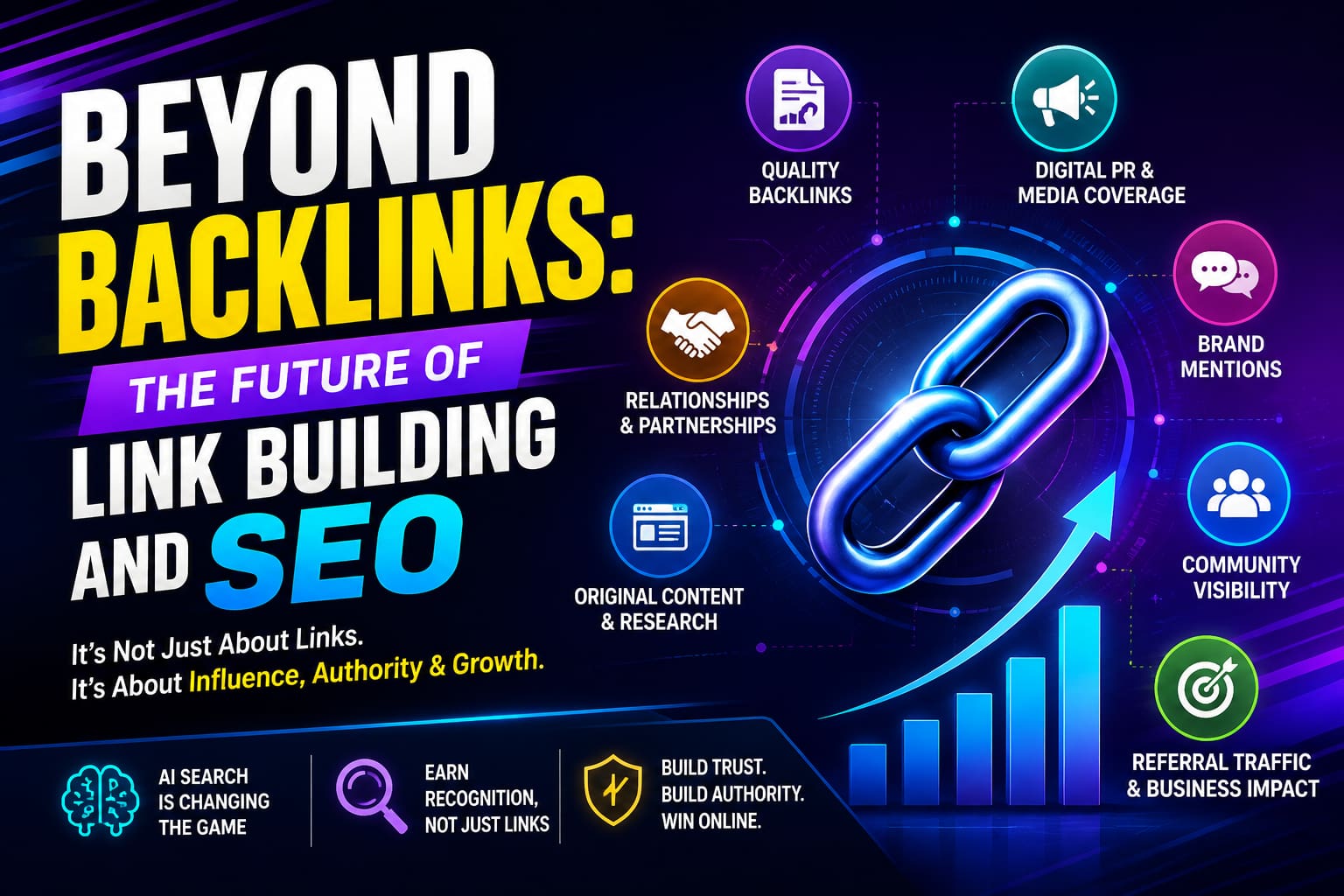
For years, backlinks have been one of the foundations of search engine optimization. SEO professionals built outreach campaigns, earned editorial mentions, published guest contributions and analyzed referring domains — all with one major objective: getting other websites to link back to their pages.
Backlinks still matter. In fact, current industry research continues to identify them as an important part of SEO. But the role of links is changing as search becomes increasingly influenced by AI-generated answers, brand signals, entities, communities and information from across the web.
The future of link building is therefore not about abandoning backlinks.
It is about thinking beyond backlinks.
Instead of measuring success only by the number of links earned, businesses need to build the authority, credibility and recognition that make people — and increasingly AI-powered search systems — understand why a brand deserves attention.

Backlinks Are Still Important
There is a temptation to declare that backlinks are no longer relevant because search behavior is changing.
That would be a mistake.
A relevant, editorially earned backlink can still help a website in several ways:
- Improve search visibility
- Support page authority
- Generate referral traffic
- Introduce a brand to new audiences
- Reinforce topical relevance
- Create relationships with publishers
- Provide additional pathways for discovery
Recent 2026 research discussed by Search Engine Land found that marketers continue to view backlinks as an important influence on search rankings. The same research also points toward a broader model in which link quality, diversity and surrounding brand signals matter alongside link volume.
The important distinction is this:
A backlink should be an asset, not the entire objective.
The Problem With Chasing Link Counts
A campaign that reports 500 new backlinks may initially look impressive.
But what if most of those links come from irrelevant websites?
What if they generate no visitors?
What if the sites have little real audience?
What if nobody recognizes the brand after seeing them?
This is where traditional link-building reporting can become misleading.
A better campaign asks:
Did these placements increase authority, visibility, trust or business value?
That could include:
- High-quality backlinks
- Brand mentions
- Referral traffic
- Media coverage
- Expert citations
- Community discussions
- Product references
- New partnerships
- Increased branded searches
- AI-search visibility
The number of links is only one measurement.
Search Is Becoming a Broader Discovery Ecosystem
The customer journey is no longer limited to typing a query into Google, clicking a result and visiting a website.
People can discover companies through:
- Google Search
- Google AI Overviews
- Google AI Mode
- ChatGPT
- Gemini
- Perplexity
- YouTube
- Podcasts
- Reviews
- News websites
- Social platforms
- Industry publications
- Creator recommendations
Modern AI search can synthesize information from multiple sources rather than relying exclusively on a traditional ranking page. Search Engine Land describes this environment as an interconnected digital ecosystem in which websites, videos, reviews, social profiles, news coverage and community discussions can all contribute to how a business is understood.
That means SEO teams need to think about visibility everywhere, not just visibility through backlinks.
Brand Mentions Are Becoming More Important
One of the biggest changes in modern link building is the growing importance of unlinked brand mentions.
Imagine that an industry publication writes:
Company X is becoming a major player in enterprise cybersecurity.
There is no hyperlink.
From a traditional link-building perspective, this might appear to have limited value.
But the brand has still been:
- Identified
- Associated with cybersecurity
- Discussed by a third party
- Exposed to an audience
- Connected to a specific topic
AI search systems can use information beyond traditional hyperlinks when building an understanding of brands and topics. Current industry research specifically highlights unlinked mentions, reviews, podcasts, Reddit discussions and social content as part of the broader authority environment.
This changes the question from:
“Where can I get a backlink?”
to:
“Where should my brand be discussed?”
Think in Terms of Entity Authority
The concept of entity SEO is becoming increasingly important in an AI-driven search environment.
An entity is a recognizable person, company, product, organization or concept.
Search systems want to understand relationships between entities.
For example:
Brand → software → project management → small businesses → automation
The more consistently a brand is associated with relevant concepts across trusted sources, the clearer its digital identity can become.
Search Engine Land’s 2026 analysis describes this shift toward entity SEO as a way of thinking about relationships rather than links alone.
This is why a strong SEO strategy should establish what a company is known for.
If your company wants to be recognized as an expert in cloud security, for example, your online presence should consistently reinforce that association through:
- Original research
- Expert articles
- Industry interviews
- Conference appearances
- Podcast discussions
- Relevant media coverage
- Helpful community participation
- Authoritative backlinks
The objective is not simply to accumulate links.
It is to create a recognizable authority footprint.
Create Content Worth Referencing
The best way to earn valuable links is still to create something people genuinely want to reference.
Generic content is becoming increasingly easy to produce.
Original information is harder to create.
That creates an opportunity.
Publish Original Research
Conduct surveys, analyze proprietary data or study industry trends.
For example:
“2026 B2B SaaS Buyer Behavior Report”
A report containing original statistics can attract journalists, analysts, bloggers and industry publications.
Develop Useful Tools
Calculators, templates, checklists, databases and interactive tools can earn attention because they provide practical value.
Publish Unique Data
If you have access to internal business data that can be anonymized and safely shared, turn it into insights.
Original statistics are naturally more referenceable than generic advice.
Build Comprehensive Resources
Create resources that become useful starting points for an entire topic.
The goal is to make your page something another writer would naturally want to reference.
Digital PR Can Turn Attention Into Authority
Modern link building increasingly overlaps with digital public relations.
Instead of contacting journalists with:
“Please link to our article.”
create a story that gives them a reason to cover your company.
Examples include:
- New research
- Consumer behavior trends
- Industry surveys
- Original statistics
- Expert commentary
- New technology
- Market changes
- Surprising findings
- Proprietary studies
A successful digital PR campaign can produce much more than backlinks.
It can generate:
- News coverage
- Brand awareness
- Expert positioning
- Referral traffic
- Social discussions
- Podcast appearances
- Video coverage
- Industry relationships
Search Engine Land’s recent coverage also emphasizes that niche, highly relevant publishers can be valuable even when they have substantially less traffic than major media outlets. Audience relevance and contextual authority can matter more than simply chasing the biggest domain metrics.
Relevance Beats Vanity Metrics
Domain Authority and similar third-party metrics can be useful for prospecting.
But they should not become the final decision-maker.
Consider two websites.
Website A
- Very high authority metric
- Completely unrelated audience
- Little topical relevance
- Minimal engagement
Website B
- Smaller authority metric
- Highly relevant audience
- Strong topical connection
- Active readership
- Genuine industry reputation
Website B may provide a better opportunity.
Why?
Because SEO is not just about passing authority.
It is about context.
A link from a trusted publication within your industry can help users and search systems understand the relationship between your brand and the subject.
Referral Traffic Should Matter More
A backlink can be valuable even when it does not produce a ranking improvement.
Why?
Because it can send customers.
Suppose a niche industry publication links to your website and generates 200 highly qualified visitors.
Those visitors might:
- Read your content
- Subscribe
- Request a demo
- Buy a product
- Share your content
- Mention your brand elsewhere
That link has created a measurable business outcome.
This is why referral traffic should be included in link-building reports.
Don’t simply report:
“We earned 35 backlinks.”
Report:
“We earned 35 relevant placements that generated qualified referral traffic, brand exposure and new industry relationships.”
That is a much stronger business story.
Community Visibility Matters
Communities are another area where marketers should think beyond links.
Platforms such as Reddit, YouTube and industry forums can influence how people discover and evaluate brands.
But these platforms should not become dumping grounds for promotional links.
Instead, brands should contribute genuinely.
That means:
- Answering questions
- Sharing expertise
- Explaining difficult topics
- Participating in relevant discussions
- Providing useful examples
- Correcting misinformation respectfully
- Mentioning products only when genuinely relevant
The objective is to become recognizable and useful, rather than simply visible.
Research discussed by Search Engine Land indicates that Reddit and other community sources can contribute to AI-search citations and brand discovery, particularly around decision-oriented queries.
Build Relationships, Not Transactions
Traditional outreach often treats publishers as link targets.
That mindset limits long-term results.
A better strategy treats journalists, editors, creators and industry experts as potential relationships.
For example, instead of contacting a journalist only when you need coverage, you can:
- Follow their work
- Share useful insights
- Offer expert commentary
- Respond quickly to relevant requests
- Provide original data
- Build a history of helpful interactions
Over time, outreach becomes easier because you are no longer a stranger asking for a favor.
You become a known source.
Optimize for Brand Recognition, Not Just Citations
AI search introduces another important distinction: being cited is not necessarily the same as being recognized.
Recent research discussed by Search Engine Land found that a significant share of AI citations can reference a source without actually naming the brand in the generated response.
That creates an important lesson.
A company should not measure AI visibility only by asking:
“How many times was our website cited?”
It should also ask:
“How often was our brand actually mentioned?”
A citation can demonstrate that your content was used as a source.
A brand mention can help demonstrate that your company was recognized.
The strongest outcome can be both.
Strengthen Your Digital Footprint
If your goal is long-term authority, your brand should be easy to understand across the web.
Review how your company appears on:
- Your website
- Social profiles
- Industry directories
- News websites
- Review platforms
- YouTube
- Podcasts
- Partner websites
- Community platforms
Make sure important information is accurate and reasonably consistent.
This includes:
- Company name
- Products
- Services
- Industry
- Expertise
- Leadership
- Locations
- Key differentiators
Search Engine Land’s recent guidance on auditing an AI entity footprint recommends examining how AI systems describe a business based on information from websites, reviews, press mentions, social profiles and other public sources.
That makes digital consistency increasingly important.
Use Internal Links to Connect Your Authority
Thinking beyond backlinks does not mean ignoring internal linking.
External links can help bring attention and authority into your website.
Internal links can then help users and search engines understand how your content fits together.
A strong structure might look like:
Original research → Main topic guide → Supporting articles → Product/service page
This creates a connected content ecosystem.
It also helps ensure that valuable external attention does not remain isolated on a single page.
Measure the New Link-Building Strategy
Modern link-building reports should include more than backlink totals.
Consider tracking:
Link Metrics
- New referring domains
- Relevant backlinks
- Link quality
- Link diversity
- Target pages
Brand Metrics
- Brand mentions
- Branded searches
- Media coverage
- Social discussions
- Podcast appearances
Traffic Metrics
- Referral sessions
- Engaged users
- New visitors
- Assisted conversions
Business Metrics
- Leads
- Sales
- Demo requests
- Signups
- Revenue influenced
AI Visibility Metrics
- Brand mentions in AI answers
- AI citations
- Frequently associated topics
- Competitor visibility
- Source presence
This gives leadership a much clearer picture of whether link building is actually working.
Avoid Manipulative Link Tactics
Thinking beyond backlinks also means moving away from tactics designed purely to inflate link counts.
Be cautious with:
- Paid links intended to manipulate rankings
- Large-scale link exchanges
- Automated link placement
- Irrelevant guest-post networks
- Spammy directories
- Comment spam
- Private networks created primarily for ranking manipulation
- Low-quality websites built solely to sell links
The safest long-term strategy is to earn attention by creating genuine value and developing legitimate relationships.
The New Link-Building Framework
A modern SEO team can organize its strategy around six steps.
Step 1: Establish Your Expertise
Determine the topics your brand should own.
Step 2: Create Original Assets
Produce research, data, tools, studies and genuinely useful resources.
Step 3: Build Relationships
Connect with journalists, creators, publishers and industry experts.
Step 4: Expand Your Brand Footprint
Participate in relevant communities, podcasts, videos, publications and discussions.
Step 5: Earn Links and Mentions
Let strong content and useful expertise create opportunities for editorial references.
Step 6: Measure Authority
Track links alongside mentions, referral traffic, brand recognition and business outcomes.
This framework treats backlinks as part of a larger system rather than an isolated SEO tactic.
What the Future of Link Building Looks Like
The future is unlikely to be completely linkless.
Instead, it will probably be link-plus.
Backlinks will remain useful, but they will operate alongside:
- Brand mentions
- Entity relationships
- Topical authority
- Digital PR
- Community discussions
- Expert recognition
- Original research
- Referral traffic
- AI citations
- Brand visibility
Current 2026 research already points in this direction: backlinks continue to matter, but search and AI systems increasingly operate across a broader information ecosystem.
This means brands that focus exclusively on acquiring links may eventually find themselves competing against brands that build something much more difficult to replicate:
recognition.
Final Thoughts
The future of link building is not about choosing between backlinks and everything else.
It is about putting backlinks in the right place.
A quality link can strengthen SEO.
A relevant mention can strengthen brand recognition.
A media relationship can create repeated opportunities.
Original research can earn dozens of references.
A strong community presence can influence recommendations.
And consistent expertise across the web can help search engines and AI systems understand what your brand represents.
So the most useful question is no longer:
“How many backlinks did we build this month?”
Ask instead:
“Did we become more authoritative, recognizable and trusted this month?”
When the answer is yes, backlinks become more than an SEO metric.
They become evidence of something much more valuable: a brand that has earned a place in the wider web.