
Google is moving Search advertising toward a more AI-driven system, and the transition to AI Max for Search campaigns is becoming increasingly important for advertisers managing legacy Dynamic Search Ads (DSA), campaign-level broad match, and automatically created assets.
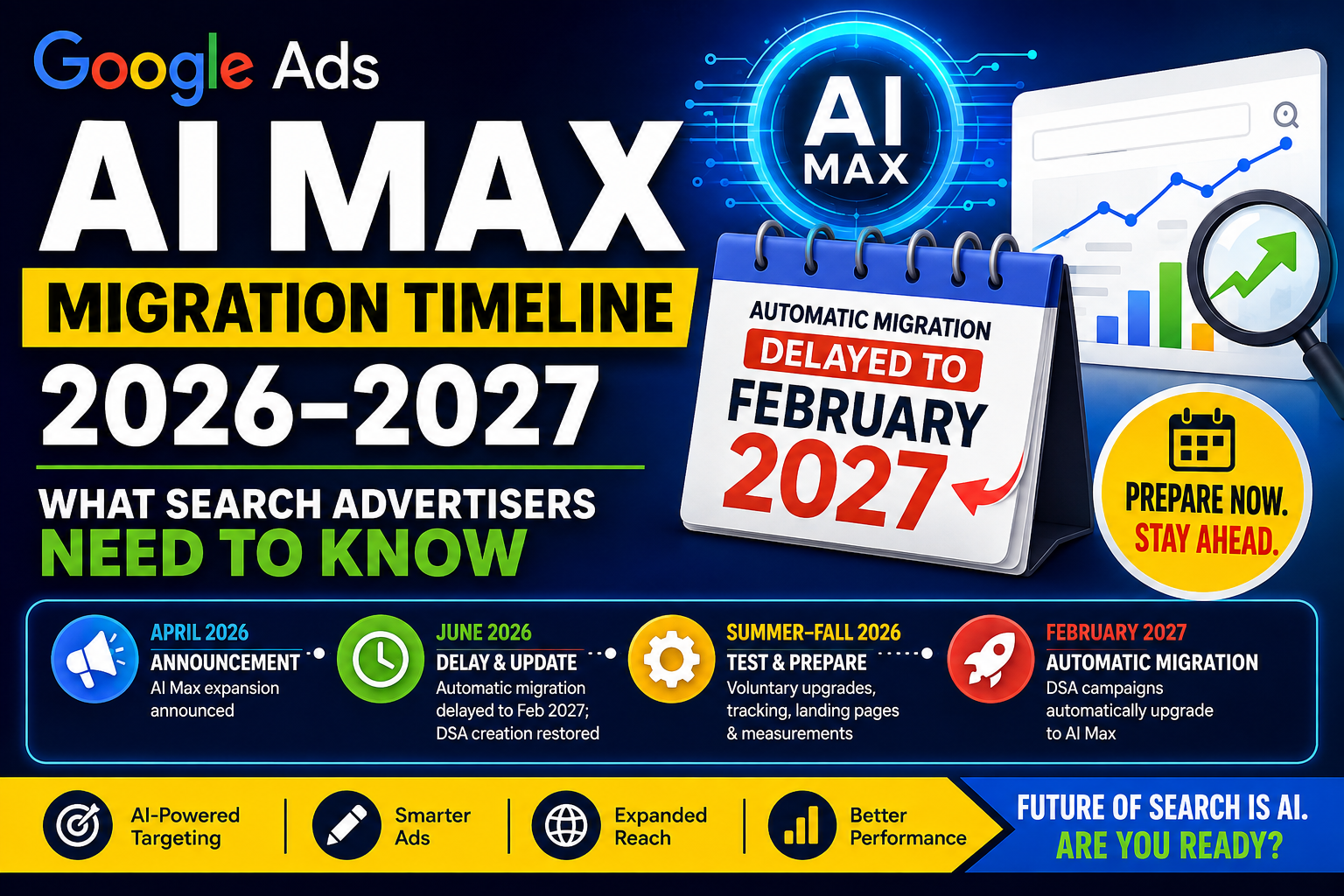
The most important update for advertisers is that Google delayed the automatic migration timeline from September 2026 to February 2027. Google also restored the ability to create new Dynamic Search Ads in June 2026, giving advertisers additional time to prepare. (Google Ads Developer Blog)
That means advertisers still have a window to audit their accounts, test AI Max voluntarily, improve conversion tracking, review landing pages, and establish a measurement strategy before automatic upgrades begin.
What Is Google AI Max?
AI Max is not a completely new Google Ads campaign type. Instead, it is an optimization layer for existing Search campaigns that combines AI-powered targeting, search-term matching, creative optimization, and landing-page expansion. (Google Help).
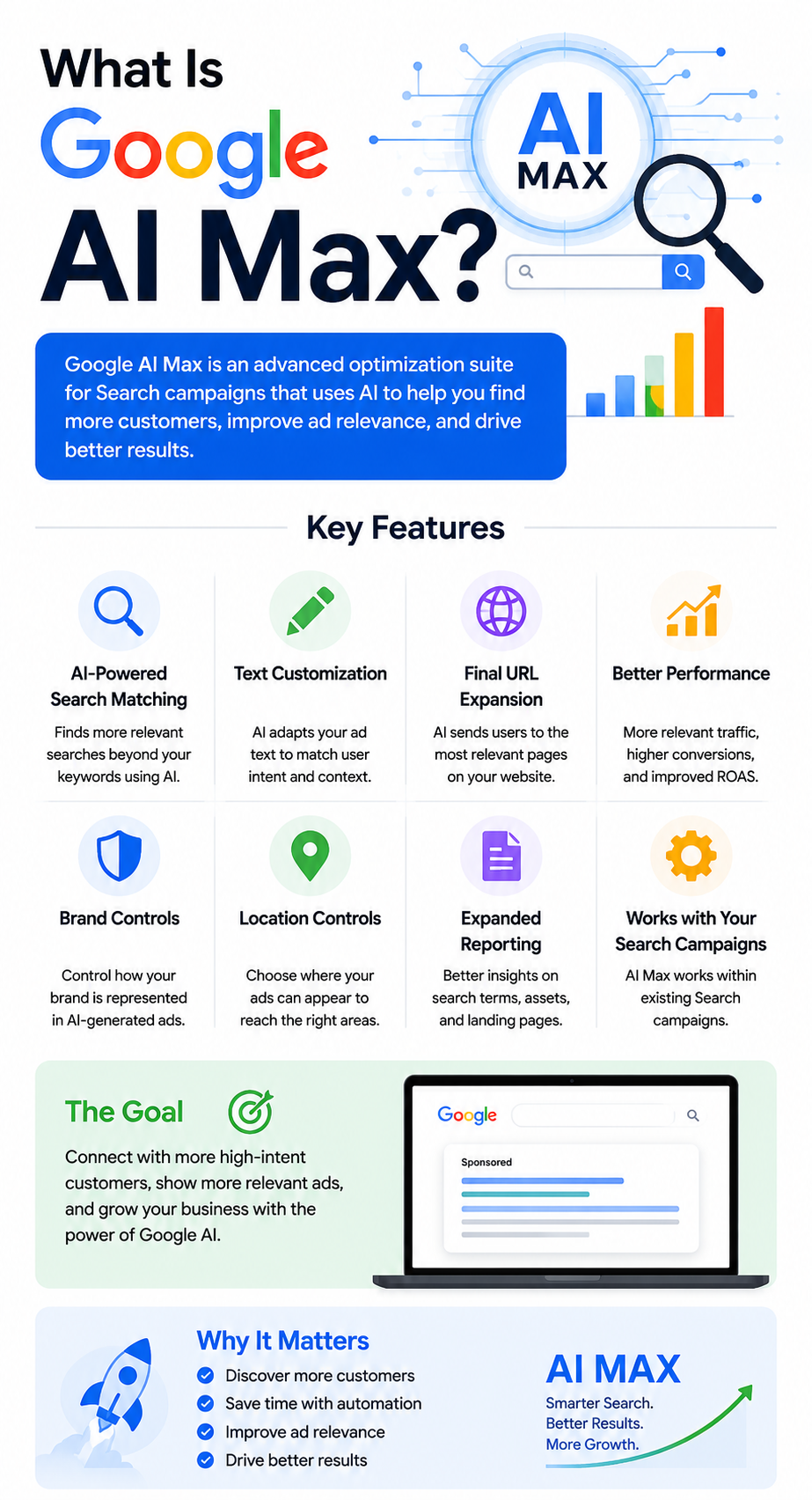
The technology is designed to help Search campaigns discover additional relevant searches beyond traditional keyword targeting.
Key AI Max capabilities include:
- AI-powered search-term matching
- Keywordless and broad-match-based expansion
- Text customization
- Final URL expansion
- Improved asset optimization
- Brand controls
- Location controls
- Expanded performance reporting
Google describes AI Max as a continuous optimization layer that processes real-time signals to improve targeting and creative delivery. (Google Help)
The Google AI Max Migration Timeline
The timeline has changed, so advertisers should be careful when reading older articles or announcements.
April 2026: Google Announces the AI Max Upgrade
In April 2026, Google announced that AI Max was moving beyond beta and that legacy Search campaign settings would eventually be upgraded.
Google initially announced that automatic upgrades would begin in September 2026. (Google)
At the time, Google encouraged advertisers to voluntarily upgrade their campaigns before the automatic transition.
June 2026: Automatic Migration Is Delayed
Google subsequently changed the schedule.
According to Google’s Ads Developer Blog, the automatic migration was postponed from September 2026 to February 2027. Google also restored the ability to create new DSAs beginning June 15, 2026. (Google Ads Developer Blog)
This delay is significant because advertisers now have additional preparation time.
September 2026: Important—but Not the Final Automatic Migration Date
Older Google announcements referenced September 2026 as the beginning of automatic upgrades. However, that timeline was later changed.
Therefore, advertisers should not treat September 2026 as the current final DSA-to-AI-Max automatic migration deadline.
The latest Google developer information says the automatic migration was delayed to February 2027. (Google Ads Developer Blog)
February 2027: Automatic DSA Migration (Google AI Max Migration)
Starting in February 2027, Google says campaigns using Dynamic Search Ads will automatically be upgraded to AI Max. (Google Help)
This is the key date advertisers should currently plan around.
Google’s documentation also describes AI Max as the successor to several older Search campaign capabilities and provides tools for upgrading existing DSA campaigns manually. (Google Help)
AI Max Migration Timeline at a Glance
| Period | What Happens | What Advertisers Should Do |
|---|---|---|
| April 2026 | Google announces AI Max expansion | Start evaluating AI Max |
| June 2026 | Automatic migration delayed; DSA creation restored | Audit legacy campaigns |
| Summer/Fall 2026 | Voluntary AI Max upgrades and testing | Test campaigns and tracking |
| September 2026 | Previous automatic-migration date is superseded | Don’t rely on old deadline |
| Late 2026 | Preparation and voluntary migration become increasingly important | Complete account audits |
| February 2027 | Automatic DSA-to-AI Max upgrades begin | Have campaigns ready |
| 2027 onward | AI Max becomes increasingly central to Search | Optimize for AI-driven Search |
What Happens to Dynamic Search Ads?
Dynamic Search Ads have traditionally helped advertisers capture searches without manually creating a keyword for every query.
DSA could use website content to determine relevant searches and dynamically generate ad headlines and landing pages.
AI Max builds on this concept while integrating it into standard Search campaigns.
When upgrading a DSA campaign to AI Max, Google says:
- Dynamic ad groups are converted into standard ad groups.
- Existing Dynamic Search Ads are transformed into Responsive Search Ads.
- Google generates the required static assets using text customization.
- Final URL expansion can be enabled.
- Unsupported legacy DSA targets become read-only.
- Existing DSA ads can continue serving temporarily during the transition while replacement ads go through policy checks. (Google Help)
This is an important structural change.
Advertisers shouldn’t think of the transition as simply switching one checkbox on or off. Campaign structure, ad assets, targeting behavior, and landing-page selection can all become more AI-driven.
What Does AI Max Change for Search Advertisers?
1. Keyword Targeting Becomes Less Central
Traditional Search advertising has historically revolved around carefully selected keywords and match types.
AI Max expands the system beyond that model.
Google says its search-term matching can use broad match and keywordless technology to discover relevant searches based on existing keywords, creatives, URLs, and other signals. (Google Help)
This means advertisers need to think less about building an exhaustive keyword list and more about providing Google with strong signals.
Those signals include:
- High-quality conversion data
- Relevant landing pages
- Strong ad assets
- Accurate conversion tracking
- Clear business goals
- Appropriate brand controls
- Effective exclusions and negative keywords
2. Ad Copy Can Become More Dynamic
AI Max includes text customization, allowing Google’s systems to adapt advertising messages to individual search intent.
This can potentially improve relevance, but advertisers need to make sure important claims, promotions, prices, legal language, and brand messaging are controlled appropriately.
Instead of writing every possible headline manually, marketers increasingly need to define what Google is allowed to communicate.
3. Landing Pages Matter Even More
Final URL expansion can help Google select a more relevant page on a website based on the user’s search intent.
That creates an important SEO-style requirement for PPC advertisers:
Your website architecture now matters more to your paid Search campaigns.
A website with:
- Clear service pages
- Strong product descriptions
- Relevant category pages
- Helpful supporting content
- Logical internal linking
- Fast loading times
- Accurate page titles
can provide better signals for automated landing-page selection.
What About Campaign-Level Broad Match?
Campaign-level broad match is also being incorporated into the AI Max ecosystem.
Google’s current documentation says that beginning in September 2026, campaigns using the campaign-level broad match setting are automatically upgraded to AI Max. (Google Help)
This is separate from the broader DSA automatic migration timeline, so advertisers should audit campaigns based on the specific legacy feature they use.
Campaigns using conversion-based Smart Bidding are particularly relevant because campaign-level broad match requires conversion-based Smart Bidding. (Google Help)
What Happens to Automatically Created Assets?
Automatically created assets are another part of the transition.
Google says text customization—previously known as automatically created assets—is upgraded into AI Max. Brand settings and campaign-level broad match settings are also incorporated into the AI Max framework. (Google Help)
For advertisers, this means several previously separate automation features are increasingly being brought together under one AI Max system.
Why Google Is Making This Change
Search behavior is becoming more complex.
Users increasingly type longer, conversational queries and searches that don’t exactly match a company’s keyword list.
For example, instead of searching:
“emergency plumber”
a customer might search:
“plumber who can fix a leaking water heater tonight”
A traditional keyword structure may not contain every variation.
AI-powered matching can analyze the intent behind the query and determine whether an advertiser’s products, services, ads, and landing pages are relevant.
The goal is to find additional high-value searches without requiring advertisers to manually build enormous keyword databases.
The Biggest Advantage of AI Max
The biggest potential advantage is incremental reach.
An advertiser may already capture the obvious searches but still miss valuable variations.
AI Max attempts to discover those additional opportunities.
Google says AI Max’s search-term matching can help find relevant and high-performing queries that advertisers might otherwise miss. (Google Help)
For businesses with strong conversion tracking and sufficient data, this can make automated optimization considerably more useful.
The Biggest Risk: Less Manual Control
The same automation that creates opportunities can also create challenges.
Advertisers accustomed to controlling every keyword and ad variation may find AI Max less predictable.
Potential concerns include:
- Queries outside the traditional keyword strategy
- Unexpected ad combinations
- Landing pages receiving traffic that marketers did not anticipate
- Higher spend on exploratory traffic
- Difficulty comparing old and new campaign structures
- Changes in search-term distribution
This does not mean AI Max is inherently bad.
It means advertisers need stronger measurement and guardrails.
How to Prepare for AI Max Migration.(Google AI Max Migration)
Step 1: Audit Your Existing DSA Campaigns
Create a list of every DSA campaign and review:
- Spend
- Conversions
- Conversion value
- CPA
- ROAS
- Search terms
- Landing pages
- Negative keywords
- Exclusions
- Ad performance
Don’t automatically migrate every campaign without understanding its historical performance.
Step 2: Check Conversion Tracking
AI-driven advertising depends heavily on conversion signals.
Before migrating, verify:
- Primary conversions are correctly configured.
- Duplicate conversions aren’t being counted.
- Revenue values are accurate.
- Enhanced conversions are configured where appropriate.
- Offline conversions are imported when relevant.
- Conversion actions match business objectives.
Bad data can lead to bad automation.
Step 3: Review Your Landing Pages
Because AI Max can use Final URL expansion, review your website carefully.
Make sure important commercial pages are:
- Indexable
- Relevant
- Mobile friendly
- Fast
- Conversion focused
- Clearly categorized
- Free of outdated information
Remove or improve pages that could create irrelevant paid traffic.
Step 4: Review Brand Controls
AI Max provides brand-related controls that can help advertisers manage how campaigns interact with brand traffic.
For companies with strict brand strategies, review these settings before enabling AI Max at scale.
Step 5: Build Strong Negative Keyword Rules
AI automation does not eliminate the need for exclusions.
Negative keywords can remain an important part of controlling irrelevant traffic.
Review historical search-term reports and identify:
- Irrelevant products
- Unwanted services
- Job seekers
- Free-information searches
- Competitor terms, where appropriate
- Unqualified geographic searches
- Research-only queries
Step 6: Test Before Scaling
Don’t move your entire advertising account to AI Max on day one.
Start with campaigns where:
- Conversion tracking is reliable.
- Landing pages are strong.
- Historical performance is stable.
- The business can tolerate some additional exploration.
Compare performance against your existing strategy.
AI Max Testing Framework
A useful test framework is:
Baseline → AI Max Test → Measure → Refine → Scale
Baseline
Record:
- CPA
- ROAS
- Conversion rate
- Conversion volume
- Cost per conversion
- Search impression share
- Revenue
AI Max Test
Enable AI Max for selected campaigns.
Avoid making several major changes simultaneously.
Measure
Compare performance using an appropriate time window rather than judging the campaign after only a few days.
Refine
Review:
- Search terms
- Assets
- Landing pages
- Conversion quality
- Budget
- Negative keywords
Scale
If AI Max produces acceptable results, gradually expand it to additional campaigns.
What Advertisers Should Do Before February 2027
The February 2027 automatic DSA migration should be treated as a planning deadline, not the date to begin preparation.
A better approach is:
August–September 2026
- Inventory DSA campaigns.
- Review campaign-level broad match usage.
- Audit conversion tracking.
- Review automatically created assets.
- Identify campaigns with unusual targeting requirements.
October–November 2026
- Test AI Max on suitable campaigns.
- Compare conversion quality.
- Analyze search-term changes.
- Improve landing pages.
- Build stronger negative keyword controls.
December 2026–January 2027
- Complete migration planning.
- Document campaign performance.
- Resolve tracking problems.
- Review budgets and bidding strategies.
- Train PPC managers and clients on the new workflow.
February 2027
- Monitor automatically migrated campaigns closely.
- Check campaign structure.
- Review newly generated assets.
- Inspect search terms.
- Verify landing-page traffic.
- Compare performance with historical benchmarks.
AI Max and Smart Bidding
AI Max works particularly well with Google’s broader automation ecosystem.
Google notes that AI Max processes real-time signals to refine targeting and creative delivery. (Google Help)
However, automation doesn’t mean advertisers should stop monitoring budgets and bidding.
Google has also announced separate changes to target-based bidding beginning August 17, 2026, affecting Search and other campaign types. Advertisers with budget-limited campaigns should review their targets and budgets. (Google Help)
Therefore, 2026 is not just an AI Max transition year. It is also a period of broader changes to Google Ads automation.
AI Max vs. Performance Max
AI Max and Performance Max both use Google’s AI systems, but they are not the same campaign type.
AI Max is specifically designed as an optimization layer for Search campaigns.
Performance Max is a broader campaign type that can distribute advertising across Google’s inventory.
Google explains that AI Max allows advertisers to maintain a Search campaign structure while using AI-driven targeting and creative features. (Google Help)
For advertisers, the distinction is important.
AI Max does not simply mean “turning a Search campaign into Performance Max.”
Reporting Becomes More Important
AI Max introduces enhanced reporting intended to help advertisers understand performance.
Google says advertisers can use search-term, keyword, asset, and landing-page reporting to evaluate AI Max performance. (Google Help)
Advertisers should therefore establish a recurring reporting routine.
Monitor:
| Metric | Why It Matters |
|---|---|
| Conversions | Measures business results |
| Conversion value | Measures revenue impact |
| CPA | Controls acquisition efficiency |
| ROAS | Measures return on advertising spend |
| Search terms | Identifies traffic quality |
| Landing pages | Shows where traffic is being sent |
| Assets | Helps evaluate AI-generated messaging |
| Spend | Controls budget expansion |
| Conversion rate | Measures traffic quality |
The New PPC Skill: Managing Signals
The future of Search advertising is increasingly less about manually controlling every possible query.
Instead, advertisers need to become better at signal management.
That means providing Google with:
Good Data + Good Creative + Good Landing Pages + Good Conversion Signals + Good Controls
When those components work together, AI systems have better information to optimize against.
Common AI Max Mistakes to Avoid (Google AI Max Migration)
Mistake 1: Migrating Everything Immediately
Not every campaign needs to be changed simultaneously.
Test first.
Mistake 2: Ignoring Search Terms
Automation doesn’t mean search-term analysis is obsolete.
Continue monitoring traffic quality.
Mistake 3: Poor Conversion Tracking
AI optimization is only as good as the signals it receives.
Mistake 4: Forgetting Landing Pages
Final URL expansion makes website quality increasingly important.
Mistake 5: Removing Negative Keywords
AI does not mean every query will be valuable.
Continue building appropriate exclusions.
Mistake 6: Judging Performance Too Quickly
AI-powered campaigns need enough data to evaluate properly.
Avoid making major decisions based on a very short period unless there is an obvious tracking or quality problem.
Frequently Asked Questions
Is AI Max a new Google Ads campaign type?
No. Google describes AI Max as an optimization layer within existing Search campaigns. (Google Help)
When will DSA campaigns automatically migrate?
Google’s latest developer information says automatic DSA migration has been delayed to February 2027. (Google Ads Developer Blog)
Can advertisers upgrade DSA campaigns before automatic migration?
Yes. Google provides an upgrade process for eligible DSA campaigns so advertisers can transition voluntarily. (Google Help)
Will Dynamic Search Ads disappear?
DSA is being transitioned into the AI Max framework rather than remaining Google’s long-term standalone direction for Search automation.
Does AI Max replace Performance Max?
No. AI Max is an optimization layer for Search campaigns, while Performance Max is a separate campaign type. (Google Help)
Should every advertiser use AI Max?
Not necessarily at the same time or in the same way. Advertisers should test it based on their conversion data, business goals, campaign structure, and tolerance for automation.
Final Takeaway
The Google AI Max migration is more than a technical campaign-setting change. It represents a broader shift in how Google Search advertising works.
The most important timeline update is this: (Google AI Max Migration)
Google delayed automatic DSA migration from September 2026 to February 2027. (Google Ads Developer Blog)
That gives advertisers additional preparation time—but waiting until February 2027 is not the best strategy.
The strongest approach is to use the remaining time to:
- Audit legacy DSA campaigns.
- Fix conversion tracking.
- Improve landing pages.
- Review negative keywords and brand controls.
- Test AI Max voluntarily.
- Monitor search terms and asset performance.
- Establish reliable performance benchmarks.
- Prepare teams and clients for increased automation.
The future of PPC is moving from keyword-by-keyword management toward AI-assisted intent and signal management.
Advertisers who use the 2026 preparation window to improve their data, creative assets, websites, and measurement systems will be in a much stronger position when the February 2027 migration arrives.