
Google may still be the center of web discovery, but a surprising shift is taking place in where people go after searching. New clickstream data shows that ChatGPT has become one of the most frequently visited destinations from Google, ranking sixth among the top sites receiving Google search clicks.
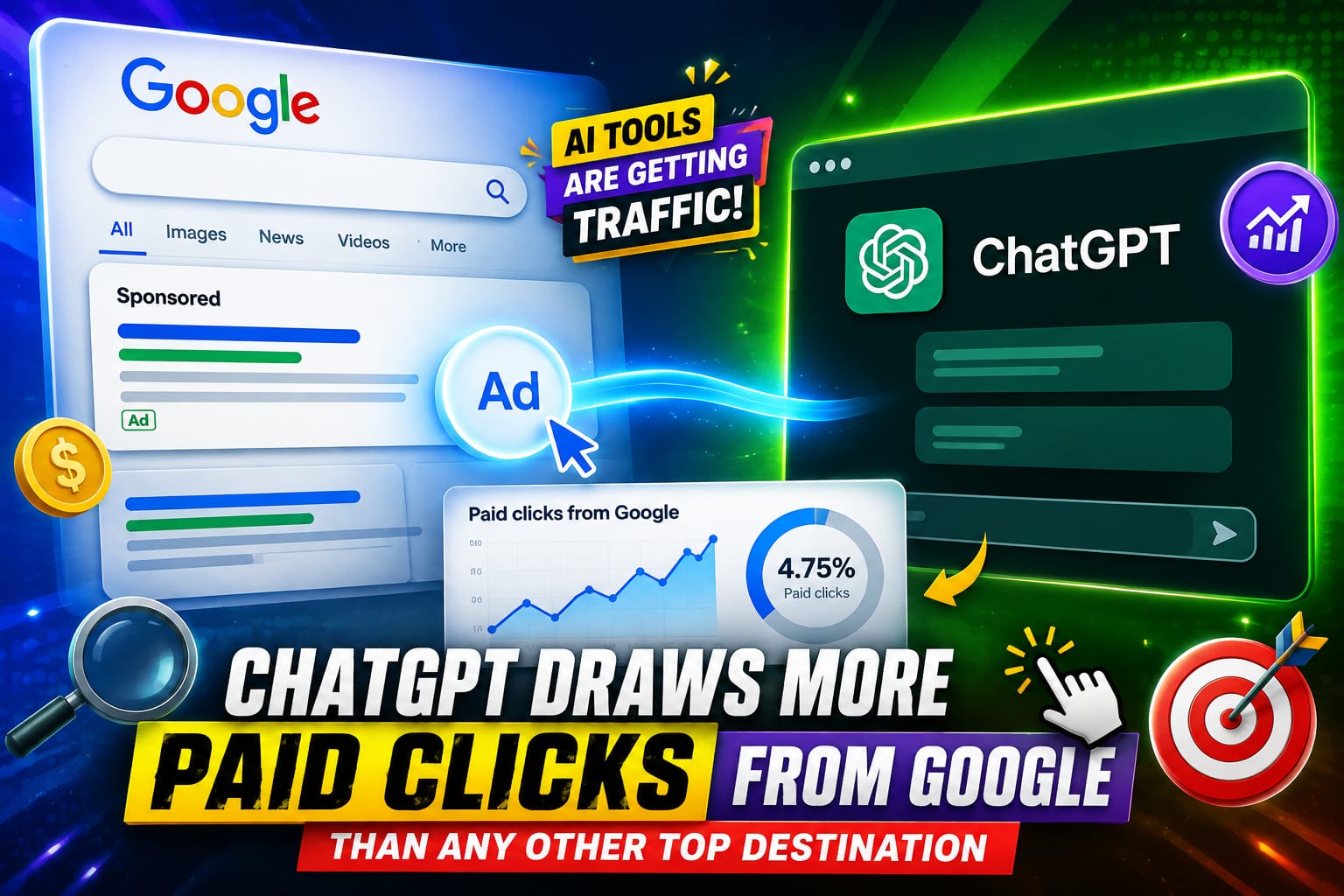
Even more notable: ChatGPT has the highest share of paid Google clicks among the major destinations analyzed. That creates an interesting overlap between traditional search advertising and the rapidly growing AI-search ecosystem.
The finding challenges the simple idea that AI platforms are replacing search engines. Instead, the data suggests that users can move between Google and AI tools as part of the same discovery journey.

ChatGPT Ranks #6 Among Major Google Click Destinations
The supplied iPullRank chart analyzes clickstream activity for the week of June 15–21, 2025. It shows the websites people clicked to most often after interacting with Google Search.

According to the analysis, YouTube led with approximately 7.8 million weekly clicks, followed by Google itself at 7.6 million. Reddit received 3.4 million, Facebook 2.2 million and Wikipedia 1.9 million.
ChatGPT followed closely at approximately 1.7 million weekly clicks.
That put ChatGPT ahead of Instagram, WhatsApp, Fandom and X, making it the only AI assistant in the top group shown in the chart. (iPullRank)
The most interesting part is the relatively small gap between ChatGPT and Wikipedia. ChatGPT’s 1.7 million clicks were only about 200,000 below Wikipedia’s 1.9 million in this dataset.
Graph: ChatGPT’s Position in the Google Click Ecosystem

This is significant because ChatGPT did not need to replace Google to become an important destination.
Instead, users are increasingly using Google to find or reach an AI service.
That means the relationship between search engines and AI platforms is more complicated than the traditional “Google versus ChatGPT” narrative suggests.
The Bigger Surprise: Paid Search
The strongest finding from the analysis concerns advertising.
Approximately 4.75% of ChatGPT’s Google traffic came through paid clicks, according to iPullRank’s analysis. That was substantially higher than the paid-click share reported for other major destinations in the comparison.
For example, YouTube’s paid share was about 0.2%, while Wikipedia had effectively no paid Google traffic in the comparison. Amazon’s share was reported as below 2%. (iPullRank)

This does not mean OpenAI’s total Google advertising spending can be calculated from the study.
Clickstream data tells us where paid clicks landed. It does not reveal the complete amount a company spent, its bids, cost per click, conversion rates or campaigns that generated impressions without clicks.
That distinction is important.
The finding is better understood as a measurement of how much of ChatGPT’s observed Google traffic was associated with paid search, rather than a measurement of OpenAI’s advertising budget.
Why Would People Search Google for ChatGPT?
At first glance, sending Google users to ChatGPT might seem unusual.
But it makes sense when considering how people use search engines.
A person may search for:
- ChatGPT
- ChatGPT login
- ChatGPT official website
- ChatGPT image generator
- ChatGPT for writing
- ChatGPT pricing
- ChatGPT app
- ChatGPT alternatives
These are often navigational or brand-oriented searches. The user already knows where they want to go and uses Google as the gateway.
This creates a very different type of search behavior from someone looking for a restaurant, product review or informational article.
Google remains the starting point, while ChatGPT becomes the destination.
Graph: ChatGPT’s Share of the Top-10 Destination Clicks
Across the ten destinations shown in the supplied chart, the combined volume is approximately 23.4 million weekly clicks.
ChatGPT’s 1.7 million represents roughly 7.3% of that top-10 click volume.

That is a meaningful amount of traffic for an AI platform, particularly considering that ChatGPT belongs to a relatively new category of web destination.
The data therefore points to something broader than an increase in ChatGPT awareness.
It suggests that AI services are becoming destinations within the existing search ecosystem.
Google and ChatGPT May Be Complementary
The data also makes the “AI will kill Google” argument look too simplistic.
Users do not necessarily choose one platform and abandon the other.
A modern discovery journey might look like this:
Google → ChatGPT → Google → Brand Website → Purchase
For example, a user could begin with Google to find information about a software product. They might then visit ChatGPT to compare alternatives, return to Google to verify a company, and finally visit the company’s website.
This creates multiple opportunities for brands.
SEO can influence the initial Google discovery.
Brand visibility can influence what the user sees inside ChatGPT.
Paid search can capture high-intent Google traffic.
And the company’s website ultimately needs to convert that visitor.
The result is an increasingly interconnected search journey rather than a single-platform funnel.
AI Is Also Creating New Search Destinations
The iPullRank analysis points to another interesting development: ChatGPT is not the only AI platform attracting navigational Google traffic.
According to the analysis, ChatGPT, DeepSeek and Gemini together accounted for roughly 720,000 navigational Google searches per week in the referenced panel. (iPullRank)
That suggests a new category of destination is emerging.
Historically, Google searches frequently led users to destinations such as:
- YouTube for video
- Reddit for discussions
- Wikipedia for reference information
- Facebook for social activity
- Amazon for shopping
AI assistants are now joining that destination ecosystem.
The important distinction is that these platforms are not necessarily receiving traffic because Google has become less important.
They can receive traffic because Google remains important.
The Implications for SEO
For SEO professionals, the biggest lesson is that rankings alone are no longer enough to understand visibility.
A brand can appear in Google, be mentioned by an AI assistant and receive a direct visit from a navigational search — all within the same customer journey.
That means marketers should begin tracking several layers of visibility:
1. Traditional search visibility
Monitor rankings, impressions, organic clicks and branded searches.
2. AI visibility
Measure how often a brand, product or website appears in AI-generated answers and recommendations.
3. Referral traffic
Look at traffic arriving from AI platforms, not just Google.
Recent Semrush research found that ChatGPT referral traffic grew significantly during 2025, while Google remained the dominant destination for outbound ChatGPT referral traffic. (Semrush)
4. Brand demand
Track whether users increasingly search directly for the brand after discovering it through AI or other channels.
5. Conversion quality
A smaller number of visitors can still be valuable if those visitors have stronger commercial intent.
This is particularly important as search engines and AI systems answer more questions before a user reaches a website.
What Advertisers Should Learn From This
The ChatGPT data also carries a lesson for paid-search teams.
AI companies are not automatically outside the traditional search advertising ecosystem.
If users continue using Google to find AI platforms, paid search can remain relevant even for businesses operating in the AI category.
Advertisers should therefore pay close attention to:
- Branded search demand
- Competitor search behavior
- Cost per acquisition
- Paid versus organic traffic
- Navigational queries
- Landing-page conversion rates
- Incremental value from search advertising
The key question should not simply be:
“How much traffic did Google send us?”
It should be:
“What role did Google play in the customer’s overall discovery journey?”
The Measurement Problem Is Getting Harder
One of the biggest challenges created by AI search is attribution.
A user might discover a company through ChatGPT, verify it through Google, watch a YouTube video and then visit the company’s website directly.
A conventional analytics report may credit only the final visit.
That can make earlier discovery channels look less valuable than they actually were.
This is why marketers increasingly need to think in terms of influence rather than last-click attribution.
AI visibility may generate awareness without immediately generating a referral.
Google may generate the final click even though ChatGPT influenced the decision.
Social media may introduce the brand months before a purchase occurs.
The customer journey is becoming distributed across multiple discovery environments.
What This Means for Publishers and Brands
The rise of ChatGPT as a Google destination does not mean websites should abandon SEO.
Quite the opposite.
Strong search visibility can still create the initial discovery that sends users toward an AI platform, a marketplace, a social network or a publisher.
The strategy should instead expand from traditional SEO toward multi-surface visibility.
Brands should create content that is:
- Useful enough to rank in traditional search
- Structured enough for machines to understand
- Specific enough to be referenced by AI systems
- Authoritative enough to earn trust
- Valuable enough to encourage a direct visit
- Distinctive enough that an AI-generated summary cannot completely replace it
This last point is becoming particularly important as AI systems increasingly summarize information directly inside search and conversational interfaces.
The Bigger Picture
The most important takeaway from the data is not simply that ChatGPT ranked sixth.
It is that Google and AI platforms are becoming interconnected parts of the same discovery ecosystem.
Users can search Google to reach ChatGPT. They can use ChatGPT to research a topic and then return to Google. They can discover a brand through AI and later search for that brand directly.
The boundaries between search, AI discovery and web navigation are becoming increasingly blurred.
For marketers, this means the old question — “Should we optimize for Google or AI?” — is becoming less useful.
A better question is:
“How do we remain visible throughout the customer’s entire discovery journey?”
ChatGPT’s strong position among Google destinations is an early signal of where that journey is heading.
The future of search may not be a battle between Google and AI.
It may be an ecosystem where Google remains the gateway, AI becomes a research layer, and websites compete to remain the trusted destination at the end of the journey.