

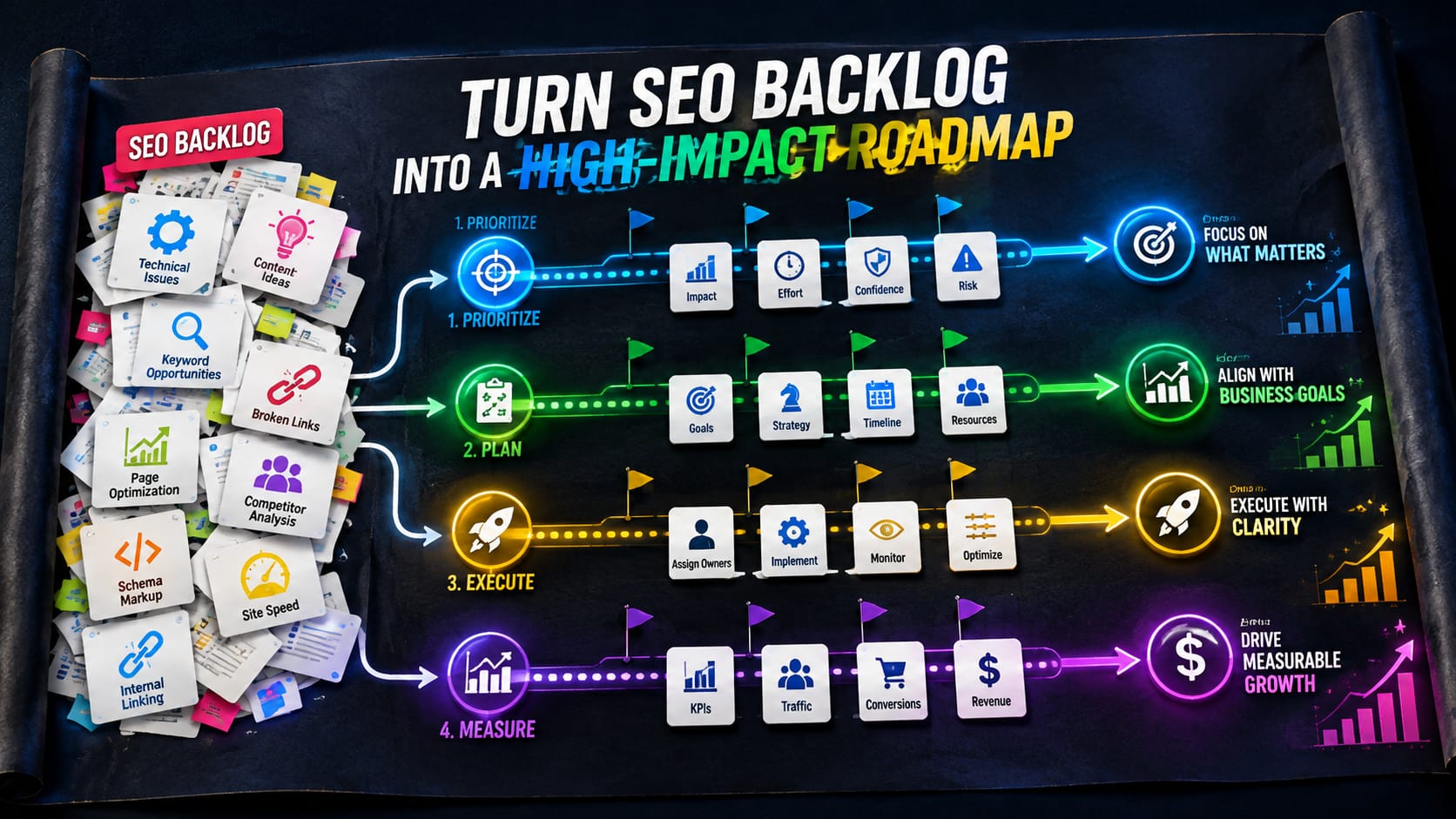
SEO teams rarely suffer from a lack of ideas. The bigger problem is having too many SEO tasks and not enough time, developers, writers, budget, or organizational support to complete them all.
Technical audits produce dozens of recommendations. Content research generates hundreds of potential topics. Google Search Console reveals pages that need improvement. Competitor research uncovers new opportunities. Meanwhile, developers have their own sprint priorities, content teams have publishing schedules, and business leaders want measurable growth.
The result is often an enormous SEO backlog.
But a backlog is not a strategy.
A useful SEO roadmap transforms that backlog into a structured plan that answers five important questions:
- What should we do?
- Why does it matter?
- What should we do first?
- Who will execute it?
- How will we measure success?
Modern SEO roadmaps increasingly need to connect SEO activities with business outcomes, ownership, implementation capacity, expected impact, and measurement rather than simply listing technical fixes or content ideas. (Search Engine Land)
This guide explains how to turn an overwhelming SEO backlog into a focused, measurable roadmap.

What Is an SEO Backlog?
An SEO backlog is a collection of potential SEO tasks, opportunities, problems, ideas, and projects that have not yet been completed.
For example, an SEO backlog might contain:
- Fix broken internal links
- Improve Core Web Vitals
- Rewrite outdated articles
- Create new topic clusters
- Improve category pages
- Add structured data
- Fix canonical tags
- Optimize title tags
- Build backlinks
- Improve internal linking
- Create comparison pages
- Consolidate duplicate content
- Improve image optimization
- Research new keywords
- Create location pages
- Improve conversion elements
- Update old statistics
- Improve author information
There is nothing wrong with having a large backlog.
The problem begins when everything is treated as equally important.
A broken canonical tag on thousands of important product pages may deserve immediate attention. A minor metadata issue on five low-traffic pages probably does not.
That difference is what your roadmap must capture.
SEO Backlog vs. SEO Roadmap
The two terms are often confused, but they serve different purposes.
| SEO Backlog | SEO Roadmap |
|---|---|
| Collection of possible work | Prioritized plan |
| Contains ideas and issues | Contains selected initiatives |
| Can be very large | Should remain focused |
| No fixed sequence required | Has sequencing |
| May not have owners | Assigns ownership |
| Often lacks business context | Connects work to goals |
| “What could we do?” | “What will we do and why?” |
A backlog might say:
Fix internal linking.
A roadmap should say:
Rebuild internal linking across the highest-value commercial category pages during Q3 to improve crawl paths, distribute authority more effectively, and support priority product clusters.
The second version gives the team a reason, scope, timing, and expected outcome.
That is the difference between activity management and strategic planning.
Why Large SEO Backlogs Become a Problem
A huge backlog can create the illusion of productivity.
Teams keep adding:
“We should also fix this.”
“We should create these 50 pages.”
“We should improve our schema.”
“We should build more links.”
Eventually, the backlog becomes a warehouse for unfinished ideas.
Several problems appear.
1. Everything looks urgent
When every task is labeled “high priority,” the priority system becomes meaningless.
2. Teams start optimizing for activity
Instead of asking:
“Did organic revenue improve?”
Teams start asking:
“How many SEO tickets did we complete?”
Those are very different measurements.
3. Developers become overwhelmed
SEO recommendations often depend on engineering resources. If dozens of technical tickets arrive without prioritization, developers naturally prioritize work connected to product, security, or revenue.
4. Content teams publish without strategic sequencing
A company may publish 20 articles while important existing pages remain underperforming.
5. Strategic projects never start
Large projects such as information architecture improvements, site migrations, international expansion, or programmatic content systems can take months.
If the team only focuses on quick tasks, these projects keep getting postponed.
Step 1: Collect Everything Into One SEO Backlog
Before prioritizing, consolidate your SEO opportunities.
Don’t begin by immediately choosing tasks.
First, create a complete inventory.
Your sources may include:
Technical SEO audits
Look for:
- Crawlability problems
- Indexation issues
- Canonical problems
- Redirect chains
- Broken links
- Duplicate pages
- XML sitemap problems
- JavaScript rendering issues
- Mobile usability problems
- Core Web Vitals issues
Google Search Console
Analyze:
- High-impression, low-click queries
- Pages ranking in positions 5–20
- Declining pages
- Queries gaining impressions
- Pages with declining CTR
- Indexing problems
- Search appearance opportunities
Analytics
Review:
- Organic conversions
- Organic revenue
- Landing pages
- Engagement
- Assisted conversions
- Conversion rates
- Revenue by landing page
Content inventory
Identify:
- Outdated content
- Thin content
- Cannibalization
- Missing topics
- Duplicate articles
- Weak commercial pages
- Underperforming pages
- Content requiring consolidation
Competitor research
Look for:
- Missing topic coverage
- Better content formats
- Stronger category structures
- Link opportunities
- SERP features competitors occupy
- Commercial pages competitors have that you don’t
Stakeholder requests
Include relevant requests from:
- Marketing
- Product
- Sales
- Engineering
- Customer success
- Leadership
Not every request belongs on the roadmap, but every potentially relevant opportunity should initially be captured.
Step 2: Group Similar SEO Tasks
A raw list of 200 tasks is difficult to prioritize.
Turn those individual tasks into meaningful initiatives.
For example:
Instead of:
- Fix 500 canonical tags
- Fix duplicate URLs
- Review parameter URLs
- Update sitemap
- Remove unnecessary indexed pages
Create an initiative:
Improve site indexation and URL architecture.
Likewise:
- Rewrite 20 old articles
- Add missing statistics
- Improve author information
- Add original examples
- Improve internal links
Could become:
Refresh high-value declining content.
This changes the conversation from hundreds of tickets to a manageable set of strategic initiatives.
Step 3: Connect Every Initiative to a Business Goal
This is one of the most important steps.
SEO should not operate independently from the business.
Ask:
What business objective does this SEO initiative support?
Potential business goals include:
- Increase qualified leads
- Increase ecommerce revenue
- Reduce customer acquisition costs
- Enter a new market
- Increase product visibility
- Improve brand discovery
- Support product launches
- Increase non-branded traffic
- Improve conversion rates
- Protect existing organic revenue
For example:
| SEO Initiative | Business Goal |
|---|---|
| Improve product category pages | Increase ecommerce revenue |
| Build comparison content | Generate qualified leads |
| Fix indexation | Protect organic visibility |
| Create location pages | Expand local demand |
| Refresh declining content | Recover organic traffic |
| Improve internal linking | Strengthen priority commercial pages |
This prevents SEO from becoming a collection of disconnected technical activities.
Step 4: Score SEO Impact
Now give every initiative an estimated impact score.
A simple 1–5 scale works well.
Impact scoring
1 — Very low
Minimal effect on organic performance or business outcomes.
2 — Low
Some potential benefit, but limited scope.
3 — Medium
Could noticeably improve traffic, visibility, or conversions.
4 — High
Strong potential to influence important SEO KPIs.
5 — Very high
Could materially affect revenue, leads, strategic visibility, or serious organic risk.
For example:
| Initiative | Impact |
|---|---|
| Fix critical indexation issue | 5 |
| Optimize high-value category pages | 5 |
| Refresh declining commercial content | 4 |
| Improve internal links | 4 |
| Update old blog metadata | 2 |
| Minor image filename cleanup | 1 |
The exact numbers are less important than consistent reasoning.
Step 5: Estimate Effort
Impact alone isn’t enough.
A task could have enormous potential but require six months of engineering work.
Estimate implementation effort using another 1–5 scale.
Effort scoring
1 — Very low
Can usually be completed quickly.
2 — Low
Requires limited coordination.
3 — Medium
Needs meaningful content, SEO, or development resources.
4 — High
Requires multiple teams or significant implementation.
5 — Very high
Large technical project, migration, architecture change, or major content operation.
For example:
| Initiative | Impact | Effort |
|---|---|---|
| Fix critical canonical issue | 5 | 2 |
| Rebuild internal linking | 4 | 3 |
| Redesign site architecture | 5 | 5 |
| Rewrite 100 articles | 4 | 5 |
| Update 10 title tags | 2 | 1 |
Step 6: Add Confidence to Your Scoring
SEO predictions are rarely certain.
You may believe an initiative has significant potential, but how confident are you?
Use:
- 1.0 = Very high confidence
- 0.8 = High confidence
- 0.6 = Moderate confidence
- 0.4 = Low confidence
- 0.2 = Very low confidence
For example:
A page ranks #12 for a valuable keyword and already receives significant impressions.
You might have relatively high confidence that improving relevance and content quality could help.
But:
Create 500 new programmatic pages.
The theoretical opportunity could be huge, but confidence may be lower because performance depends on implementation quality, search demand, competition, and user value.
Step 7: Create a Practical SEO Priority Score
You can combine impact, confidence, and effort.
One simple model is:
Priority Score = Impact × Confidence ÷ Effort
Suppose an initiative has:
- Impact = 5
- Confidence = 0.8
- Effort = 2
Then:
5 × 0.8 ÷ 2 = 2.0
Another initiative:
- Impact = 5
- Confidence = 0.6
- Effort = 5
Then:
5 × 0.6 ÷ 5 = 0.6
The first initiative should generally be considered earlier.
This isn’t a mathematical prediction of traffic. It is a decision-making tool that forces the team to compare opportunities consistently.
Step 8: Use the Impact-Effort Matrix
Another simple visualization is the impact-effort matrix.


Divide initiatives into four groups:
1. Quick Wins
High impact + low effort
These should usually move toward the front of the roadmap.
Examples:
- Fix important broken links
- Correct critical canonical errors
- Optimize high-value pages
- Improve internal links on priority pages
- Update titles on important pages
2. Strategic Bets
High impact + high effort
These deserve planning rather than avoidance.
Examples:
- Site architecture redesign
- International SEO expansion
- Large-scale content restructuring
- Programmatic SEO infrastructure
- Major migration
3. Fill-In Work
Low impact + low effort
These can be completed when capacity exists.
Examples:
- Minor metadata improvements
- Small image optimization tasks
- Low-priority content updates
4. Low-Value Work
Low impact + high effort
These deserve serious scrutiny.
Ask:
Why are we doing this?
If there is no compelling business reason, it may belong in the backlog rather than the roadmap.
Impact-versus-effort prioritization is a commonly used approach for SEO roadmaps because it helps teams focus limited resources on work with stronger potential returns. (Ahrefs)
Step 9: Don’t Put Every Quick Win First
This is an important mistake.
A roadmap shouldn’t become:
January: 30 quick fixes
February: 40 quick fixes
March: 50 quick fixes
April: Start strategic project
That approach can delay initiatives that need time to produce results.
Instead, combine:
- Quick wins
- Medium-sized initiatives
- Long-term projects
- Measurement
- Maintenance
For example:
| Month | Quick Wins | Strategic Initiative |
|---|---|---|
| Month 1 | Technical fixes | Architecture research |
| Month 2 | Content refreshes | Architecture implementation |
| Month 3 | Internal linking | Content cluster expansion |
| Month 4 | Commercial optimization | New scalable content system |
This creates a healthier pipeline.
Step 10: Map Dependencies
SEO work rarely happens in isolation.
One initiative may depend on another.
For example:
New category pages
may require:
Keyword research → Information architecture → UX design → Development → Internal linking → Content → QA → Launch
If you place “publish category pages” at the top of your roadmap without accounting for dependencies, the timeline becomes unrealistic.
For each initiative, ask:
- Does development need to approve it?
- Does content need to be created first?
- Does design need to change?
- Is data required?
- Does another project need to finish first?
- Does legal or compliance approval apply?
- Does the CMS support the implementation?
A roadmap should show sequence, not just priority.
Step 11: Assign One Clear Owner
Every major initiative should have an accountable owner.
Possible owners include:
- SEO Manager
- Technical SEO
- Content Manager
- Developer
- Product Manager
- UX Designer
- Data Analyst
- Marketing Manager
Avoid assigning an initiative to:
“SEO + Development + Content.”
That’s a group, not an owner.
Instead:
Owner: SEO Manager
Supporting team: Development
Content: Content Manager
This makes accountability much clearer.
Step 12: Consider Actual Team Capacity
A roadmap that ignores capacity is just a wish list.
Suppose your development team can dedicate only:
30 hours per month to SEO.
Your roadmap shouldn’t contain:
- 80 hours of technical work
- 40 hours of analytics
- 30 hours of migration work
- 20 hours of QA
That’s 170 hours of planned work for 30 available hours.
The roadmap will immediately become unrealistic.
Instead, calculate approximate capacity.
Example
Available SEO development capacity
30 hours/month
Planned work
- Canonical fixes: 8 hours
- Internal linking implementation: 10 hours
- Schema improvements: 5 hours
- Technical QA: 4 hours
Total = 27 hours
Now the plan is realistic.
Implementation bottlenecks and development capacity are particularly important because SEO initiatives frequently depend on teams whose priorities extend far beyond organic search. (Search Engine Land)
Step 13: Build the Roadmap Around Outcomes
A weak roadmap says:
Publish 20 articles.
A stronger roadmap says:
Build coverage around three commercial topic clusters to increase qualified non-branded search visibility and support product discovery.
The first measures activity.
The second explains purpose.
Weak SEO roadmap language
- Write articles
- Fix pages
- Build links
- Improve rankings
- Add schema
Stronger roadmap language
- Recover traffic from declining commercial pages
- Expand topical coverage around priority product categories
- Improve internal authority flow toward revenue-driving pages
- Resolve indexation problems affecting high-value URLs
- Increase qualified organic conversions
The activity still exists.
But it is connected to an outcome.
Step 14: Define KPIs Before You Start
Every major initiative should have a measurement plan.
Potential SEO KPIs include:
Visibility
- Impressions
- Ranking distribution
- Top 3 keywords
- Top 10 keywords
- Non-branded visibility
Traffic
- Organic clicks
- Organic sessions
- Landing-page traffic
- New-user organic traffic
Business
- Leads
- Transactions
- Revenue
- Conversion rate
- Revenue per organic session
Technical
- Indexed URLs
- Crawl errors
- Core Web Vitals
- Broken links
- Canonical errors
Content
- Organic traffic per page
- Click-through rate
- Content decay
- Conversion rate
- Assisted conversions
Don’t track every possible metric.
Choose metrics connected to the initiative.
Step 15: Establish a Baseline
You cannot evaluate improvement without knowing where you started.
Before launching an initiative, record the baseline.
For example:
Organic clicks: 82,000/month
Organic conversions: 2,400/month
Priority keywords in Top 10: 740
Organic revenue: $185,000/month
Then define the target.
For example:
Goal: Increase organic conversions by 15% over the next six months.
This makes the roadmap measurable.
Step 16: Create 30-, 60-, and 90-Day Priorities
A 12-month roadmap can be useful for strategic planning, but execution should remain much more concrete.
A practical approach is to divide your roadmap into:
First 30 Days
Focus on:
- Critical technical issues
- Measurement
- Quick wins
- Baseline analysis
- High-value content updates
Days 31–60
Focus on:
- Medium-sized content initiatives
- Internal linking
- Commercial-page improvements
- Technical projects already prepared
Days 61–90
Focus on:
- Strategic initiatives
- Scalable content systems
- Larger architecture improvements
- New market opportunities
- Testing and optimization
This gives the team both a long-term direction and short-term actions.
Example: Turning a Backlog Into a Roadmap
Imagine an ecommerce website has this backlog:
- Fix 2,000 broken internal links
- Create 100 blog posts
- Improve product category pages
- Fix canonical tags
- Build backlinks
- Improve Core Web Vitals
- Add product schema
- Rewrite old content
- Create comparison pages
- Redesign the website
Instead of immediately starting all ten projects, score them.
| Initiative | Impact | Confidence | Effort | Priority |
|---|---|---|---|---|
| Fix critical canonical issues | 5 | 0.9 | 2 | 2.25 |
| Improve category pages | 5 | 0.8 | 3 | 1.33 |
| Product schema | 3 | 0.8 | 1 | 2.40 |
| Internal linking | 4 | 0.8 | 3 | 1.07 |
| Comparison content | 4 | 0.7 | 3 | 0.93 |
| Content refresh | 4 | 0.8 | 3 | 1.07 |
| Core Web Vitals | 3 | 0.7 | 4 | 0.53 |
| 100 blog posts | 3 | 0.5 | 5 | 0.30 |
| Link building | 4 | 0.5 | 4 | 0.50 |
| Full redesign | 5 | 0.6 | 5 | 0.60 |
The result doesn’t automatically dictate the roadmap, but it creates a much better discussion.
You might then build:
Phase 1 — Foundation
- Critical canonical fixes
- Product schema
- Measurement improvements
Phase 2 — Revenue Pages
- Category-page optimization
- Internal linking
- Comparison pages
Phase 3 — Content Growth
- Refresh declining content
- Expand priority topic clusters
Phase 4 — Strategic Projects
- Core Web Vitals improvements
- Larger architecture or redesign work
- Scalable content initiatives
Build a Simple SEO Roadmap Template
Your spreadsheet or project-management system can use these columns:
| Column | Purpose |
|---|---|
| Initiative | What will be done |
| Problem | What issue/opportunity exists |
| Business Goal | Why it matters |
| SEO Goal | Expected SEO outcome |
| Impact | 1–5 score |
| Confidence | 0.2–1.0 |
| Effort | 1–5 score |
| Priority Score | Calculated ranking |
| Owner | Accountable person |
| Dependencies | Required work |
| Start Date | Planned start |
| End Date | Expected completion |
| KPI | Measurement |
| Baseline | Starting point |
| Target | Desired result |
| Status | Current progress |
This turns the roadmap into an operating document rather than a presentation that nobody revisits.
Don’t Forget SEO Risks
Not every roadmap item is about growth.
Some work exists to prevent losses.
For example:
- Site migration
- Canonical corrections
- Indexation problems
- Security issues
- Broken templates
- International hreflang problems
- Major URL changes
A task with modest growth potential could still have extremely high priority if not doing it creates substantial organic risk.
Therefore, add a separate risk/urgency dimension when appropriate.
For example:
“This task may not increase traffic, but failing to complete it could cause a significant traffic loss.”
That can justify prioritization even when direct ROI is difficult to calculate.
Measure Both Leading and Lagging Indicators
SEO results can take time.
If you only measure revenue, you may wait months before knowing whether implementation is progressing.
Use leading indicators alongside final business outcomes.
Leading indicators
- Pages published
- Technical fixes deployed
- Indexation improvements
- Internal links added
- Content updates completed
- Ranking movement
- Impressions
- Crawlability improvements
Lagging indicators
- Organic revenue
- Leads
- Transactions
- Customer acquisition cost
- Conversion rate
This creates a better feedback loop.
Review the Roadmap Regularly
Your roadmap should not be frozen.
SEO conditions change.
Competitors change.
Search behavior changes.
Google changes.
Your business priorities change.
New technical constraints appear.
Therefore, review your roadmap regularly.
Weekly
Check:
- Execution
- Blockers
- Ownership
- Upcoming dependencies
Monthly
Check:
- KPI movement
- Completed initiatives
- Delayed projects
- New opportunities
- Capacity
Quarterly
Review:
- Business goals
- SEO strategy
- Major initiatives
- Investment
- Expected returns
- Competitive environment
A roadmap should function as a living planning document rather than a static list; established SEO roadmap guidance also recommends revisiting and reprioritizing it as circumstances and learnings change. (Ahrefs)
Common SEO Roadmapping Mistakes
Mistake 1: Treating the audit as the roadmap
An SEO audit tells you what may be wrong.
It doesn’t automatically tell you what should happen first.
Better approach: Prioritize audit findings based on business impact, risk, effort, and confidence.
Mistake 2: Adding everything
More roadmap items don’t make your roadmap better.
They make it harder to execute.
Better approach: Keep the active roadmap focused and leave lower-priority items in the backlog.
Mistake 3: Ignoring development capacity
An SEO manager can create 100 technical recommendations in an afternoon.
A developer may need several months to implement them.
Better approach: Build the roadmap together with engineering.
Mistake 4: Measuring only rankings
Ranking improvements are useful, but rankings aren’t the final business objective.
Better approach: Connect rankings to clicks, conversions, revenue, leads, or another meaningful business outcome.
Mistake 5: Only chasing quick wins
Quick wins create momentum, but strategic SEO projects often need months to mature.
Better approach: Run quick wins and long-term bets in parallel.
Mistake 6: No owner
If everyone owns something, nobody owns it.
Better approach: Give each initiative one accountable owner.
Mistake 7: Never removing projects
A backlog can become permanent.
Some ideas become obsolete.
Some assumptions turn out to be wrong.
Some projects lose business relevance.
Better approach: Regularly archive or remove low-value initiatives.
A Better SEO Roadmap Formula
A useful way to think about the entire process is:
Backlog → Qualification → Prioritization → Sequencing → Ownership → Execution → Measurement → Learning
Each stage solves a different problem.
Backlog
Collect everything.
Qualification
Determine whether the opportunity is strategically relevant.
Prioritization
Compare impact, confidence, effort, and risk.
Sequencing
Determine what happens first and what depends on what.
Ownership
Assign accountability.
Execution
Ship the work.
Measurement
Evaluate the outcome.
Learning
Use the results to update future priorities.
That final step is critical.
Your roadmap should become smarter over time.
Final SEO Roadmap Checklist
Before approving your roadmap, ask:
- Does every major initiative support a business objective?
- Have we removed low-value tasks?
- Is each initiative prioritized?
- Have we considered impact?
- Have we estimated effort?
- Have we considered confidence?
- Have we identified dependencies?
- Does every initiative have an owner?
- Does the timeline match actual capacity?
- Have we defined KPIs?
- Do we have a baseline?
- Have we defined expected outcomes?
- Are quick wins balanced with long-term projects?
- Have we considered SEO risks?
- Is there a review cadence?
- Can we explain why every major item belongs on the roadmap?
If you cannot answer these questions, the document may still be a backlog rather than a roadmap.
Conclusion: Your SEO Backlog Is the Starting Point, Not the Strategy
A large SEO backlog isn’t necessarily a problem.
In fact, it can be valuable because it represents the opportunities your team has discovered.
The mistake is trying to execute everything.
The goal is to transform that collection of ideas into a focused sequence of initiatives tied to business outcomes.
Start by collecting your opportunities. Group related tasks. Connect initiatives to business goals. Score impact, confidence, and effort. Identify risks and dependencies. Assign owners. Account for team capacity. Sequence quick wins alongside strategic projects. Then define how success will be measured.
Most importantly, remember that an SEO roadmap isn’t supposed to predict the future perfectly.
It is supposed to help your team make better decisions about where to invest limited resources today.
When your backlog tells you what could be done, your roadmap should clearly explain what will be done, why it matters, who will do it, when it will happen, and how you’ll know it worked.
That is what turns SEO from an endless task list into a measurable growth program.