

Introduction
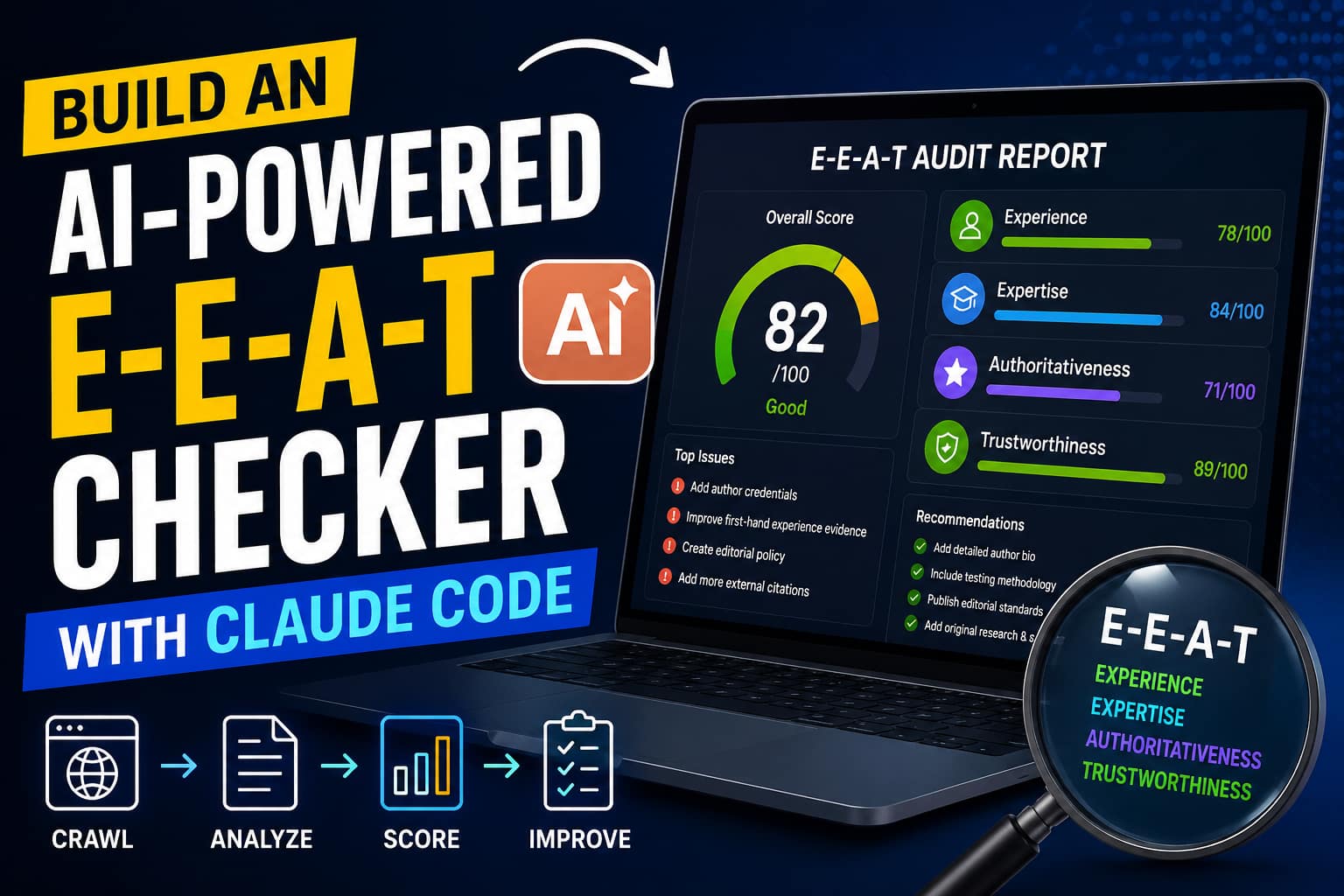
Search engine optimization is moving beyond keywords, backlinks, and technical optimization. In an increasingly AI-driven search environment, trust, credibility, first-hand experience, and demonstrated expertise are becoming increasingly important parts of content quality. (E-E-A-T Checker)
Google describes this framework as E-E-A-T: Experience, Expertise, Authoritativeness, and Trustworthiness. It is particularly important when users could be significantly affected by the information they consume, such as health, finance, legal, safety, and other high-impact topics.
The challenge for SEO teams is that E-E-A-T is not a simple checkbox. A website may have excellent content but weak author information. Another site may have strong authors but provide little evidence of first-hand experience. A third site may look authoritative but lack transparent contact information, sourcing, or editorial standards.
This is where AI-assisted development can help.
With Claude Code, marketers and developers can build a customized E-E-A-T auditing system that crawls pages, extracts relevant signals, analyzes content, assigns scores, identifies weaknesses, and generates recommendations.
The goal is not to create a magical “Google ranking score.” Instead, the goal is to build a repeatable quality-assessment workflow that helps humans identify credibility gaps faster.
Search Engine Land’s current coverage reflects the growing intersection between Claude Code, SEO automation, AI visibility, and E-E-A-T auditing.

What Is E-E-A-T?
E-E-A-T stands for:
- Experience
- Expertise
- Authoritativeness
- Trustworthiness
Trust is generally treated as the central concept because users need confidence that information is accurate, transparent, and safe to act upon.
1. Experience
Experience asks whether the content demonstrates genuine first-hand involvement with the subject.
For example, imagine two articles reviewing a project-management application.
One article simply repeats the vendor’s feature list.
Another explains:
- How the software was tested
- What happened during implementation
- Which features worked well
- Which limitations were discovered
- How the product performed in a real workflow
- Original screenshots or examples
The second article provides stronger evidence of experience.
2. Expertise
Expertise concerns the depth and accuracy of knowledge demonstrated by the content or its creator.
A technical cybersecurity article written by an experienced security professional may provide stronger evidence of expertise than a generic article assembled from superficial summaries.
Signals can include:
- Author credentials
- Professional experience
- Technical depth
- Accurate terminology
- Original research
- References to authoritative sources
- Demonstrated subject knowledge
3. Authoritativeness
Authority is about recognition.
A company, author, or website may demonstrate authority through:
- Industry recognition
- Citations
- Mentions from reputable publications
- Quality backlinks
- Professional profiles
- Original research
- Strong reputation within its field
Authority is broader than simply counting backlinks.
4. Trustworthiness
Trust asks whether users can reasonably rely on the website and its information.
Potential trust signals include:
- Clear authorship
- Transparent ownership
- Contact information
- Editorial policies
- Sources and references
- Accurate claims
- Updated information
- Secure website
- Clear disclosures
- Transparent corrections
A site can have significant authority and still have trust problems.
Why Build an E-E-A-T Checker?
Manual E-E-A-T auditing is time-consuming.
Imagine an agency managing 200 websites.
A human auditor might need to examine:
- Homepage
- About page
- Author pages
- Contact page
- Editorial policy
- Privacy information
- Individual articles
- References
- External mentions
- Structured data
- Business information
- Content freshness
Doing this manually for every client can become expensive.
An AI-assisted checker can turn the process into a structured workflow:
Website → Crawl → Extract → Analyze → Score → Prioritize → Report
The AI does not replace the SEO professional. Instead, it acts as a first-pass auditor.
What the E-E-A-T Checker Should Analyze
A useful system should examine several categories instead of relying on one AI-generated score.
Content Experience Signals
The checker can look for:
- First-person testing
- Original observations
- Case studies
- Real examples
- Screenshots
- Original data
- Product testing
- Practical implementation details
- Evidence of real-world usage
For example:
“We tested the platform with 50,000 URLs and discovered…”
is substantially different from:
“This platform can help businesses improve SEO.”
The first statement potentially contains evidence of direct experience.
Expertise Signals
The checker can evaluate:
- Author credentials
- Author biography
- Professional experience
- Subject depth
- Technical terminology
- Original analysis
- References
- Content specificity
A simple scoring model might look like:
| Signal | Weight |
|---|---|
| Author information | 15% |
| Demonstrated expertise | 20% |
| Content depth | 20% |
| Original analysis | 15% |
| References | 10% |
| Experience evidence | 20% |
These percentages are custom audit weights, not Google’s official ranking formula.
That distinction is extremely important.
An E-E-A-T checker should never claim that its numerical score represents Google’s actual ranking algorithm.
Authoritativeness Signals
The tool can investigate signals such as:
- Brand mentions
- Industry references
- Author reputation
- Relevant backlinks
- External publications
- Professional profiles
- Awards
- Original research citations
If external APIs are connected, the system can incorporate third-party data.
For example:
Brand authority
├── Relevant backlinks
├── Brand mentions
├── Expert citations
├── Industry publications
└── Original research references
The tool can then identify areas requiring deeper investigation.
Trustworthiness Signals
Trust should receive significant attention.
The checker could search for:
- HTTPS
- Contact information
- Company information
- Author identity
- Editorial policy
- Privacy policy
- Terms
- Disclosure statements
- Sources
- Publication dates
- Update dates
- Correction information
- Transparent affiliations
For example:
Potential trust issue
Article contains financial advice but does not identify the author or provide supporting sources.
Potential improvement
Add qualified author information, source citations, editorial review information, and appropriate disclosures.
How Claude Code Fits Into the System
Claude Code is particularly useful because the project is not simply a chatbot prompt.
You are building an actual workflow.
The architecture can look like this:
                  ┌──────────────────┐
                  │   Website URL    │
                  └────────┬─────────┘
                           ↓
                  ┌──────────────────┐
                  │ Website Crawler  │
                  └────────┬─────────┘
                           ↓
                  ┌──────────────────┐
                  │ Content Extractor│
                  └────────┬─────────┘
                           ↓
                  ┌──────────────────┐
                  │ E-E-A-T Analyzer │
                  └────────┬─────────┘
                           ↓
             ┌─────────────┼─────────────┐
             ↓             ↓             ↓
        Experience     Expertise    Authority
             └─────────────┼─────────────┘
                           ↓
                  ┌──────────────────┐
                  │ Trust Evaluation │
                  └────────┬─────────┘
                           ↓
                  ┌──────────────────┐
                  │ Scoring Engine   │
                  └────────┬─────────┘
                           ↓
                  ┌──────────────────┐
                  │ Audit Report     │
                  └──────────────────┘
Claude Code can help generate, modify, test, and debug the components required for this workflow.
Step 1: Define the Audit Framework
Before opening Claude Code, define exactly what the application should evaluate.
For example:
Experience
- Does the page demonstrate first-hand experience?
- Does it include original examples?
- Are testing methods explained?
- Are screenshots or original evidence available?
Expertise
- Is the author identified?
- Are credentials available?
- Does the content demonstrate subject knowledge?
- Are important claims supported?
Authority
- Is the author or organization recognized?
- Does the site have relevant external references?
- Is there evidence of industry reputation?
Trust
- Is ownership transparent?
- Is contact information available?
- Are sources cited?
- Are disclosures provided?
- Is the content maintained?
This framework becomes the foundation for your application.
Step 2: Create the Project With Claude Code
Create a dedicated project directory.
For example:
mkdir eeat-checker
cd eeat-checker
Then initialize your development environment and open the project with Claude Code.
Your first instruction should be highly specific.
Instead of saying:
Build me an E-E-A-T checker.
Give Claude a structured specification.
For example:
Build an E-E-A-T auditing application.

The application should:
1. Accept a website URL.
2. Crawl a configurable number of pages.
3. Extract visible text and metadata.
4. Detect author information.
5. Detect experience signals.
6. Detect expertise signals.
7. Identify authority indicators.
8. Identify trust signals.
9. Generate category scores.
10. Explain the evidence behind every score.
11. Generate prioritized recommendations.
12. Export a report as JSON and HTML.

Do not claim that the score represents Google's ranking algorithm.
Treat the score as an internal auditing framework.
The more precise the specification, the more predictable the implementation.
Step 3: Build the Crawler
The crawler is responsible for collecting website information.
A basic crawler should identify:
- URLs
- Titles
- Meta descriptions
- Headings
- Main content
- Author information
- Publication dates
- Modification dates
- Internal links
- External links
- Structured data
- Canonical URLs
You should also impose limits.
For example:
Maximum pages: 100
Maximum depth: 3
Request delay: configurable
Allowed domains: target domain only
This prevents the crawler from accidentally consuming unlimited resources.
Step 4: Extract Structured Information
Raw HTML isn’t particularly useful to an E-E-A-T analyzer.
Convert it into structured records.
For example:
{
  "url": "/seo-guide",
  "title": "Complete SEO Guide",
  "author": "Jane Smith",
  "published": "2026-08-10",
  "updated": "2026-08-20",
  "word_count": 2450,
  "external_sources": 12,
  "internal_links": 18,
  "experience_signals": [],
  "expertise_signals": [],
  "trust_signals": []
}
This makes the information easier for the analysis layer to process.
Step 5: Create the E-E-A-T Detection Layer
This is where Claude becomes particularly useful.
The analyzer can inspect extracted content and ask structured questions.
Experience prompt
Analyze the supplied article for evidence of first-hand experience.

Identify:
- testing
- personal observations
- original examples
- case studies
- experiments
- implementation details
- screenshots or evidence

Return:
1. Evidence found
2. Evidence missing
3. Confidence
4. Recommended improvements
Expertise prompt
Evaluate the article for demonstrated expertise.

Check:
- author information
- credentials
- technical depth
- factual specificity
- supporting references
- original analysis

Return structured findings.
Trust prompt
Evaluate the page for trustworthiness.

Check:
- author transparency
- ownership information
- contact information
- citations
- disclosures
- dates
- editorial information
- potentially misleading claims

Return evidence and recommendations.
Structured prompts make the output more consistent.
Step 6: Require Evidence for Every Score
This is one of the most important design decisions.
Don’t allow the AI to output:
Trust score: 72/100
without explaining why.
Instead, require:
{
  "category": "trust",
  "score": 72,
  "confidence": 0.82,
  "evidence": [
    "Author is clearly identified",
    "Article includes 8 external references",
    "Contact page exists"
  ],
  "gaps": [
    "No visible editorial policy",
    "No correction policy detected"
  ],
  "recommendations": [
    "Create an editorial standards page",
    "Explain how factual corrections are handled"
  ]
}
This transforms the checker from a mysterious score generator into an auditable system.
Step 7: Build the Scoring Model
You can create separate scores for each component.
For example:
Experience       78
Expertise        84
Authoritativeness 71
Trustworthiness  89
--------------------
Overall           81
But the report should explain that this is an internal diagnostic score.
A simple weighted formula could be:
Overall Score =
Experience × 0.25
+ Expertise × 0.25
+ Authority × 0.20
+ Trust × 0.30
Trust receives the largest weight because a website that appears authoritative but provides unreliable information is still problematic.
Again, this is a custom methodology, not a representation of Google’s internal scoring.
Step 8: Add Confidence Scores
AI analysis is probabilistic.
The system should therefore distinguish between:
Score
and
Confidence
For example:
Experience: 76/100
Confidence: High

Reason:
The page contains testing methodology,
first-person observations and original screenshots.
Another page might produce:
Experience: 62/100
Confidence: Low

Reason:
The AI found language suggesting first-hand experience,
but there is insufficient supporting evidence.
This prevents false precision.
Step 9: Detect Missing Evidence
A strong checker should not only identify what exists.
It should identify what is missing.
For example:
Missing author evidence
The article contains no visible author identity.
Missing experience evidence
The article describes product features but does not explain whether the product was actually tested.
Missing trust evidence
The page provides recommendations but does not disclose commercial relationships.
Missing authority evidence
The site has limited evidence of recognition outside its own domain.
This makes the tool actionable.
Step 10: Build a Priority System
Not every problem deserves immediate attention.
Create three levels:
High Priority
Issues that can significantly affect credibility.
Examples:
- Anonymous YMYL content
- Unsupported medical claims
- Missing disclosures
- Misleading author credentials
- Broken or fabricated references
Medium Priority
Issues that reduce transparency.
Examples:
- Weak author bio
- Missing editorial policy
- Old content without update information
- Limited supporting references
Low Priority
Optimization opportunities.
Examples:
- Improve author page
- Add additional first-hand examples
- Add relevant external references
- Improve content structure
This turns the report into an SEO action plan.
Example Audit Report
A useful report could look like this:
E-E-A-T Audit
Website: example.com
Overall score: 78/100
Experience — 70/100
Strengths
- Original screenshots detected
- Several first-person observations
- Practical implementation examples
Weaknesses
- Testing methodology is unclear
- No case-study evidence
Recommended action
Add a short methodology section explaining how the product or process was tested.
Expertise — 84/100
Strengths
- Author identified
- Relevant professional background
- Detailed technical explanations
- Multiple references
Weaknesses
- Author credentials are not prominently displayed
Recommended action
Add a detailed author bio and link to the author’s professional profile.
Authority — 73/100
Strengths
- Several external industry mentions
- Relevant backlinks detected
Weaknesses
- Limited evidence of independent recognition
Recommended action
Develop original research, expert commentary, and digital PR opportunities.
Trust — 86/100
Strengths
- Clear contact information
- HTTPS
- Sources provided
- Updated publication date
Weaknesses
- Editorial policy not found
Recommended action
Publish a transparent editorial standards and corrections policy.
Step 11: Add Website-Level Analysis
Don’t limit the tool to individual articles.
E-E-A-T often makes more sense when analyzed at the website level.
The checker can inspect:
Homepage
│
├── About
├── Authors
├── Contact
├── Editorial Policy
├── Privacy
├── Terms
├── Articles
└── References
Then it can identify relationships between these pages.
For example:
Article → Author → Author Bio → Professional Profile
If an article claims expertise but the author page contains no information, the checker can flag the inconsistency.
Step 12: Analyze Author Pages
Author transparency is particularly valuable.
The checker can look for:
- Full name
- Biography
- Professional experience
- Qualifications
- Areas of specialization
- Published work
- Professional profiles
- Author-specific content
It can also detect whether multiple articles use the same author but provide inconsistent credentials.
Step 13: Detect Content Patterns
An advanced version can analyze entire content libraries.
For example, suppose a website contains 500 articles.
The checker discovers:
500 articles analyzed

Author identified: 68%
Original examples: 41%
External citations: 63%
First-hand experience: 29%
Updated dates: 52%
Author bios: 35%
This immediately reveals systemic weaknesses.
Instead of asking:
Which article should we improve?
you can ask:
What credibility problem exists across the entire website?
That is much more valuable for large SEO programs.
Step 14: Add an E-E-A-T Dashboard
A simple dashboard could display:
E-E-A-T HEALTH

Experience       ███████░░░ 72
Expertise        ████████░░ 84
Authority        ███████░░░ 73
Trust            █████████░ 89

Overall          ████████░░ 80
Then show:
Top Issues
- Weak first-hand experience evidence
- Incomplete author profiles
- Limited original research
- Missing editorial policy
- Inconsistent update information
Recommended Actions
- Improve author pages
- Add testing methodology
- Publish original research
- Add editorial standards
- Review outdated articles
Step 15: Connect SEO Data
The E-E-A-T checker becomes more powerful when combined with SEO data.
Potential integrations include:
- Google Search Console
- Google Analytics
- Backlink databases
- Crawlers
- Keyword tools
- Content management systems
For example:
E-E-A-T score: 84
Organic clicks: declining
Impressions: stable
Position: 7.4
The system could flag the page for investigation.
However, it should not automatically conclude:
Low E-E-A-T caused the ranking decline.
Correlation does not establish causation.
The AI should identify the issue as a hypothesis requiring human validation.
Step 16: Add Human Review
The most reliable architecture is:
AI → Evidence → Human Review → Decision
not:
AI → Automatic Decision
For example, if Claude detects:
“The author appears to have professional medical experience.”
a human should verify the claim before publishing it in an audit.
AI can misunderstand:
- Credentials
- Organizations
- Dates
- Professional relationships
- Context
- Sarcasm
- First-person language
Human review is therefore essential.
Step 17: Protect Against Hallucinations
Your checker should have strict rules.
Rule 1
Never invent credentials.
Rule 2
Never assume experience from writing style alone.
Rule 3
Never treat a backlink count as proof of authority.
Rule 4
Never treat an AI score as Google’s score.
Rule 5
Never generate recommendations without evidence.
Rule 6
Clearly distinguish:
Detected
from
Not detected
and:
Unable to verify
This is especially important for credibility auditing.
Step 18: Make the Output Explainable
Instead of:
Authority: 61
provide:
Authority: 61/100
Evidence detected: 7 relevant external mentions and 14 referring domains.
Evidence missing: limited independent references to the organization and no obvious original research citations.
This makes the system much more useful to SEO professionals.
Step 19: Build a Technical Architecture
A production version could use:
Frontend
   ↓
API
   ↓
Crawler
   ↓
Content Parser
   ↓
Data Store
   ↓
E-E-A-T Analysis Engine
   ↓
Scoring Engine
   ↓
Recommendation Engine
   ↓
Report Generator
A possible technology stack might include:
| Component | Example |
|---|---|
| Frontend | Next.js |
| Backend | Node.js/Python |
| Database | PostgreSQL |
| Crawler | Playwright/custom crawler |
| AI analysis | Claude API |
| Authentication | Optional |
| Reports | HTML/PDF |
| Deployment | Cloud platform |
The exact stack is less important than the architecture.
Step 20: Add a Crawl Queue
For large websites, don’t analyze everything simultaneously.
Use a queue:
URL discovered
      ↓
Queue
      ↓
Crawler
      ↓
Parser
      ↓
Analyzer
      ↓
Database
This allows you to:
- Retry failures
- Limit requests
- Track progress
- Pause jobs
- Resume crawls
- Process thousands of pages
Step 21: Add Page-Type Detection
Different page types should be evaluated differently.
For example:
Blog article
Focus on:
- Author
- Experience
- Sources
- Content quality
- Updates
Product page
Focus on:
- Product information
- Reviews
- First-hand testing
- Business transparency
Service page
Focus on:
- Company identity
- Expertise
- Credentials
- Reviews
- Contact information
About page
Focus on:
- Organization identity
- People
- Experience
- Credentials
- History
This makes the checker much more intelligent than applying one generic prompt to every URL.
Step 22: Create an E-E-A-T Gap Score
Instead of only measuring strengths, calculate the gap between the current state and your target standard.
For example:
Experience
Current: 65
Target: 85
Gap: 20

Expertise
Current: 80
Target: 90
Gap: 10

Authority
Current: 58
Target: 80
Gap: 22

Trust
Current: 82
Target: 90
Gap: 8
The biggest opportunities are:
- Authority
- Experience
- Expertise
- Trust
This makes prioritization easier.
Step 23: Turn Recommendations Into Tasks
An advanced version can automatically create an implementation list.
For example:
TASK-001
Create detailed author bio
Priority: High

TASK-002
Add testing methodology to product reviews
Priority: High

TASK-003
Create editorial policy
Priority: Medium

TASK-004
Add original research to industry guides
Priority: Medium
Now the E-E-A-T checker becomes a workflow management tool, not simply an auditing tool.
Step 24: Validate the Checker
Before trusting the system, test it against real websites.
Create a test dataset containing:
- Strong E-E-A-T websites
- Average websites
- Weak websites
- Anonymous content sites
- Publisher websites
- Ecommerce sites
- Service businesses
- YMYL websites
Then compare AI assessments with expert human audits.
Look for:
- False positives
- False negatives
- Inconsistent scores
- Hallucinated evidence
- Overly generic recommendations
Improve the prompts and scoring rules based on those results.
Common Mistakes to Avoid
Mistake 1: Treating the score as a Google ranking score
Don’t do this.
Google does not provide a public E-E-A-T numerical score that your application can reproduce.
Your score should be presented as an internal diagnostic framework.
Mistake 2: Measuring only backlinks
Authority is broader than links.
External recognition, reputation, original research, citations, expert references, and brand/entity signals can all contribute to the broader picture.
Mistake 3: Assuming AI-generated content automatically has poor E-E-A-T
The production method alone doesn’t tell you whether content is useful or trustworthy.
Evaluate the actual content, evidence, experience, expertise, and transparency.
Mistake 4: Using generic recommendations
Avoid:
“Improve your E-E-A-T.”
Instead:
“Add an author biography describing the writer’s relevant professional experience and link to verifiable professional information.”
Specific recommendations are much more useful.
Mistake 5: Ignoring website-level signals
An article may look excellent while the overall website lacks transparency.
Analyze both:
Page-level E-E-A-T
and
Site-level E-E-A-T
A More Advanced Version
Once the basic application works, you can extend it into a complete AI SEO Quality Intelligence Platform.
Potential features include:
Automated content auditing
Analyze thousands of URLs.
Author entity auditing
Determine whether author information is consistent and verifiable.
Content decay detection
Identify pages where outdated information may undermine trust.
Competitor comparison
Compare your site’s observable quality signals with competing websites.
AI visibility monitoring
Track whether your brand appears in AI-generated search answers.
Citation analysis
Determine which external sources reference your brand.
Automated recommendations
Convert audit findings into prioritized SEO tasks.
These capabilities align with a broader shift toward using AI-assisted systems for scalable SEO analysis and content workflows.
Example: Before and After
Imagine a technology website has 1,000 articles.
The checker discovers:
| Signal | Before | Target |
|---|---|---|
| Identified authors | 54% | 95% |
| Detailed author bios | 31% | 90% |
| First-hand evidence | 28% | 75% |
| External references | 61% | 85% |
| Updated articles | 49% | 90% |
| Editorial transparency | 40% | 90% |
The audit doesn’t simply say:
“Your E-E-A-T is weak.”
Instead, it identifies the operational problems responsible for the gap.
The SEO team can then create a roadmap.
Why Claude Code Is Useful for This Project
Traditional AI chat interfaces are excellent for generating individual answers.
Claude Code can be more useful when you need to work with an actual software project.
You can use it to help:
- Create files
- Modify application logic
- Debug errors
- Refactor code
- Build components
- Run tests
- Inspect project structure
- Iterate on the application
This makes the workflow particularly interesting for SEO professionals who want to build specialized internal tools rather than rely entirely on off-the-shelf platforms.
Claude Code can therefore become the development layer behind a customized SEO auditing system.
The Bigger SEO Opportunity
The real opportunity isn’t simply building another SEO score.
It’s building a system that answers:
“What evidence does this website provide that users should trust it?”
That is a much more useful question.
A good E-E-A-T checker should therefore move through four stages:
Detect
   ↓
Explain
   ↓
Prioritize
   ↓
Improve
Detect the signals.
Explain the evidence.
Prioritize the weaknesses.
Improve the website.
This approach turns E-E-A-T from an abstract SEO concept into a measurable operational process.
Final Thoughts
Building an AI-powered E-E-A-T checker with Claude Code is an excellent example of how SEO and software development are converging.
The objective shouldn’t be to reverse-engineer Google’s ranking algorithm or manufacture an artificial E-E-A-T number.
Instead, build a transparent auditing framework that evaluates observable evidence across Experience, Expertise, Authoritativeness, and Trustworthiness.
The most valuable version of the tool will:
- Crawl websites systematically
- Extract meaningful evidence
- Evaluate pages and authors
- Analyze site-wide trust signals
- Explain every finding
- Separate evidence from assumptions
- Assign transparent internal scores
- Prioritize improvements
- Support human verification
- Generate actionable reports
As AI-assisted search continues to change how users discover information, building systems around evidence, credibility, and transparency can become more valuable than simply producing more content.
The best E-E-A-T checker isn’t the one that produces the highest score.
It’s the one that helps a team understand why a website deserves to be trusted—and exactly what it needs to improve.
Sources and further reading
Google’s documentation and Search quality guidance should be treated as the primary reference when defining your auditing methodology. Search Engine Land’s ongoing E-E-A-T and Claude Code coverage is useful for understanding how these concepts are being applied in modern SEO workflows.
For Claude Code development workflows, consult Anthropic’s official Claude documentation.