
Introduction
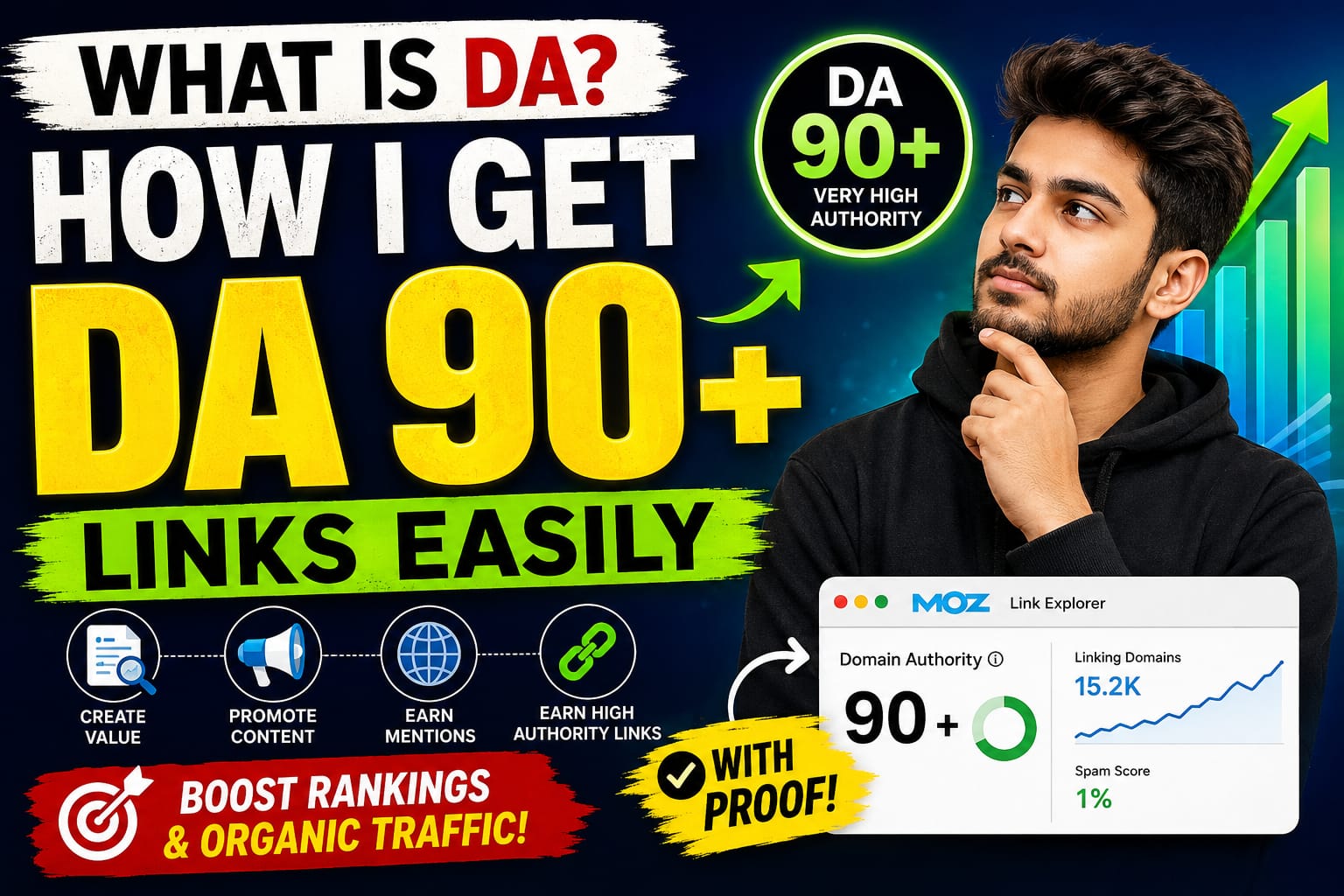
If you work in SEO, you have probably heard terms such as DA 20, DA 50, DA 70, or DA 90+. Many website owners believe that getting backlinks from websites with very high Domain Authority automatically makes their website rank higher.
The reality is more complicated.
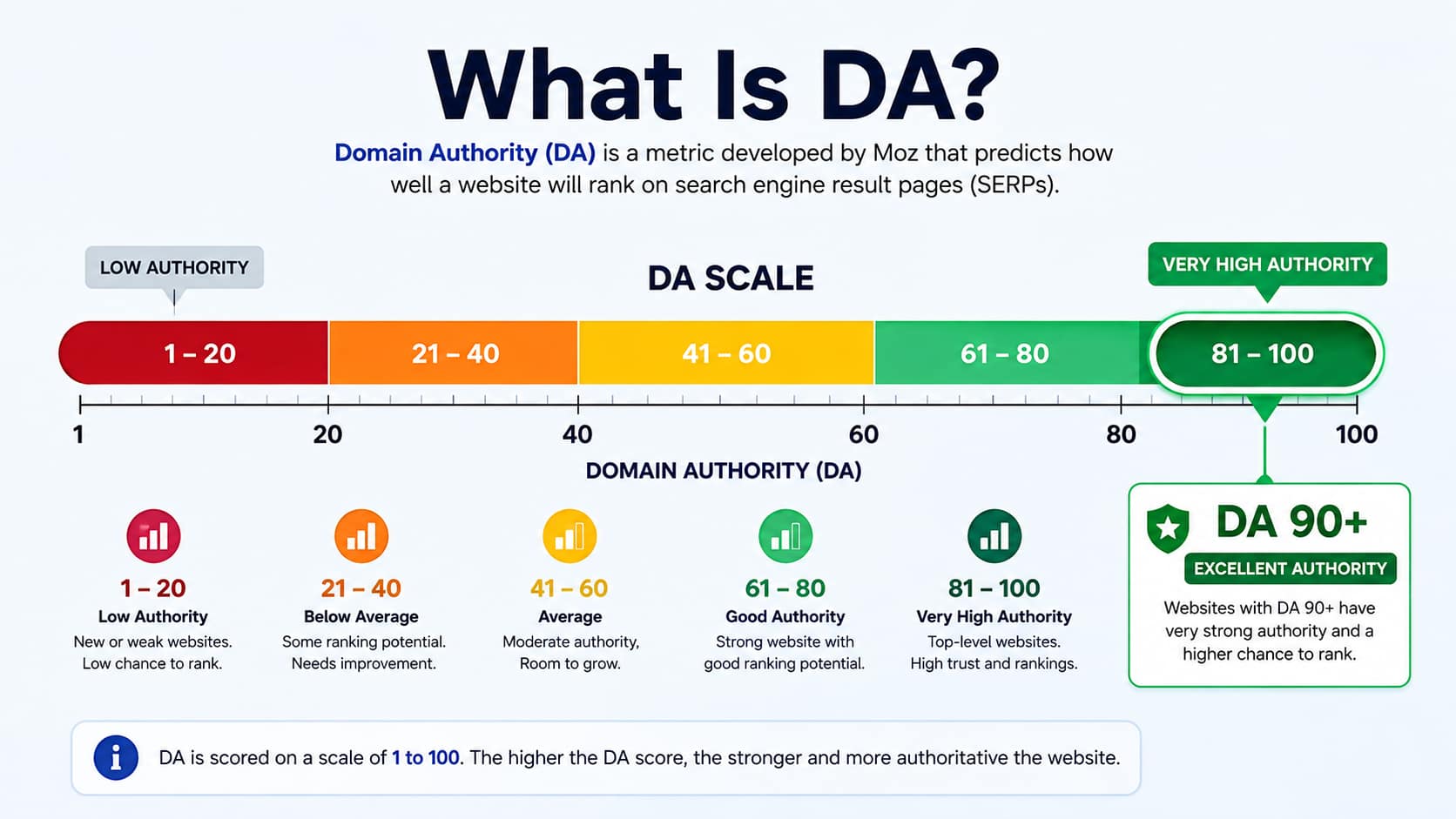
Domain Authority (DA) is a proprietary SEO metric developed by Moz. It uses a 1–100 scale to estimate how likely a domain is to rank in search results. A higher score generally indicates a stronger link profile, but DA itself is not a Google ranking factor. (Moz Static)
This means you should not chase a DA 90 link simply because the number looks impressive. A relevant, editorially earned backlink from a trusted website can be much more useful than hundreds of random links from websites with artificially inflated metrics.
In this guide, you will learn:
- What DA actually means
- How DA is calculated
- What a DA 90+ website is
- Whether DA 90+ backlinks really help SEO
- How to find high-authority websites
- How to earn high-authority backlinks
- How to create link-worthy content
- How to use digital PR and expert contributions
- How to check whether a backlink is genuine
- What Google considers link spam
- A practical 90-day DA backlink strategy
- How to document your backlink results as proof
What Is Domain Authority (DA)?
Domain Authority is an SEO metric created by Moz to predict the ranking strength of a domain.
The score ranges from 1 to 100.
Generally:
| DA Score | General Interpretation |
|---|---|
| 1–10 | Very new or weak domain |
| 11–20 | Low authority |
| 21–40 | Developing authority |
| 41–60 | Established authority |
| 61–80 | Strong authority |
| 81–90 | Very strong authority |
| 91–100 | Extremely strong authority |
These ranges are useful for comparison, not official Google classifications.
Moz explains that DA is based on information about a website, including links pointing to it, and uses a machine-learning model to estimate ranking potential. (Moz Static)
Important: DA Is Not Google Authority
One of the biggest SEO misconceptions is:
“Google gives websites a DA score.”
It does not.
DA is a Moz metric. Google does not assign websites a publicly visible DA score.
Therefore, a website can have:
DA 90 + poor content + little relevant traffic
while another website can have:
DA 45 + excellent content + highly relevant audience
For link building, you should evaluate more than DA.
What Does DA 90+ Mean?
A DA 90+ website is a domain with an exceptionally strong authority score according to Moz.
Examples can include large publishers, major organizations, universities, established technology websites, government-related websites, and globally recognized brands.
However, getting a link from such a website is usually difficult.
You should therefore avoid promises such as:
“Get 100 DA 90 backlinks in one day.”
Those offers frequently involve automated links, paid link schemes, irrelevant websites, or networks created primarily for SEO manipulation.
Google specifically identifies buying or selling links for ranking purposes, excessive link exchanges, automated link creation, and low-quality directory/bookmark links as examples of link spam. (Google for Developers)
Do DA 90+ Backlinks Help SEO?
They can help, but DA itself is not the reason.
The value of a backlink depends on multiple factors, including:
- Relevance
- Authority of the linking page/domain
- Editorial placement
- Context
- Quality of the referring website
- Link attributes
- Whether the page is indexed
- Whether the website attracts real users
- Number and quality of other links on the page
Ahrefs similarly recommends looking beyond a single authority metric when evaluating backlink quality. (Ahrefs Help Center)
For example:
Example A — High DA but irrelevant
A website about construction links to your article about WordPress plugins.
DA: 92
Topic relevance: Low
Editorial relevance: Low
This may not be an ideal backlink.
Example B — Lower DA but highly relevant
A respected WordPress website links naturally to your detailed WordPress security guide.
DA: 55
Topic relevance: Very high
Editorial context: Strong
This could be a much more meaningful link for your SEO strategy.
The Real Goal: Quality Backlinks, Not Just DA
Instead of saying:
“I need 50 DA 90 links.”
Use this goal:
“I need relevant, trustworthy websites to mention and cite my content.”
That changes your entire link-building strategy.
A good backlink usually has several characteristics:
Relevant website → Relevant page → Useful content → Natural editorial mention → Appropriate anchor text
This is much safer than mass-producing backlinks.
How to Get DA 90+ Links Easily
There is no legitimate method that guarantees dozens of DA 90+ backlinks instantly.
But you can make the process easier by targeting websites where you have a genuine reason to be mentioned.
Here are the most practical methods.
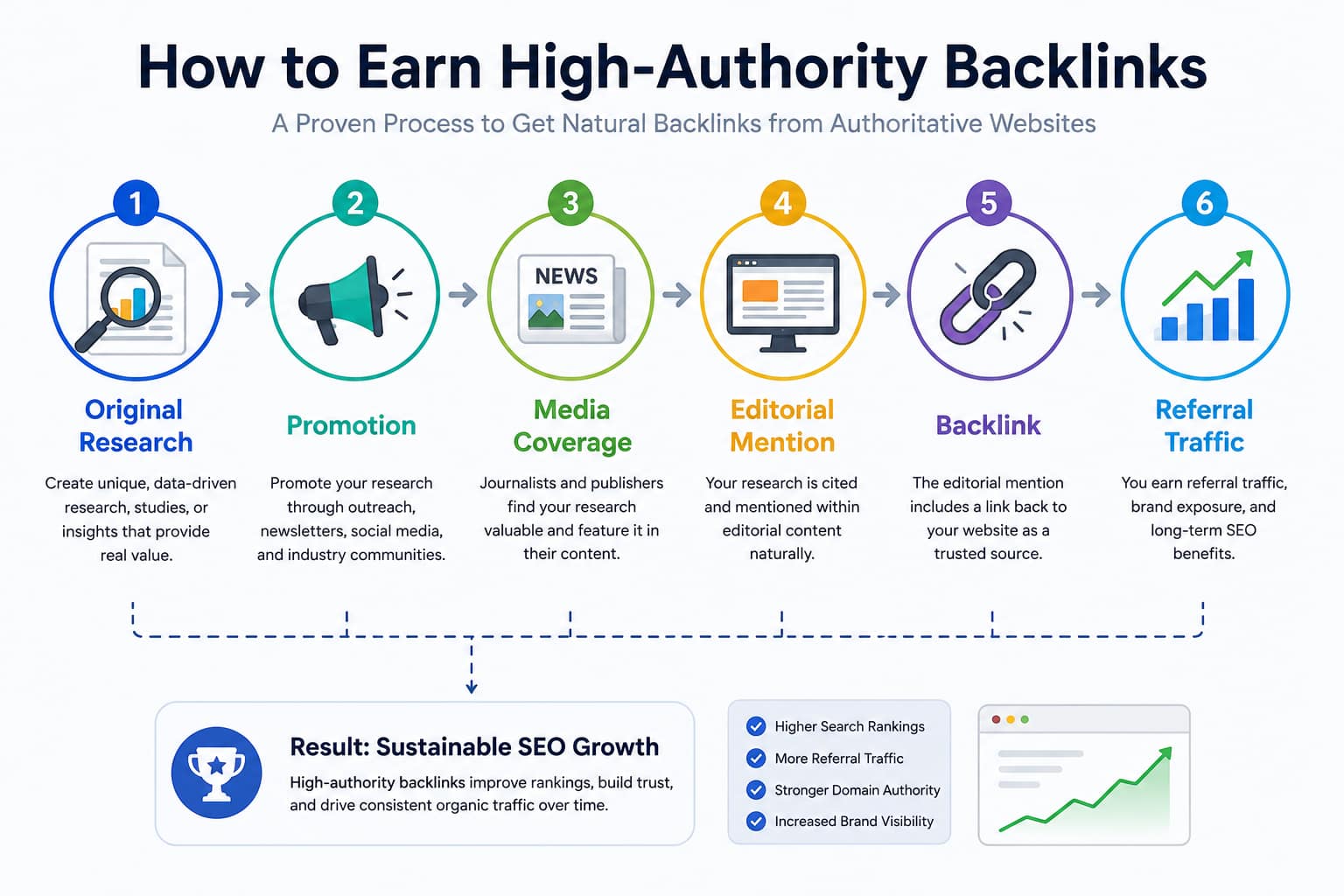
1. Create Link-Worthy Research
Original research is one of the strongest ways to attract high-authority backlinks.
Instead of publishing another generic article such as:
“10 SEO Tips”
create something original.
For example:
Research idea
“100 WordPress Websites Tested: Average PageSpeed Performance in 2026”
You could collect:
- Website type
- Hosting provider
- PageSpeed score
- Core Web Vitals
- WordPress version
- Number of plugins
- Image optimization status
Then publish the results.
Other writers can reference your research when discussing website performance.
Why it works
Journalists, bloggers, and SEO professionals need statistics to support their articles.
If your research contains useful original data, you have created a reason for other websites to cite you.
2. Create Original Statistics
Statistics are highly linkable.
For example:
“We analyzed 500 WordPress websites and found that 62% had unoptimized images.”
A publisher writing about WordPress performance could reference your research.
This creates a natural backlink opportunity.
Content formula
Collect data → Analyze it → Create charts → Publish findings → Promote to relevant publishers
This is much stronger than publishing hundreds of short articles.
3. Publish Free Tools
A useful tool can attract links for years.
Examples include:
- SEO calculators
- Meta description generators
- Word counters
- Image compression tools
- Heading analyzers
- Keyword density checkers
- UTM builders
- Redirect checkers
- Schema generators
Imagine creating:
Free SEO Meta Title Checker
A blogger writing about SEO tools may naturally mention and link to your tool.
4. Use Digital PR
Digital PR is one of the best strategies for reaching authoritative publications.
The basic process is:
Interesting story → Research/data → Press outreach → Editorial coverage → Mentions/backlinks
For example, suppose your company publishes:
“The 2026 Small Business Website Performance Report.”
You can pitch the findings to:
- Technology publications
- Marketing publications
- Business websites
- Local newspapers
- Industry blogs
- Journalists covering digital marketing
The objective is not to ask:
“Can you give me a backlink?”
Instead, give the journalist something genuinely useful.
5. Become a Source for Journalists
Journalists frequently need experts for articles.
If you have genuine expertise, provide useful answers to journalist requests.
Your contribution might include:
- Expert opinion
- Original statistics
- Case studies
- Industry predictions
- Practical examples
If the journalist chooses your contribution, your company or website may be mentioned in the article.
This type of editorial mention can be significantly more valuable than creating hundreds of profile links.
6. Guest Contributions — But Do Them Correctly
Guest posting can be useful when the primary purpose is providing valuable content to the publication’s audience.
For example, you might write:
“How Small Businesses Can Build a Technical SEO Strategy”
for a relevant marketing publication.
The article should:
- Be original
- Match the site’s audience
- Provide genuine expertise
- Avoid keyword-stuffed anchors
- Avoid excessive self-promotion
Google warns that excessive sponsored or guest posting primarily intended to obtain links can fall into link-spam territory. (Google for Developers)
So don’t build your entire strategy around paid guest-post links.
7. Create Ultimate Guides
An ultimate guide should be significantly more useful than the average search result.
For example:
Instead of:
What Is SEO?
Create:
The Complete SEO Guide for Small Businesses: Technical SEO, Content, Local SEO, Backlinks and Measurement
Include:
- Definitions
- Examples
- Screenshots
- Original diagrams
- Statistics
- Templates
- Checklists
- Case studies
- Expert quotes
- FAQs
When other writers reference the topic, your comprehensive guide becomes a potential resource.
8. Build Free Templates
Templates can generate backlinks because people naturally reference useful resources.
Examples:
- SEO audit template
- Content calendar
- Keyword research spreadsheet
- Link-building outreach template
- Website launch checklist
- Blog brief template
- SEO reporting template
Give users genuine value.
You can add your website branding, but don’t force users to link to you.
9. Use Resource Pages
Search for websites that maintain useful resource pages.
For example, search Google for combinations such as:
SEO resources
SEO tools resources
digital marketing resources
WordPress resources
free SEO tools
SEO guide resources
Then identify pages where your resource would genuinely improve the page.
Send a personalized outreach email.
Bad outreach
“Please add my website. It has DA 40.”
Better outreach
“I noticed your SEO resources page includes several technical SEO guides. We recently published a free Core Web Vitals checklist that may be useful for your readers. If you think it fits, you’re welcome to include it.”
The second approach focuses on the reader rather than your SEO metric.
10. Use Broken-Link Building
Broken-link building involves finding outdated or dead links on relevant websites.
The process:
Find broken link → Create/use a better resource → Contact website owner → Suggest replacement
Example:
A website has:
“SEO Tools for Beginners”
but one of the recommended tools no longer exists.
You have a relevant replacement.
Contact the website owner and explain the problem.
This provides a legitimate reason for your outreach.
11. Create Statistics Pages
Create pages such as:
“100 SEO Statistics for 2026”
Include sources and explain your methodology.
Statistics pages can become reference resources for writers.
You can also publish separate research reports:
- SEO statistics
- WordPress statistics
- AI statistics
- E-commerce statistics
- Local SEO statistics
- Website performance statistics
The key is to add original value rather than simply copying statistics from other websites.
12. Create Infographics and Original Visuals
A useful infographic can earn backlinks when people embed or reference it.
For example:
“How Google Search Works”
Create a visual showing:
Crawling → Indexing → Ranking → Search Results
Then publish the infographic with supporting explanatory content.
Make the underlying information accurate and useful.
13. Use Expert Roundups Carefully
Instead of creating a low-value article containing dozens of random quotes, create a genuinely useful expert resource.
Example:
“25 SEO Experts Explain How They Build Topical Authority”
Ask relevant professionals one specific question.
Then combine the answers into a useful guide.
Participants may share the article with their audiences.
Some may also reference it from their websites.
14. Get Listed in Relevant Industry Directories
Not every directory is valuable.
Avoid submitting your website to hundreds of low-quality directories.
Google specifically lists low-quality directory and bookmark links among examples of link spam. (Google for Developers)
Instead, prioritize:
- Legitimate business directories
- Industry associations
- Professional organizations
- Local business directories
- Trusted niche resources
The directory should exist for users, not merely for manipulating search rankings.
15. Build Relationships Before Asking for Links
This is one of the most overlooked strategies.
Instead of immediately asking:
“Give me a backlink.”
Start by:
- Reading their content
- Sharing useful articles
- Leaving thoughtful contributions where appropriate
- Connecting professionally
- Providing useful information
- Collaborating on research
Eventually, a natural collaboration may produce a mention.
Relationship → Collaboration → Mention → Backlink
is generally more sustainable than:
Cold email → Link request → Follow-up → Follow-up → Spam
How to Find DA 90+ Opportunities
You can use SEO tools such as Moz, Ahrefs, Semrush, or other backlink databases to identify websites and referring domains.
But don’t filter only by DA.
Create a prospecting spreadsheet with columns such as:
| Website | DA | Topic | Traffic | Relevance | Contact | Opportunity |
|---|---|---|---|---|---|---|
| Website A | 92 | SEO | High | Excellent | Available | Research citation |
| Website B | 84 | WordPress | High | Excellent | Available | Expert contribution |
| Website C | 76 | Marketing | Medium | Good | Available | Guest contribution |
| Website D | 61 | General | Low | Poor | Available | Reject |
This prevents you from becoming obsessed with the DA number.
How to Check Whether a DA 90 Website Is Real
Before pursuing a backlink, investigate the website.
Check 1 — Topic
Is the site related to your industry?
Check 2 — Organic visibility
Does the website appear to receive search traffic?
Check 3 — Content quality
Are real people publishing useful content?
Check 4 — Outbound links
Does every article contain dozens of commercial backlinks?
Check 5 — Indexation
Are the site’s important pages indexed?
Check 6 — Reputation
Does the website have a genuine audience and recognizable brand?
Check 7 — Link placement
Would your link be placed naturally within useful content?
A DA score alone cannot answer these questions.
“Proof” of a DA 90+ Backlink
If you want to demonstrate that you obtained a high-authority backlink, don’t simply show a screenshot saying:
DA 90
Create proper evidence.
Your proof should contain:
1. Linking URL
Show the exact page containing the backlink.
2. Destination URL
Show which page on your website receives the link.
3. Anchor text
Show the text used for the link.
4. Context
Show the paragraph surrounding the backlink.
5. DA/authority measurement
Record the DA score using your chosen SEO tool.
6. Date
Record when the link was discovered.
7. Index status
Check whether the linking page is accessible to search engines.
8. Traffic/reputation evidence
Where possible, document evidence that the referring website has genuine visibility.
Example Proof Table
| Evidence | What to Record |
|---|---|
| Referring domain | example.com |
| Linking page | Exact article URL |
| DA | 90+ according to Moz |
| Linking page | Relevant article |
| Anchor text | Natural descriptive text |
| Destination | Your target page |
| Link context | Relevant paragraph |
| Date discovered | August 2026 |
| Status | Live |
| Screenshot | Save evidence |
Important: A DA screenshot alone does not prove that the backlink is valuable. It only proves the metric shown by the tool at that time.
What You Should NOT Do
Avoid these shortcuts:
❌ Buy hundreds of DA 90 backlinks
❌ Use automated backlink software
❌ Create thousands of forum comments
❌ Spam blog comments
❌ Create private blog networks solely for manipulating rankings
❌ Exchange links excessively
❌ Use exact-match anchors everywhere
❌ Submit your site to hundreds of low-quality directories
❌ Publish meaningless guest posts only for links
❌ Generate large quantities of low-value content for backlinks
Google explicitly identifies automated link creation, excessive link exchanges, paid links intended to manipulate rankings, and low-quality directory/bookmark links as examples of link spam. (Google for Developers)
A Better Backlink Formula
Use this formula:
Relevance + Authority + Editorial Context + Real Value = Strong Backlink Opportunity
For example:
Your SEO research
↓
Marketing publication discovers the research
↓
Publication references your statistics
↓
Editorial backlink
↓
Referral traffic + brand exposure + potential SEO value
This is much better than:
Buy backlink → Publish → Forget
90-Day DA Backlink Strategy
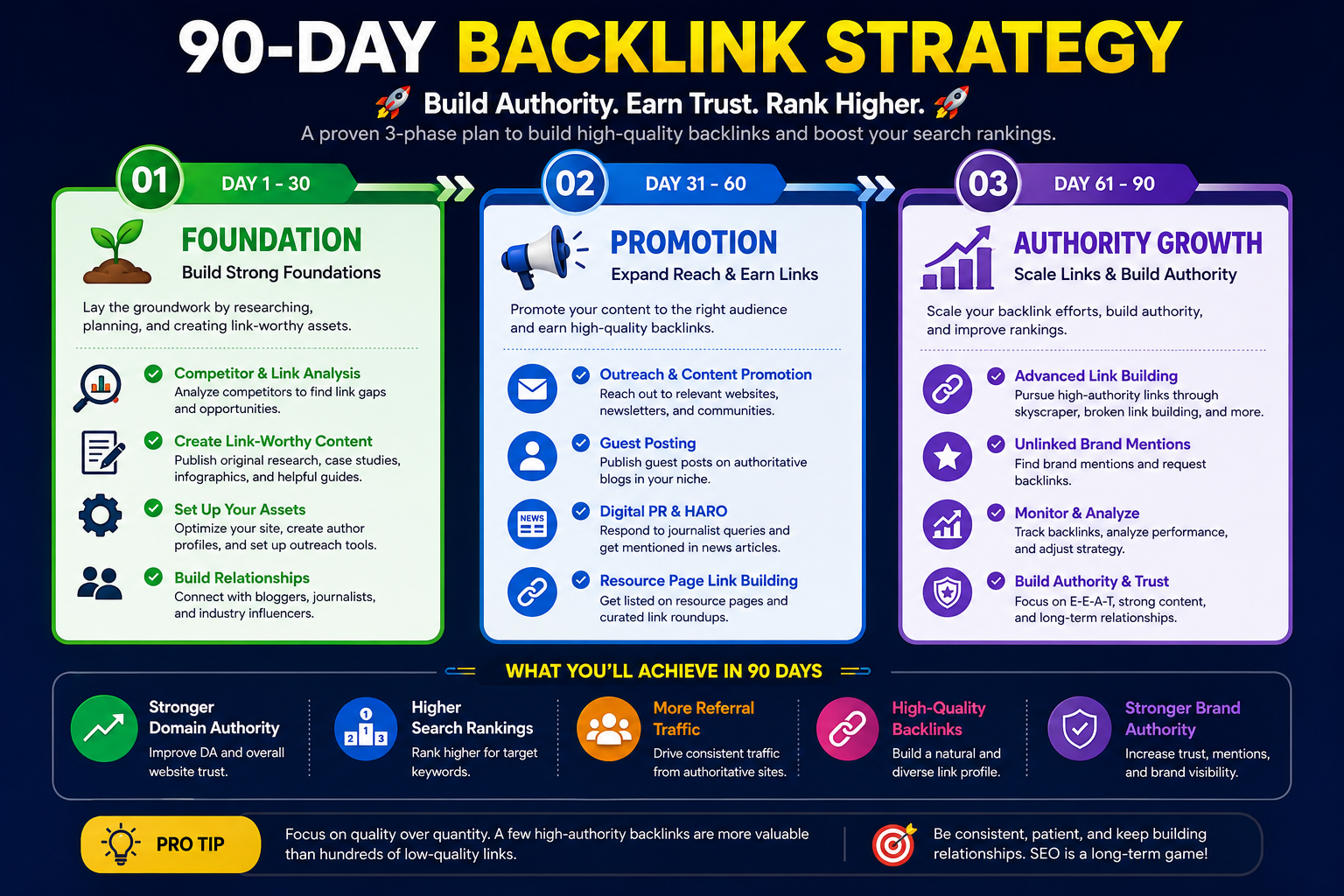
Days 1–30: Foundation
Week 1
Audit your existing backlinks.
Identify:
- Strong links
- Weak links
- Relevant domains
- Spammy links
- Competitor backlinks
Week 2
Create one major linkable asset.
Examples:
- Original research
- Industry report
- Free tool
- Ultimate guide
- Statistics page
Week 3
Create supporting content.
Publish:
- Blog posts
- Data visualizations
- Charts
- Case studies
- Social posts
Week 4
Build your prospect list.
Target:
50–100 highly relevant websites
Do not target hundreds of random websites.
Days 31–60: Promotion
Start outreach.
Send personalized messages to:
- Journalists
- Bloggers
- Editors
- Industry websites
- Resource-page owners
- Researchers
- Professional communities
Your goal is to make your content discoverable.
Do not ask every person for the same backlink.
Days 61–90: Relationship and Authority
Continue:
- Digital PR
- Expert contributions
- Broken-link opportunities
- Resource outreach
- Data promotion
- Industry partnerships
- Content collaborations
Track every opportunity.
At the end of 90 days, evaluate:
Referring domains → Relevant links → Quality links → Referral traffic → Search visibility
DA 90+ Backlinks: The Reality
Here’s the most important point:
You cannot guarantee a DA 90+ backlink.
A website owner, editor, or journalist ultimately decides whether your content deserves a link.
You can improve your chances by creating something worth referencing.
For example:
Weak asset
“10 SEO Tips Everyone Already Knows”
Chance of earning a major editorial backlink: Low.
Strong asset
“2026 SEO Industry Report Based on 2,000 Websites”
Chance of earning references: Much better.
The difference is original value.
DA vs. Other SEO Metrics
Don’t evaluate backlinks using DA alone.
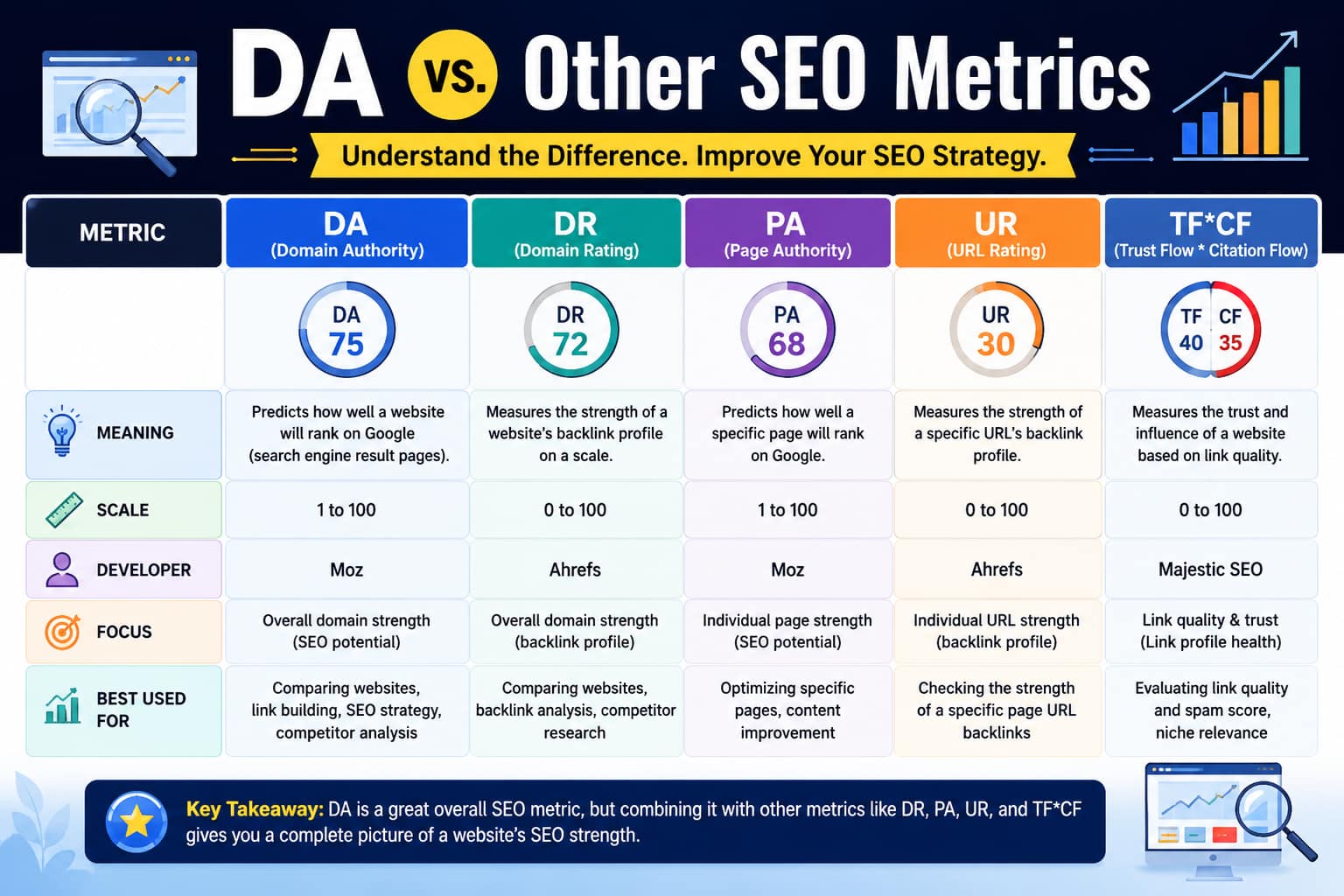
| Metric | What It Helps You Understand |
|---|---|
| DA | Moz’s estimate of domain ranking potential |
| PA | Moz’s estimate for a specific page |
| DR | Ahrefs’ domain-level link authority metric |
| UR | Ahrefs’ page-level link authority metric |
| Organic traffic | Potential real search visibility |
| Referring domains | Breadth of backlink profile |
| Relevance | Topical relationship |
| Editorial placement | Naturalness of the link |
| Spam indicators | Potential quality problems |
These metrics are not interchangeable.
A DA 70 in one tool should not automatically be treated as equivalent to another tool’s authority score.
Does a DA 90 Link Guarantee Higher Rankings?
No.
Google uses many signals to determine search rankings, and Google’s public documentation does not state that Moz DA is a ranking factor.
Google does use links to discover pages and understand relationships between pages, but it also emphasizes useful, people-first content and warns against manipulative link practices. (Google for Developers)
Therefore:
DA 90 backlink ≠ guaranteed ranking
Instead:
Relevant backlink + excellent content + strong technical SEO + useful user experience + broader authority = stronger SEO strategy
Frequently Asked Questions
What is DA in SEO?
DA stands for Domain Authority, a Moz metric that estimates how likely a domain is to rank in search results. It uses a 1–100 scale. (Moz Static)
Is DA 90 good?
Yes. DA 90 is an exceptionally high score. However, DA is a third-party metric and should not be treated as a direct Google ranking score.
Are DA 90 backlinks powerful?
They can be valuable when they are relevant, editorially earned, trustworthy, and placed in useful content. DA alone does not determine backlink quality.
Can I buy DA 90 backlinks?
You can encounter services selling them, but buying links for the purpose of manipulating Google rankings violates Google’s link-spam policies. (Google for Developers)
How can I get DA 90 backlinks for free?
The safest approach is to create valuable resources that authoritative websites want to reference. Original research, free tools, expert contributions, digital PR, statistics, and useful guides are strong strategies.
How many DA 90 backlinks do I need?
There is no universal number. One highly relevant editorial backlink can be more useful than dozens of irrelevant links.
Is DA a Google ranking factor?
No. DA is a Moz metric, not a Google-published ranking factor.
Final Verdict
If your goal is to build a powerful backlink profile, don’t make DA 90 your only target.
DA is useful for comparing domains, but successful SEO requires a broader evaluation.
The strongest approach is:
Create something valuable
↓
Make it original
↓
Promote it to the right audience
↓
Build genuine relationships
↓
Earn editorial mentions
↓
Monitor your backlinks
↓
Improve your content
Google’s own guidance emphasizes avoiding manipulative link schemes and focusing on high-quality content and user experience. (Google for Developers)
So the real secret to getting “DA 90+ links easily” is not a shortcut.
Make your website and content useful enough that authoritative websites have a reason to reference it.
That is the sustainable way to build authority.