

Google has officially started rolling out its August 2026 Spam Update, giving website owners, publishers, and SEO professionals another reason to closely monitor their organic search performance.(Google August 2026 Spam Update)
The update began on August 18, 2026, and Google says the rollout applies globally and across all languages. The company also indicates that the rollout may take a few days to complete. (Google Search Status)
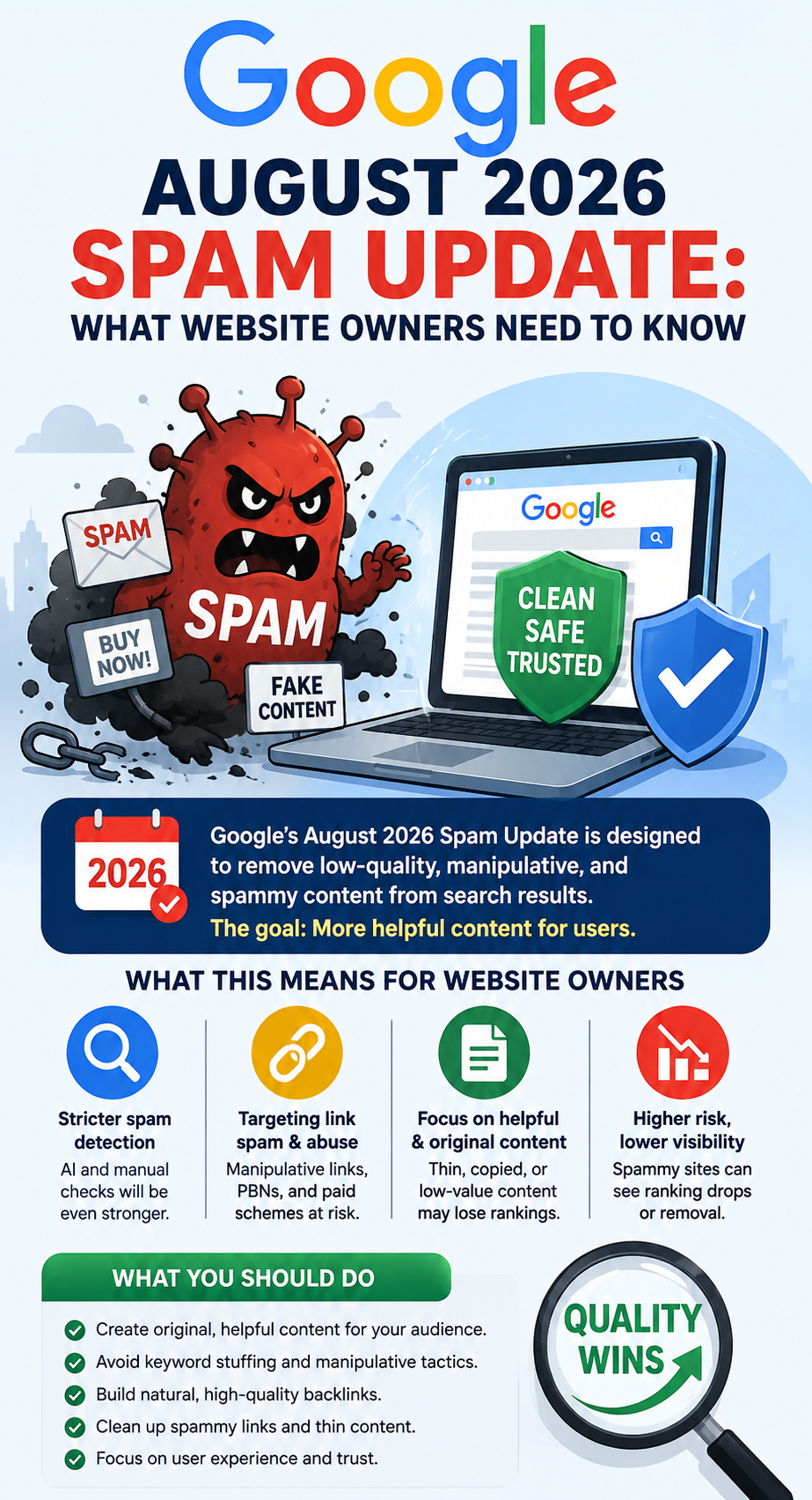
Unlike a broad core update, this is specifically a spam-focused update. That means websites engaging in practices that violate Google’s Search spam policies may experience ranking or visibility changes.
For legitimate websites, there is no reason to panic. However, the update is a good opportunity to review your content, technical implementation, backlinks, publishing processes, and overall SEO strategy.
What Is the August 2026 Google Spam Update?
The August 2026 Spam Update is a Google Search algorithm update designed to improve the quality of search results by identifying and reducing websites that use spammy or manipulative practices.
Google’s Search Status Dashboard lists the update as beginning on August 18, 2026. The dashboard also records earlier 2026 spam updates, including the March and June updates. (Google Search Status)
Google has described the August rollout as a normal spam update rather than a new core algorithm update. Current reporting indicates that Google has not announced a new spam policy specifically accompanying this rollout. (Search Engine Journal)
Key facts at a glance
| Factor | August 2026 Spam Update |
|---|---|
| Launch date | August 18, 2026 |
| Update type | Spam update |
| Global rollout | Yes |
| Languages | All languages |
| Expected rollout | A few days |
| Primary focus | Search spam and policy violations |
| Core update? | No |
| Recommended response | Monitor, audit, and improve |
Why This Update Matters
Google Search is becoming increasingly sophisticated at detecting websites that attempt to manipulate rankings.
Search spam can take many forms, including automatically generated low-value pages, deceptive redirects, manipulative links, misleading content, and other techniques designed primarily to influence search rankings rather than help users.
Google’s spam policies exist to protect the quality of its search results. The company has also introduced policies addressing practices such as scaled content abuse, site reputation abuse, and expired domain abuse. (Google for Developers)
In 2026, Google also introduced a specific spam policy addressing back-button hijacking, demonstrating that Google’s spam systems continue to evolve as new manipulative techniques emerge. (Google for Developers)
Is This a Core Update?
No.
This distinction is important.
A core update generally involves broader improvements to Google’s ranking systems and can affect many types of websites and queries.
A spam update, on the other hand, is focused on detecting and reducing the visibility of websites or pages that violate Google’s spam policies.
Therefore, website owners should not automatically interpret every ranking movement during the August rollout as evidence that their content quality has been reassessed by a core update.
That said, legitimate sites can sometimes experience ranking fluctuations during algorithm changes because search results are interconnected.
Who Could Be Most Affected?
Websites that rely heavily on questionable SEO tactics are more likely to be vulnerable.
Potentially vulnerable areas include:
1. Scaled Low-Quality Content
Publishing hundreds or thousands of pages without providing meaningful value can create problems.
The issue is not simply the number of pages or whether AI was used.
The bigger concern is whether the content exists primarily to manipulate search rankings and whether it provides genuine value to visitors.
For example:
Creating 5,000 automatically generated pages targeting slightly different keyword combinations, with almost identical information and little original value, is a risky strategy.
By contrast, using automation or AI as part of a legitimate editorial workflow while adding original research, expertise, examples, editing, and useful information is a very different approach.
Google has previously stated that its focus is on whether content is helpful and created for people rather than produced primarily to manipulate rankings. (Google for Developers)
2. Keyword Stuffing
Repeating the same keyword excessively does not make a page more relevant.
For example, a page that repeatedly forces phrases such as:
“best SEO tools,” “best SEO tools 2026,” “SEO tools,” “top SEO tools”
into every paragraph can become unnatural and provide a poor reading experience.
Modern SEO should focus on satisfying the search intent rather than maximizing keyword frequency.
3. Manipulative Links
Artificial link-building practices can create significant risk.
Examples include:
- Buying links primarily to manipulate rankings
- Excessive link exchanges
- Automated link schemes
- Low-quality networks
- Unnatural anchor-text patterns
- Large numbers of irrelevant backlinks
Google has long maintained systems designed to reduce the impact of manipulative links. Its Search guidance also explains how commercially motivated links should be appropriately handled. (Google for Developers)
4. Deceptive Redirects
Redirects are not inherently bad.
They are commonly used when:
- A page moves to a new URL
- A website changes domains
- Content is consolidated
- A product is discontinued
- A site restructures its URLs
The problem occurs when redirects are used deceptively—for example, sending search users somewhere substantially different from what they expected.
5. Cloaking
Cloaking occurs when a website presents substantially different content to search engines and users.
This is a high-risk SEO practice because it attempts to manipulate how search engines understand a page.
6. Doorway Pages
Doorway pages are created primarily to rank for specific searches and then funnel users toward another destination.
Examples can include numerous nearly identical city pages created solely to capture local keyword variations without providing meaningful local information.
What About AI-Generated Content?
This is one of the most important questions for publishers in 2026.
The use of AI itself should not be treated as synonymous with spam.
Google has previously explained that its approach focuses on the quality and purpose of content rather than simply whether content was produced using AI. (Google for Developers)
The bigger risk is mass-producing low-value content for search manipulation.
Risky AI workflow
AI → Generate thousands of articles → Publish automatically → Add keywords → Build links → Wait for rankings
Better AI workflow
Research → AI assistance → Human verification → Original insights → Expert editing → Useful examples → Fact checking → Publish → Monitor performance
The second workflow provides a much stronger foundation for sustainable SEO.
What Should Website Owners Do During the Update?
The most important recommendation is simple:
Do not make major changes just because rankings move during the rollout.
Google says the August update may take a few days to complete, so fluctuations during the rollout should be interpreted carefully. (Search Engine Journal)
Instead, follow a structured monitoring process.
Step 1: Monitor Google Search Console
Check:
- Total clicks
- Impressions
- Average position
- CTR
- Top-performing pages
- Pages losing impressions
- Pages losing clicks
- Important queries
Compare your performance against previous periods.
Do not rely on one day’s data.
Step 2: Compare Before and After the Update
Create a simple comparison:
| Metric | Before Update | During Rollout | After Rollout |
|---|---|---|---|
| Organic clicks | — | — | — |
| Impressions | — | — | — |
| Average position | — | — | — |
| CTR | — | — | — |
| Indexed pages | — | — | — |
| Organic conversions | — | — | — |
This makes it easier to identify whether the change is temporary or persistent.
Step 3: Identify Pages With the Largest Declines
Look for patterns.
For example:
Pattern A: Only AI-generated articles decline.
This may suggest content-quality problems.
Pattern B: Entire site declines.
Investigate broader technical or spam-related issues.
Pattern C: One directory declines.
The problem may be concentrated in a particular content category.
Pattern D: Rankings fluctuate but return after the rollout.
This may simply be normal algorithm volatility.
Conduct a Content Quality Audit
Review your important pages manually.
Ask:
Does the page answer the user’s question?
A visitor should be able to find the information promised by the title.
Does the page provide original value?
Consider adding:
- Original research
- First-hand observations
- Unique examples
- Screenshots
- Data
- Expert commentary
- Comparisons
- Case studies
- Practical instructions
Is the article substantially different from competing pages?
If your article simply repeats information already available across hundreds of websites, it may have limited ability to stand out.
Is the content written for people?
Avoid producing articles solely because a keyword has search volume.
Start with the user problem.
Then build the content around solving it.
Review Your Backlink Profile
A spam update is also a good time to examine your link profile.
Look for suspicious patterns such as:
- Large numbers of irrelevant links
- Paid links intended to pass ranking signals
- Sitewide links
- Automated link placements
- Unnatural anchor text
- Links from obviously low-quality websites
However, don’t panic over every unfamiliar backlink.
The existence of a poor-quality link does not automatically mean your site has violated Google’s policies.
Focus on patterns and deliberate manipulation, not individual links in isolation.
Don’t Delete Content Too Quickly
A common mistake after a Google update is immediately deleting dozens or hundreds of pages.
That can make the situation worse.
Before removing a page, ask:
- Is the page actually low quality?
- Does it satisfy a real user need?
- Does another page cover the same topic better?
- Can the content be improved?
- Does it have useful backlinks or traffic?
- Does it support an important customer journey?
Sometimes improving and consolidating content is better than deleting it.
What If Your Rankings Drop?
A ranking decline does not automatically mean you received a manual penalty.
First, determine what happened.
Check for:
- Algorithm rollout timing
- Search Console messages
- Manual actions
- Security issues
- Indexing problems
- Robots.txt changes
- Noindex tags
- Canonical problems
- Server errors
- Major website redesigns
- Content changes
- Traffic changes from other channels
Google’s Search Status Dashboard can help you determine whether a confirmed search-ranking update was active during the period of the decline. (Google Search Status)
Manual Action vs. Algorithmic Ranking Change
These are different situations.
Algorithmic change
Google’s automated systems change how pages are evaluated.
You may see ranking fluctuations without receiving a notification.
Manual action
A Google reviewer determines that a site violates specific spam policies and applies a manual action.
The appropriate response depends on the specific issue identified.
Therefore, don’t assume that every traffic decline is a manual penalty.
A Practical Recovery Strategy
If your website experiences a sustained decline, use this process.
Phase 1: Diagnose
Identify:
- Which pages declined
- Which keywords declined
- Which categories declined
- When the decline started
- Whether competitors changed
- Whether technical issues appeared
Phase 2: Audit
Review:
- Content quality
- Search intent
- Internal links
- External links
- Metadata
- Structured data
- Redirects
- Indexation
- Technical SEO
- Publishing practices
Phase 3: Improve
Upgrade important pages with:
- Better explanations
- Original information
- Accurate facts
- Stronger examples
- Better formatting
- Relevant visuals
- Clear authorship
- Helpful references
- Updated information
Phase 4: Monitor
After improvements, monitor performance over time.
Don’t expect every change to produce an immediate recovery.
August 2026 Spam Update vs. Earlier 2026 Spam Updates
The August update is the third spam update of 2026, following the March and June spam updates. (Search Engine Journal)
This is significant because it shows that spam-related algorithmic improvements are becoming a recurring part of Google’s Search ecosystem.
| Update | Timing | Scope |
|---|---|---|
| March 2026 Spam Update | March 2026 | Global, all languages |
| June 2026 Spam Update | June 2026 | Global, all languages |
| August 2026 Spam Update | August 2026 | Global, all languages |
The repeated global rollout pattern means international publishers should not assume that spam updates only affect specific countries or languages.
SEO Strategy After the August 2026 Update
The safest long-term strategy is to move away from algorithm chasing.
Instead, build a website that would still be useful if search algorithms changed tomorrow.
Focus on these areas:
1. Helpful content
Answer real questions with depth and clarity.
2. Originality
Add information that competitors don’t simply copy.
3. Expertise
Demonstrate genuine knowledge of the subject.
4. Trust
Make authorship, sources, business information, and contact details clear where appropriate.
5. Technical quality
Keep your website crawlable, indexable, fast, and mobile-friendly.
6. Natural SEO
Use keywords naturally instead of forcing them into every paragraph.
7. Sustainable link acquisition
Earn links through useful resources, research, tools, data, and genuinely valuable content.
What Publishers Should Avoid
During and after the August 2026 Spam Update, avoid making decisions based on fear.
Do not:
- Buy thousands of backlinks
- Generate thousands of thin AI pages
- Stuff keywords into articles
- Create fake local pages
- Copy competitors
- Hide text
- Use deceptive redirects
- Publish automatically without quality control
- Change URLs unnecessarily
- Delete large portions of the site without analysis
These tactics can create additional problems rather than solve an existing ranking decline.
Final Takeaway
Google’s August 2026 Spam Update is another reminder that sustainable SEO depends on creating useful websites rather than exploiting search-engine weaknesses.
The update began on August 18, 2026, applies globally and across languages, and is expected to take a few days to roll out. (Google Search Status)
For most legitimate websites, the best response is not an emergency redesign. Instead, monitor Search Console, analyze ranking changes after the rollout settles, audit suspicious SEO practices, and strengthen content that genuinely helps users.
The broader lesson is straightforward:
Don’t optimize only for Google’s algorithm. Build a website that deserves to rank because it is genuinely useful.
As Google continues improving its ability to identify spam, websites built around original expertise, useful information, trustworthy publishing, and strong user experiences are better positioned for long-term organic visibility.
Frequently Asked Questions
When did the August 2026 Google Spam Update start?
Google began the August 2026 Spam Update on August 18, 2026. The rollout is expected to take a few days. (Google Search Status)
Does the August 2026 update affect every website?
No. The update is focused on spam-related systems and websites that violate Google’s spam policies. However, broader ranking fluctuations can occur while search systems adjust.
Does Google penalize AI-generated content?
AI-generated content is not automatically spam simply because AI was used. The important issue is whether the content provides value and complies with Google’s policies. (Google for Developers)
Should I change my website immediately after a traffic drop?
Usually, no. Wait for the rollout to progress, collect sufficient data, and identify a pattern before making major changes.
Is this the same as a Google Core Update?
No. The August 2026 update is a spam update, not a core update. (Search Engine Journal)
How can I protect my website from future spam updates?
Prioritize helpful original content, avoid manipulative SEO techniques, maintain a technically healthy website, build natural links, and regularly review your content and publishing practices.
Sources
- Google Search Status Dashboard
- Google Search Central Blog
- Google’s guidance on AI-generated content
- Search Engine Journal coverage of the August 2026 update
- Search Engine Roundtable coverage of the August 2026 update