

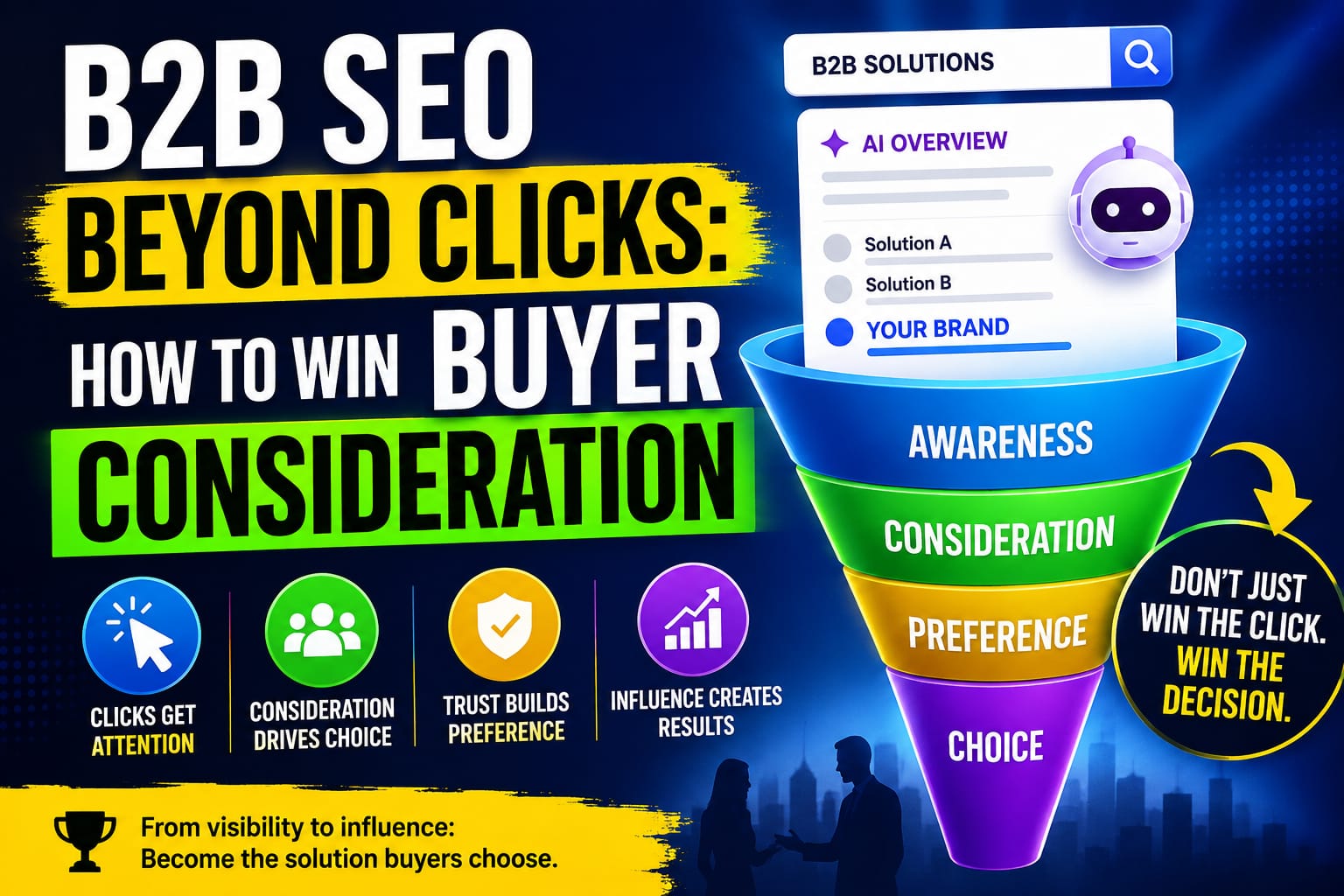
B2B SEO has traditionally been built around a simple formula: rank for valuable keywords, attract organic clicks, and turn those visitors into leads.
That model is becoming incomplete.
Search is increasingly answering questions before a potential customer reaches a website. Google’s AI Overviews and other AI-powered search experiences can summarize information, compare solutions and help buyers form an initial shortlist directly on the search results page. As a result, a company can achieve strong rankings and visibility while still failing to influence the buyer’s final decision. (Search Engine Land)
This creates a new challenge for B2B marketers: winning the click is not necessarily the same as winning consideration.

The New B2B Search Journey
B2B purchases are rarely spontaneous. A buyer may spend weeks or months researching vendors, comparing capabilities, checking reviews, evaluating integrations and looking for evidence that a product will work in their particular environment.
Previously, much of that research happened after the searcher clicked through to websites.
Now, more of that evaluation can happen before the click.
An AI-powered search experience can answer questions such as:
- Which platforms are best for a particular business size?
- What are the main differences between competing solutions?
- Which product is strongest for a specific use case?
- What features should buyers prioritize?
- Which vendors appear to have the strongest reputation?
That means search visibility is moving further up the decision-making process. A brand can influence a buyer without receiving a website visit at all. (Search Engine Land)
Ranking Is No Longer the Entire Goal
Traditional SEO reporting often focuses on metrics such as:
- Keyword rankings
- Organic impressions
- Click-through rate
- Organic sessions
- Landing-page conversions
- Backlinks
These metrics remain useful, but they don’t tell the complete story.
Imagine two software companies competing for the same market.
Company A ranks first for a valuable commercial query. It receives thousands of impressions and hundreds of clicks.
Company B appears repeatedly in AI-generated answers, industry comparisons, reviews and third-party discussions. Its website receives fewer clicks, but buyers increasingly recognize its name when they enter the sales process.
Which company has actually won?
The answer isn’t necessarily Company A.
The second company may have built stronger consideration, even without capturing the most traffic.
This is the fundamental shift B2B marketers need to understand.
Clicks and Consideration Are Different Outcomes
A click proves that a user was interested enough to visit your website.
It does not prove that the user considered your company seriously.
Consideration requires something deeper:
- The buyer understands what your company does.
- Your product is associated with the right category.
- Your strengths are clear.
- Your weaknesses are understood honestly.
- Your brand appears credible.
- Your solution fits the buyer’s use case.
- Your company remains on the shortlist when alternatives are compared.
AI-powered search can influence several of these decisions before a user ever reaches your website.
That is why the traditional SEO funnel is becoming less linear.
Old journey:
Search → Result → Click → Website → Research → Comparison → Conversion
Emerging journey:
Search → AI answer → Brand discovery → Comparison → Shortlist → Website verification → Conversion
The website is still important, but it may arrive later in the process.
The “Best Software” Problem
One of the most important examples involves B2B searches such as:
“Best CRM software for small businesses”
or:
“Best project management software for enterprise teams.”
A company might publish a page titled “The Best Project Management Software,” place its own product at the top and include several competitors underneath.
In conventional SEO, this can look like a smart strategy.
The page targets a high-value commercial keyword. It provides useful information. It creates opportunities for internal links. It can attract backlinks and rankings.
But AI search changes the equation.
An AI system can extract the competitors, features, pricing information and evaluation criteria from the article. It may then use those signals to construct its own shortlist.
The result can be uncomfortable: your content may help educate the buyer about the market without guaranteeing that your company becomes the recommended choice.
Search Engine Land’s August 13, 2026 report highlights this broader gap between being used as a source and actually influencing which brands buyers consider. (Search Engine Land)
Being Cited Is Not the Same as Being Recommended
This distinction is becoming increasingly important.
A brand can appear as a source supporting an AI-generated answer without becoming one of the solutions recommended to the user.
Think about it this way:
Citation = “This source contains useful information.”
Recommendation = “This is a company worth considering.”
The second outcome is much closer to commercial value.
For B2B companies, the goal should therefore move beyond asking:
“Did AI cite our website?”
The better questions are:
- Was our brand mentioned?
- Was it recommended?
- How was it described?
- Was the description accurate?
- Were our key differentiators included?
- Which competitors appeared alongside us?
- Were we presented as a leader, specialist or alternative?
- What evidence supported the recommendation?
These questions reveal whether SEO is influencing consideration rather than simply generating visibility.
Why Third-Party Reputation Matters More
A company can say almost anything about itself.
That doesn’t automatically make the market believe it.
A SaaS company can describe itself as the “industry-leading platform.” A cybersecurity provider can claim to offer the “most secure solution.” An analytics company can call itself the “best enterprise platform.”
AI systems and buyers increasingly have access to information beyond the company’s own website.
That includes:
- Independent reviews
- Industry publications
- Customer discussions
- Forums
- Videos
- Comparison websites
- Analyst commentary
- Case studies
- Social conversations
- Third-party articles
Search Engine Land’s reporting on the issue points to the importance of broader corroboration around brands and categories when AI systems decide what to surface. (Search Engine Land)
This means B2B SEO is becoming less about controlling the narrative on your own domain and more about building a consistent reputation across the wider web.
Your Website Should Provide Evidence, Not Just Claims
A modern B2B SEO strategy needs to make important claims easy to verify.
Instead of simply saying:
“Our platform saves businesses time.”
Show:
- How much time was saved.
- For which customers.
- Under what conditions.
- How the result was measured.
- What the implementation involved.
Instead of:
“Our platform integrates with leading tools.”
Explain:
- Which integrations are available.
- Whether they are native or third-party.
- What data can be exchanged.
- What limitations exist.
- When each integration was last updated.
Specific information creates stronger evidence than generic marketing language.
Build Content Around Buyer Decisions
Many B2B websites are organized around keywords rather than decisions.
For example, a company may publish separate articles targeting:
- CRM software
- CRM benefits
- CRM features
- CRM implementation
- CRM pricing
That can create substantial search coverage.
But a buyer may actually be asking:
“Is this CRM suitable for a 200-person company with a distributed sales team and an existing ERP system?”
That is a decision question, not simply a keyword.
Your content should therefore answer questions around:
Fit
Who is the product actually designed for?
Use cases
What problems does it solve particularly well?
Limitations
When might another solution be better?
Cost
How does the pricing model work?
Implementation
How difficult is deployment?
Integrations
How does the product fit into an existing technology stack?
Proof
What evidence demonstrates that the solution works?
This makes content more useful to both human buyers and AI systems attempting to understand product-market fit.
Comparison Content Needs a New Approach
Comparison pages remain valuable, but they should not simply be promotional pages disguised as neutral research.
A strong comparison should explain:
- Where each product performs well.
- Which businesses each product suits.
- Major differences in functionality.
- Pricing considerations.
- Implementation requirements.
- Integration options.
- Potential limitations.
- Appropriate use cases.
This creates a decision resource instead of a sales brochure.
Transparency can actually strengthen credibility.
If your product is genuinely stronger for a particular segment, explain why.
If a competitor has an advantage in another area, acknowledge it.
That gives buyers a clearer understanding of where your solution belongs in the market.
Create Content That Can Survive the Zero-Click Environment
If searchers increasingly receive answers without clicking, your content has to communicate value even when the website visit never happens.
That means important information should not be hidden deep inside a page.
Use:
- Clear definitions
- Direct answers
- Concise summaries
- Specific statistics
- Original research
- Expert commentary
- Transparent methodology
- Product specifications
- Customer evidence
- Clearly explained comparisons
The objective is not to write specifically for machines.
The objective is to make your expertise so clear and structured that both humans and search systems can understand it.
Build a Stronger Brand Entity
B2B SEO increasingly overlaps with brand building.
Search engines need to understand:
Who are you?
What category do you belong to?
Who is your product for?
What are you known for?
Why should buyers trust you?
If your website describes your company as an enterprise analytics platform while third-party sources describe it primarily as a small-business reporting tool, the overall picture becomes less consistent.
Consistency matters.
Your website, profiles, industry publications, customer stories and other external references should reinforce a clear understanding of your company.
Measure Consideration, Not Just Traffic
The biggest change may need to happen inside SEO reporting.
Instead of reporting only:
“Organic traffic increased 18%.”
Teams should also ask:
“Did our visibility increase among the buyers who matter?”
Useful metrics can include:
1. AI visibility
Track how frequently your brand appears in relevant AI-generated answers.
2. Recommendation presence
Measure whether your company is merely mentioned or actually recommended.
3. Brand search growth
An increase in branded searches can indicate that earlier discovery is creating later demand.
4. Direct traffic
Some buyers may discover a company through search or AI and later return directly.
5. Assisted conversions
The first search interaction may not receive conventional conversion credit even though it influenced the eventual purchase.
6. Sales feedback
Ask new prospects how they first encountered your company and which alternatives they considered.
This qualitative information can reveal consideration patterns that analytics platforms miss.
Treat Prompts Like Keywords
Traditional SEO teams build keyword lists.
The next evolution is to build buyer prompt lists.
For example:
- “Best ERP for manufacturing companies”
- “ERP alternatives for mid-sized manufacturers”
- “ERP with strong inventory management”
- “ERP for companies with multiple warehouses”
- “Compare ERP A and ERP B”
- “What should a manufacturer look for in ERP software?”
Then periodically test how AI search experiences describe your brand.
Record:
- Which brands appear.
- How your brand is described.
- Which strengths are mentioned.
- Which weaknesses are mentioned.
- Which competitors are recommended.
- Which sources are cited.
This turns AI visibility into something that can be monitored rather than treated as a vague concept.
From Content Volume to Content Quality
The answer is not necessarily to publish more articles.
In fact, producing hundreds of generic pages may create little additional competitive advantage.
A better strategy is to build fewer, stronger assets containing information that competitors cannot easily reproduce.
Examples include:
- Original research
- Proprietary datasets
- Customer benchmarks
- Detailed case studies
- Expert interviews
- Product comparisons
- Implementation guides
- Industry-specific frameworks
- Technical documentation
- Transparent pricing information
These assets provide stronger evidence than another generic article explaining the same basic topic.
The Role of Technical SEO Still Matters
This shift does not mean technical SEO is obsolete.
A company still needs:
- Crawlable pages
- Strong site architecture
- Fast performance
- Proper indexing
- Clear internal linking
- Structured information
- Mobile-friendly experiences
- Accurate metadata
- Accessible content
Technical SEO creates the foundation.
But technical excellence alone does not guarantee consideration.
A perfectly crawlable website with weak positioning and little external credibility can still lose the buyer.
What B2B SEO Teams Should Do Now
A practical strategy can be divided into five stages.
Stage 1: Identify Your Commercial Prompts
Go beyond conventional keywords and list the questions buyers ask when researching, comparing and selecting solutions.
Stage 2: Audit Your Existing Content
Look for pages that:
- Make unsupported claims.
- Depend heavily on generic information.
- Promote your product without explaining fit.
- List competitors without meaningful methodology.
- Hide important product information.
- Lack customer evidence.
Stage 3: Strengthen Proof
Add data, customer stories, technical documentation, benchmarks and independent evidence wherever possible.
Stage 4: Improve Third-Party Visibility
Develop relationships with legitimate industry publications, communities, analysts, customers and other relevant sources that can independently describe your company.
The goal is not to manufacture mentions. It is to build genuine market recognition.
Stage 5: Measure the Decision Layer
Monitor rankings and traffic, but add AI visibility, brand mentions, recommendations, branded demand and pipeline influence to the reporting framework.
The Future of B2B SEO Is About Influence
SEO isn’t disappearing.
Its job is changing.
The old objective was often:
Get the searcher onto the website.
The emerging objective is broader:
Make your company one of the solutions the buyer remembers, trusts and considers.
That can happen before the click.
A search result may introduce the brand. An AI answer may explain its strengths. A review may establish credibility. A comparison may validate the fit. A customer case study may provide the final proof.
By the time the prospect reaches the website, much of the consideration process may already be underway.
That is why B2B marketers should stop treating the click as the finish line.
It may only be the moment when the buyer starts verifying a decision they have already begun forming.
Final Takeaway
The biggest lesson from the changing B2B search landscape is simple:
Visibility is not the same as influence.
A high ranking can generate traffic, but traffic alone doesn’t guarantee that your company will make the shortlist.
Modern B2B SEO needs to compete on three levels:
Visibility → Consideration → Revenue
The first gets your brand discovered.
The second gets it evaluated.
The third proves that the strategy actually influenced business results.
As AI-powered search continues to compress research and comparison into the search experience itself, the companies that succeed will be those that provide more than optimized pages. They will build recognizable brands, credible evidence, useful comparisons and a consistent reputation across the entire information ecosystem.
In other words, don’t optimize only to win the click. Optimize to become the choice.