
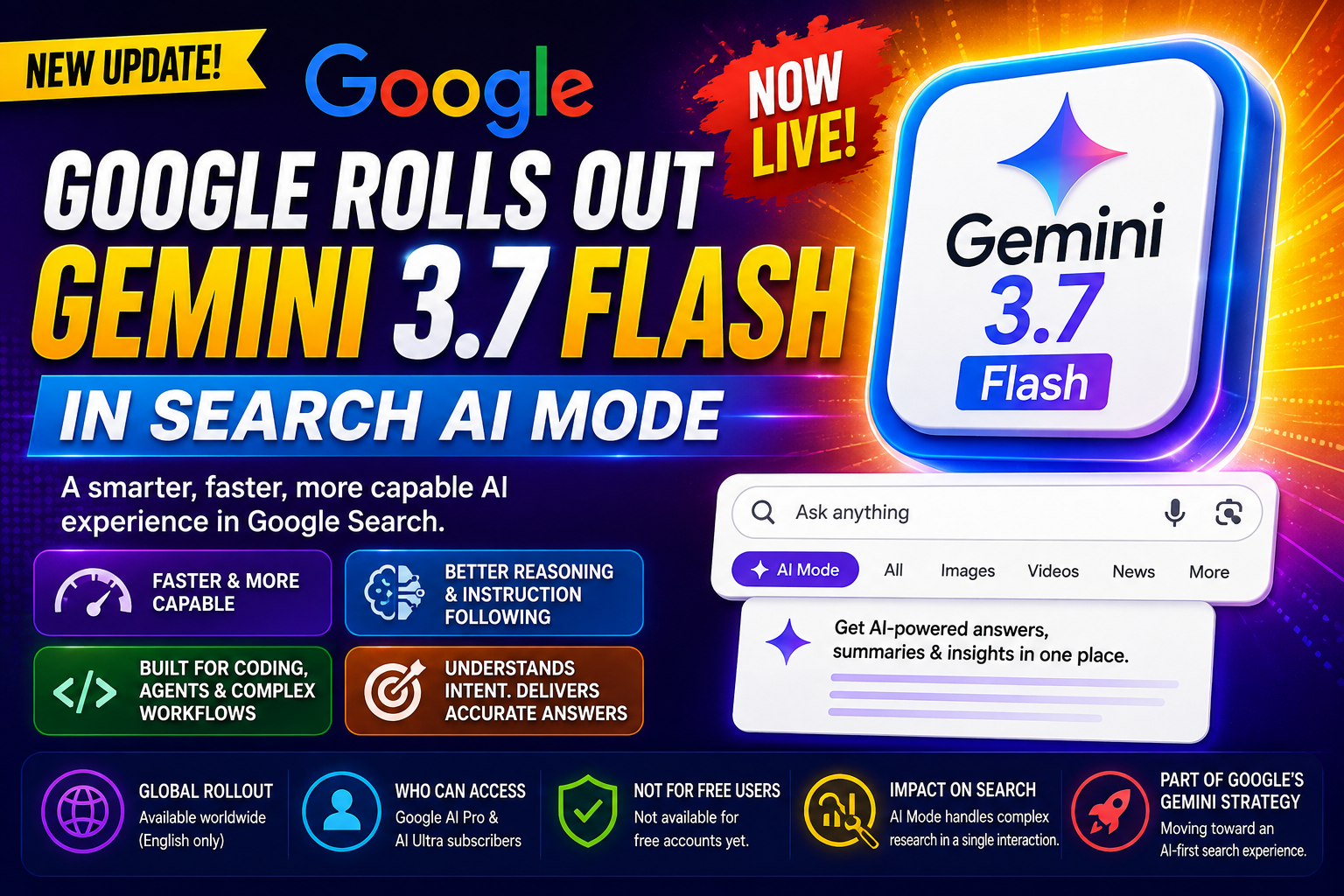
Google is bringing its latest Gemini 3.7 Flash model into Google Search’s AI Mode, giving eligible users another AI model option for handling complex questions and research tasks. The update arrives just one day after Google introduced Gemini 3.7 Flash as its newest “workhorse” model for coding, AI agents and knowledge-intensive workflows. (Search Engine Journal) (Gemini 3.7 Flash in Search AI Mode)
The move highlights Google’s continued effort to make Search more conversational and capable of handling requests that go beyond traditional keyword-based queries.
What Is Gemini 3.7 Flash?
Gemini 3.7 Flash is the newest addition to Google’s Flash family of AI models. Google designed the model to combine strong reasoning and instruction-following capabilities with the speed expected from a Flash model.
The model is particularly focused on software development, web development, agentic workflows and other tasks that require multiple steps. Google also says it has improved the model’s ability to understand instructions and produce accurate results on the first attempt. (VentureBeat)
Unlike a model designed only for simple question answering, Gemini 3.7 Flash is intended to work through more complicated tasks where planning, tool use and contextual understanding are important.
Gemini 3.7 Flash Comes to Search AI Mode
Google has now added Gemini 3.7 Flash as a selectable model inside AI Mode in Search.
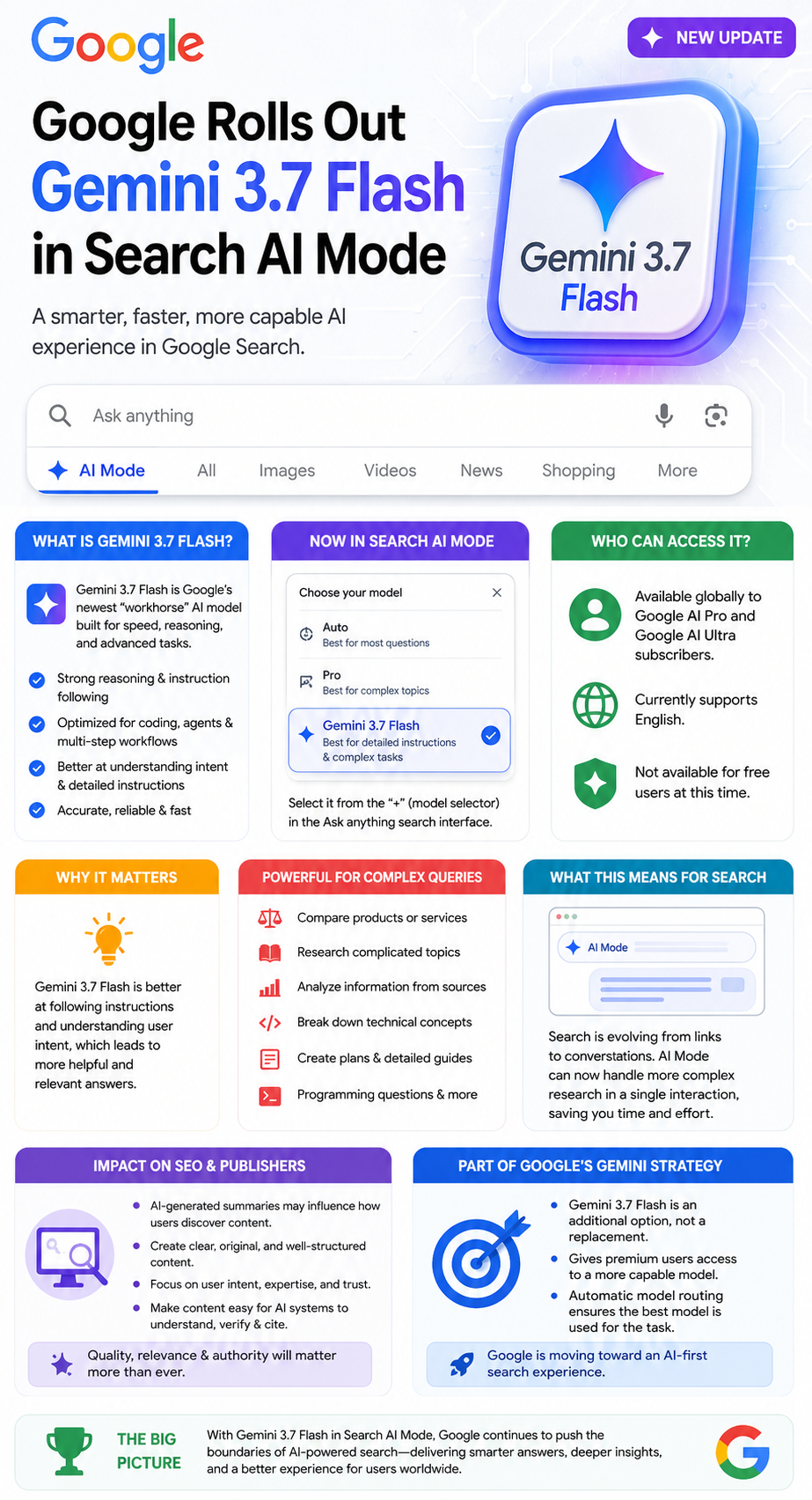
Users who have access can open the model selector from the “Ask anything” search interface by selecting the + icon. Gemini 3.7 Flash appears alongside other Gemini model choices, including Auto and Pro. (Search Engine Journal)
This means Search users are no longer limited to a single AI experience when using AI Mode. Instead, eligible subscribers can choose a model that Google positions as particularly capable at following detailed instructions and understanding user intent.
Who Can Access It?
The initial rollout is relatively limited.
Google says Gemini 3.7 Flash in Search AI Mode is available globally to Google AI Pro and Google AI Ultra subscribers, with the current rollout supporting English. (Search Engine Journal)
That makes this primarily a premium Search feature for now. Free users should not expect to see Gemini 3.7 Flash as an available AI Mode model at this stage.
Google has also not indicated that Gemini 3.7 Flash has replaced the default AI Mode model. Instead, it is currently presented as an additional option that eligible users can select when they want to use it.
Why Better Instruction Following Matters
One of the most important improvements Google is highlighting is instruction following.
Search questions are becoming increasingly detailed. Instead of searching for a few keywords, users may ask AI Mode to compare products, analyze information, summarize several sources, create a plan or answer a complicated question with specific requirements.
A model that better understands the exact instructions can potentially produce more relevant responses without requiring users to repeatedly clarify what they want.
Google Search VP of Product Robby Stein said Gemini 3.7 Flash is better at following instructions and understanding user intent, which Google believes can lead to more helpful answers. (Search Engine Journal)
What This Could Mean for Search
The Gemini 3.7 Flash rollout is another indication that Google is transforming Search from a simple link-discovery tool into a more interactive research environment.
Traditional Google Search generally requires users to enter a query, scan results and open multiple pages. AI Mode takes a different approach by allowing users to ask longer questions and continue the conversation.
With increasingly capable Gemini models behind that experience, Google can potentially handle more complicated searches in a single interaction.
For example, instead of searching separately for information about several options, a user could ask AI Mode to compare them according to a specific set of requirements. The AI system can then attempt to organize the information into a more useful response.
A Stronger Model for Complex Queries
Gemini 3.7 Flash could be particularly useful for queries that require several stages of reasoning.
Potential use cases include:
- Comparing multiple products or services
- Researching complicated topics
- Breaking down technical concepts
- Analyzing information from different sources
- Creating detailed plans
- Working through programming questions
- Understanding lengthy or complicated instructions
- Asking follow-up questions without starting a new search
The model’s broader focus on coding and agentic workflows also suggests that Google is optimizing its AI systems for tasks that involve more than generating a simple response. (Reuters)
How It Fits Into Google’s Gemini Strategy
Google’s rollout follows a broader pattern in which newer Gemini Flash models are increasingly integrated directly into Search.
Gemini 3 Flash previously became the default model for AI Mode, while Google later moved to Gemini 3.5 Flash as the global default. The addition of Gemini 3.7 Flash as another selectable model gives subscribers access to a newer model without necessarily changing the underlying default experience for everyone. (Search Engine Journal)
This approach gives Google flexibility. It can continue optimizing the default model for speed and broad availability while allowing premium users to select a more advanced model for demanding tasks.
What It Means for SEO and Publishers
The development is also important for website owners and SEO professionals.
As AI Mode becomes more capable, users may rely more heavily on AI-generated summaries and comparisons before deciding which websites to visit. That could change how search visibility works.
Traditional rankings remain important, but publishers may increasingly need to make their content easy for AI systems to understand, verify and cite.
Clear organization, original information, strong topical coverage and trustworthy sources could become even more important as AI-powered search systems perform more complex research on behalf of users.
For SEO professionals, the rise of increasingly capable AI models means optimizing only for individual keywords may be less effective than building comprehensive content around user intent and real information needs.
Is Gemini 3.7 Flash the New Default in AI Mode?
Not according to the information currently available.
Google has added Gemini 3.7 Flash as a selectable model, but it has not announced that the model has replaced the default AI Mode model. The company also has an automatic model-routing approach in its AI Mode strategy, making it possible for different models to be used depending on the task. (Search Engine Journal)
That distinction is important. The current update should be viewed as an expansion of model choice rather than a complete replacement of the AI system powering Search.
Why Google Is Making This Move
The rollout comes as competition among AI-powered search and assistant products continues to intensify.
Google has a major advantage because its AI technology can be integrated directly into Search, where users already go for information every day. By bringing newer Gemini models into Search quickly, Google can make advanced AI capabilities available without requiring users to move to a separate chatbot.
Gemini 3.7 Flash also strengthens Google’s push toward AI systems that can understand intent, reason through tasks and eventually take actions rather than simply provide text responses.
What Users Should Expect Next
For now, Gemini 3.7 Flash in Search AI Mode is best understood as a premium model option rather than a universal Search upgrade.
Google is likely to continue experimenting with how different Gemini models are used inside AI Mode. Future changes could include wider availability, additional languages, improved automatic model selection or deeper integration with other Search capabilities.
The bigger trend is clear: Google is steadily moving Search toward an AI-first experience in which users can ask increasingly complicated questions and expect the system to do more of the research and reasoning.
Final Thoughts
Google’s Gemini 3.7 Flash rollout adds another layer to the rapidly evolving AI Mode experience.
The model brings stronger instruction following and improved intent understanding to eligible Search users, while its broader capabilities in coding, agentic workflows and complex knowledge tasks make it a natural candidate for more demanding searches. (Search Engine Journal)
For Google, the update is more than another model release. It represents another step toward turning Search into an intelligent research assistant rather than simply a directory of web pages.
For users, the immediate benefit is greater model choice. For publishers and SEO professionals, however, the change could be much more significant: as AI becomes better at interpreting questions and synthesizing information, the way people discover and interact with websites is likely to continue changing.