
Google Ads is moving toward an increasingly agentic advertising model in which AI does more than generate suggestions—it can analyze campaigns, identify problems, recommend actions, and increasingly help execute tasks under advertiser guidance. Google has already introduced agentic capabilities such as Ads Advisor, while its broader advertising strategy is expanding AI-powered campaign automation and advertising experiences across Search, Shopping, and other surfaces. (blog.google)
The important question for advertisers is no longer whether AI will influence Google Ads. It is how quickly advertisers should adapt their workflows to an AI-agent-driven environment.
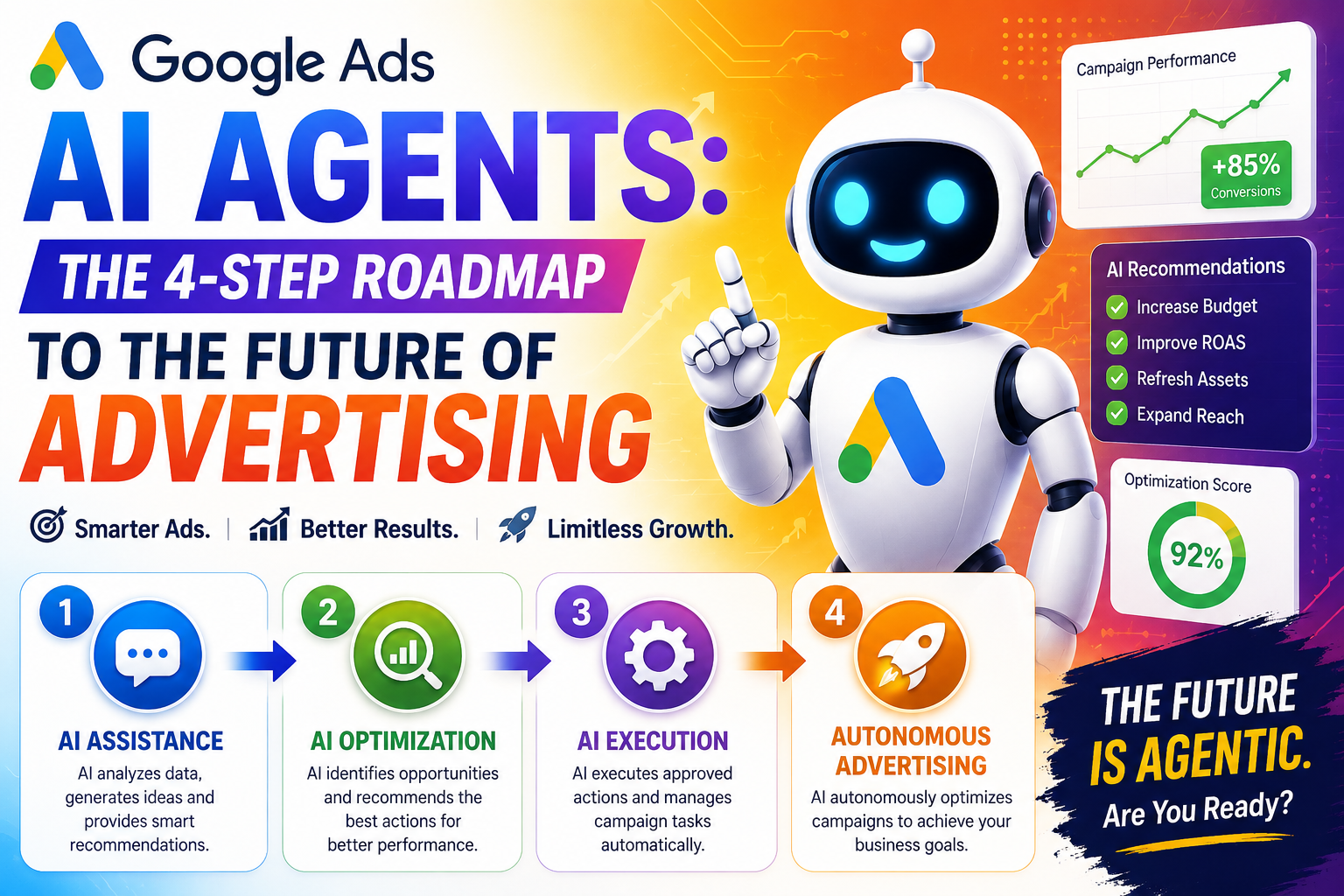
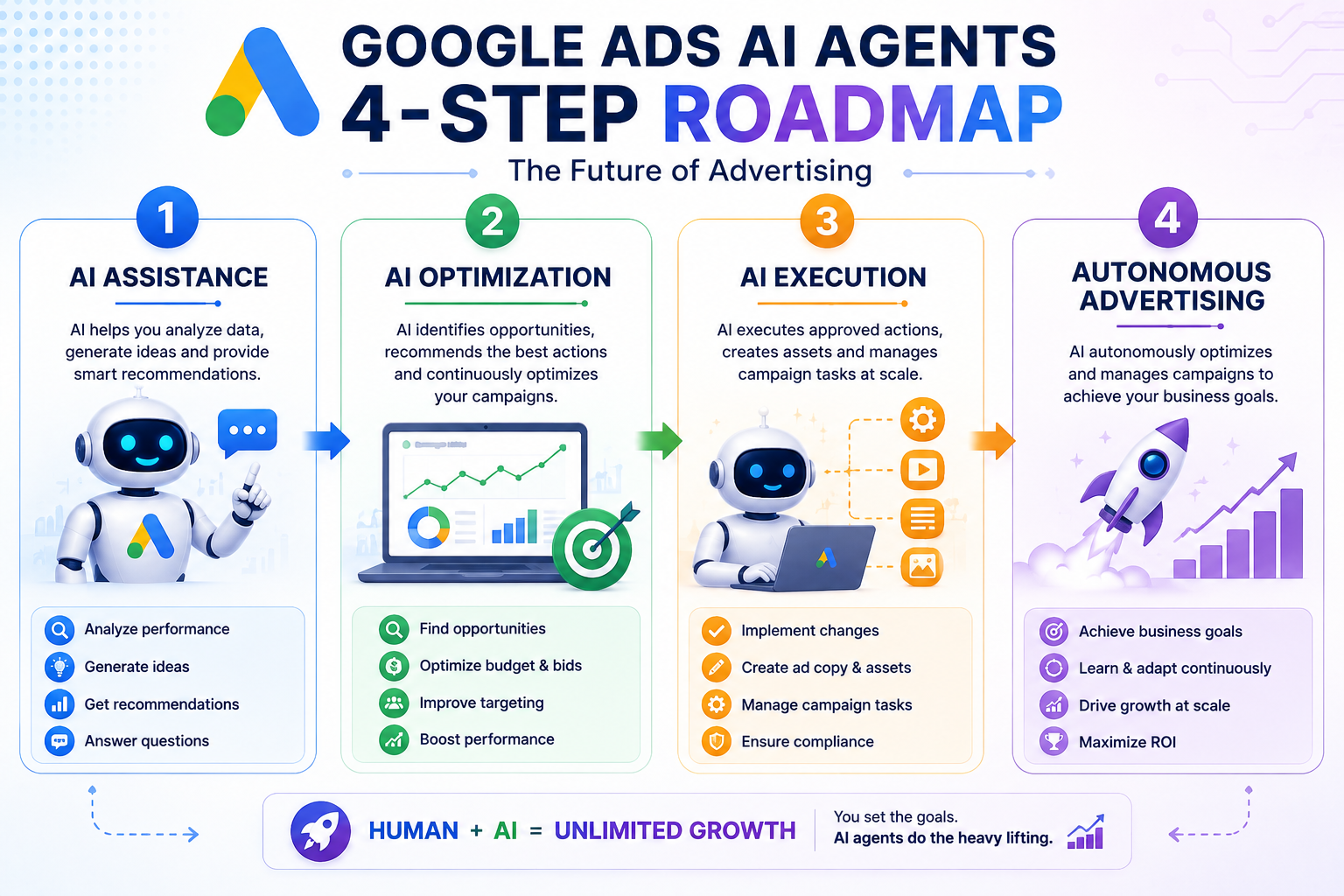
A useful way to understand this transition is through a four-step roadmap:
AI Assistance → AI Optimization → AI Execution → Autonomous Advertising
What Are Google Ads AI Agents?
Google Ads AI agents are AI-powered systems designed to help advertisers perform tasks that previously required manual campaign management.
Traditional advertising software generally waits for an advertiser to make a decision. An AI agent can instead analyze information, reason about possible actions, recommend a solution, and—where supported and authorized—take action.
For example, an agent could potentially help answer questions such as:
- Why did conversions decline this week?
- Which campaigns are wasting budget?
- Which search themes are generating valuable customers?
- Should campaign assets be refreshed?
- Are there policy problems affecting delivery?
- Which opportunities deserve additional budget?
- What changes could improve conversion value?
Google’s Ads Advisor already represents an important step in this direction. Google describes it as an AI partner inside Google Ads that can help advertisers with campaign management, insights, creative ideas, and optimization. (blog.google)
Google has also expanded agentic safety capabilities, including real-time policy guidance, troubleshooting of complex policy violations, and account-security recommendations. (blog.google)
The 4-Step Roadmap
Step 1: AI Assistance
The first stage is AI-assisted advertising.
Here, the advertiser remains firmly in control while AI helps with research, analysis, recommendations, and content creation.
What AI can help with
Advertisers can use AI to:
- Generate campaign ideas
- Suggest keywords and search themes
- Analyze campaign performance
- Create ad copy variations
- Identify optimization opportunities
- Explain performance changes
- Recommend audience strategies
- Troubleshoot potential issues
This stage is relatively low risk because humans continue making the final decisions.
Example
Imagine an ecommerce advertiser notices that conversion rates have fallen.
Instead of manually examining dozens of reports, the advertiser could ask an AI assistant:
“Why did conversion value decline during the last seven days?”
The AI could examine campaign performance, identify changes in traffic or conversion behavior, and present possible explanations.
The advertiser then decides what to do.
Why this stage matters
AI assistance reduces the amount of time marketers spend searching through dashboards and reports.
The marketer’s role changes from collecting information to interpreting recommendations.
Step 2: AI Optimization
The second stage moves from suggestions toward continuous optimization.
Instead of simply answering questions, AI begins identifying opportunities and recommending changes based on campaign objectives.
This fits into Google’s broader movement toward AI-driven campaign systems. Google is increasingly automating targeting, bidding, creative optimization, and campaign management through products such as Performance Max and AI Max for Search campaigns. (Search Engine Land)
What changes?
At this stage, AI can potentially monitor:
- Conversion performance
- Cost per acquisition
- Conversion value
- Search behavior
- Creative performance
- Budget allocation
- Audience signals
- Landing-page performance
- Campaign health
The agent can then identify patterns that might otherwise take hours for a PPC specialist to discover.
Example
An AI system might identify:
Campaign A
- High conversion value
- Strong return
- Limited budget
Campaign B
- High spending
- Declining conversion value
- Weak return
Instead of simply reporting the information, an AI optimization system could recommend reallocating budget from Campaign B toward Campaign A.
The human still reviews the recommendation before implementation.
AI Max and the Shift Toward Automated Search
The evolution toward AI agents is closely connected to Google’s broader transformation of Search advertising.
Google is moving eligible Search campaigns toward AI Max, with automatic migration beginning in September 2026 for certain legacy Search campaign features. (Search Engine Land)
AI Max expands automation around areas such as search-term matching and text customization.
This illustrates an important change:
Advertisers are moving away from controlling every individual targeting decision and toward defining business objectives, supplying quality inputs, and allowing Google’s systems to optimize delivery.
That means advertisers need to become better at providing:
- Accurate conversion data
- Strong first-party signals
- High-quality creative assets
- Clear business goals
- Reliable product feeds
- Useful audience information
In an AI-driven environment, input quality becomes increasingly important.
Step 3: AI Execution
The third stage is where AI agents begin moving beyond recommendations and into execution.
Instead of saying:
“Your campaign needs new creative.”
An agent could potentially progress toward:
“I found three underperforming assets, generated replacements, checked them against campaign requirements, and prepared the changes for approval.”
This is a major shift.
The advertiser is no longer performing every individual task.
Instead, the advertiser defines:
Goal → Rules → Budget → Constraints → Approval
while the agent handles more of the operational work.
What AI Execution Could Look Like
A mature advertising agent could eventually coordinate multiple activities:
Research
Analyze market and campaign data.
↓
Strategy
Identify opportunities and recommend an approach.
↓
Creation
Generate advertisements, assets, audiences, or campaign structures.
↓
Validation
Check policies, tracking, budgets, and campaign requirements.
↓
Execution
Apply approved changes.
↓
Measurement
Monitor results.
↓
Learning
Use performance data to improve future decisions.
This creates a continuous optimization loop.
Google’s Agentic Direction
Google has already signaled this direction.
In 2025, Google announced broader agentic capabilities for marketers, describing systems that could assist with activities ranging from onboarding and campaign creation to reporting and troubleshooting across Google Ads and Google Analytics. (blog.google)
Google has continued expanding the concept in 2026.
For example, Ads Advisor has gained agentic safety capabilities designed to help identify and address policy issues, monitor account security, and simplify certification workflows. (blog.google)
These developments suggest that the future Google Ads interface may become less like a collection of dashboards and more like an AI marketing operating system.
Step 4: Autonomous Advertising
The fourth stage is the long-term vision:
Autonomous or Semi-Autonomous Advertising
At this stage, an advertiser could give an AI system a business objective rather than manually specifying every campaign decision.
For example:
“Generate $100,000 in incremental monthly revenue while maintaining a target return on ad spend of 500%.”
The system could then coordinate multiple activities around that objective.
It might:
- Analyze historical performance.
- Identify valuable customer segments.
- Discover relevant search demand.
- Allocate budgets.
- Generate creative variations.
- Adjust bidding.
- Test landing-page experiences.
- Monitor conversion quality.
- Detect problems.
- Reallocate resources based on results.
The human would establish the business objective and boundaries.
The AI would increasingly handle the operational details.
The Future PPC Manager’s Role
AI agents will not necessarily eliminate PPC professionals.
Instead, the role is likely to change.
Traditional PPC workflow
Research → Build → Launch → Monitor → Optimize → Report
Agentic PPC workflow
Define Objective → Set Constraints → Supervise Agents → Evaluate Outcomes → Improve Strategy
This means marketers will need fewer skills related to repetitive campaign maintenance and more skills related to:
- Business strategy
- Data quality
- Measurement
- Experimentation
- Customer economics
- Creative strategy
- AI supervision
- Risk management
- Attribution
- Incrementality
The most valuable advertiser may increasingly be the person who knows what the AI should optimize for rather than the person who manually changes the most settings.
Why Data Will Become More Important
Automation does not eliminate the need for good data.
It makes good data even more important.
An AI agent can make decisions only as effectively as the signals available to it.
Important foundations include:
Conversion tracking
Make sure meaningful business outcomes are measured correctly.
First-party data
Use reliable customer and business signals where appropriate.
Product information
For ecommerce, maintain accurate product feeds, prices, availability, categories, and attributes.
Customer-value information
Not every conversion is equally valuable.
A lead worth $10,000 should not necessarily be treated like a lead worth $50.
Clean analytics
AI systems need trustworthy measurement to determine whether their actions are working.
AI Search Is Changing the Advertising Environment
The rise of AI agents is happening alongside the transformation of Google Search itself.
Google is expanding AI Mode and testing new advertising experiences designed for more conversational and complex search journeys. In May 2026, Google announced new AI-powered ad formats in Search built with Gemini and continued expanding Direct Offers for shoppers. (blog.google)
This creates a new advertising environment.
Previously, advertisers often optimized around:
Keyword → Ad → Landing Page
The emerging model is closer to:
Intent → AI Understanding → Multiple Search/Commerce Experiences → Recommendation → Action
That makes understanding user intent and business context more important than simply maximizing keyword coverage.
What Advertisers Should Do Now
Advertisers do not need to wait for fully autonomous agents.
The transition can begin today.
1. Improve conversion tracking
Before increasing automation, make sure Google receives accurate conversion signals.
Poor tracking can cause automated systems to optimize toward the wrong outcome.
2. Define business goals clearly
Do not simply tell an AI system:
“Get more conversions.”
Define what a valuable conversion means.
For example:
“Generate qualified B2B leads while maintaining a cost per qualified opportunity below $X.”
Clear objectives give automation a better target.
3. Build strong creative assets
AI can generate many variations, but marketers still need to provide strong:
- Brand messaging
- Product information
- Offers
- Differentiators
- Customer insights
- Visual assets
- Proof points
Automation increases the value of good creative inputs.
4. Prepare for less manual targeting
Google’s continued movement toward automated matching and AI Max means advertisers should become comfortable with systems making more targeting decisions. Google is also removing some manual Search controls, such as campaign-level language targeting, further emphasizing automated matching. (Search Engine Land)
5. Monitor recommendations
More automation does not mean “set it and forget it.”
Advertisers should review:
- Spending
- Conversion quality
- Search behavior
- Creative performance
- Policy issues
- Budget changes
- Customer quality
- Incremental results
AI should be supervised rather than blindly trusted.
A Practical AI Agent Framework for Google Ads
A useful framework for advertisers is:
| Layer | AI Responsibility | Human Responsibility |
|---|---|---|
| Data | Analyze signals | Ensure data quality |
| Strategy | Find opportunities | Define business objectives |
| Creation | Generate assets | Approve brand direction |
| Optimization | Identify improvements | Set constraints |
| Execution | Apply approved actions | Establish permissions |
| Measurement | Report outcomes | Judge business impact |
| Learning | Detect patterns | Decide strategic direction |
This creates a human + AI operating model rather than an AI-only advertising model.
The Biggest Opportunity
The biggest opportunity is not simply saving time.
It is increasing the speed of experimentation.
Imagine a marketing team that can test:
- 20 creative concepts
- Multiple offers
- Different audience signals
- Landing-page variations
- Budget allocations
- Search themes
without requiring a large team to manually configure every experiment.
AI agents could make the advertising organization much more responsive.
Instead of running a few large experiments each quarter, companies could potentially run continuous smaller experiments and allow successful ideas to scale.
The Biggest Risk
The biggest risk is also automation.
If advertisers give AI systems poor goals, inaccurate data, or excessive permissions, automation can scale mistakes just as quickly as it scales successful strategies.
Potential risks include:
- Optimizing for low-quality conversions
- Overspending
- Incorrect attribution
- Weak creative decisions
- Policy problems
- Loss of strategic control
- Overdependence on platform recommendations
This is why human oversight remains important.
The Future: From Campaign Manager to AI Marketing Supervisor
The evolution can be summarized in four stages:
1. AI Assistant
AI answers questions and provides recommendations.
2. AI Optimizer
AI continuously identifies opportunities and suggests improvements.
3. AI Operator
AI performs approved advertising tasks.
4. AI Agent
AI coordinates multiple advertising activities around business objectives.
The transition is already underway, although the fully autonomous fourth stage remains a longer-term direction rather than a universally available Google Ads capability today.
Final Takeaway
Google Ads is moving from manual campaign management toward increasingly agentic advertising.
Google’s Ads Advisor, AI Max, Performance Max, AI-powered Search experiences, and agentic safety features all point toward a platform where AI handles a growing share of campaign analysis and operational work. (blog.google)
The four-step roadmap is:
AI Assistance → AI Optimization → AI Execution → Autonomous Advertising
For advertisers, the best preparation is not to fight automation. It is to build the foundations that allow automation to work safely and profitably:
Better data + clearer objectives + stronger creative + reliable measurement + human oversight.
The future Google Ads expert may spend less time adjusting individual campaign settings and more time deciding what the advertising system should accomplish, what constraints it must follow, and whether its actions are producing genuine business growth.
That is the real shift from PPC management to AI-powered advertising strategy.