

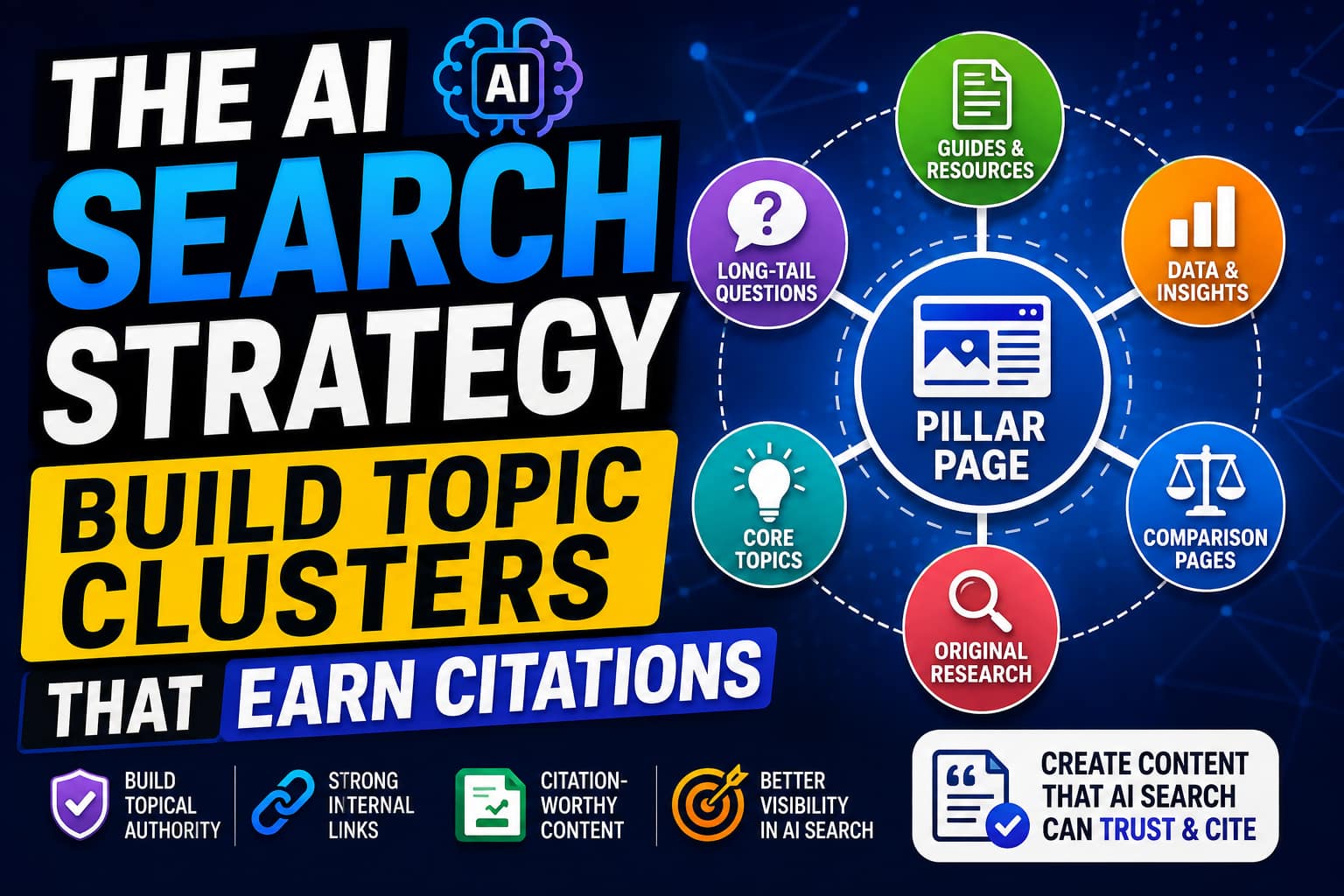
Introduction of AI Search Strategy
Search is changing.
Traditional SEO focused heavily on ranking individual pages for specific keywords. Today, that approach is no longer enough. Search engines and AI-powered discovery systems increasingly evaluate whether a website demonstrates depth, relevance, consistency, and authority across an entire subject.
Google’s AI features, ChatGPT-style search experiences, Microsoft Copilot, Perplexity, and other answer engines can synthesize information from multiple sources before presenting an answer. That creates a new opportunity for publishers: instead of optimizing only for rankings, businesses can build topic ecosystems designed to become useful reference sources.
One of the strongest strategies for this environment is the AI search topic cluster.
A topic cluster connects a central pillar page with supporting articles that answer related questions, explain subtopics, provide examples, compare alternatives, and address practical problems.
The objective isn’t simply to publish more content.
The objective is to create a connected knowledge system that makes it easy for both humans and search systems to understand:
- What your website is about
- Which subjects you specialize in
- How different concepts relate to each other
- Where specific answers can be found
- Why your information deserves to be referenced
In other words:
Don’t build a collection of articles. Build a knowledge network.
What Is an AI Search Topic Cluster?
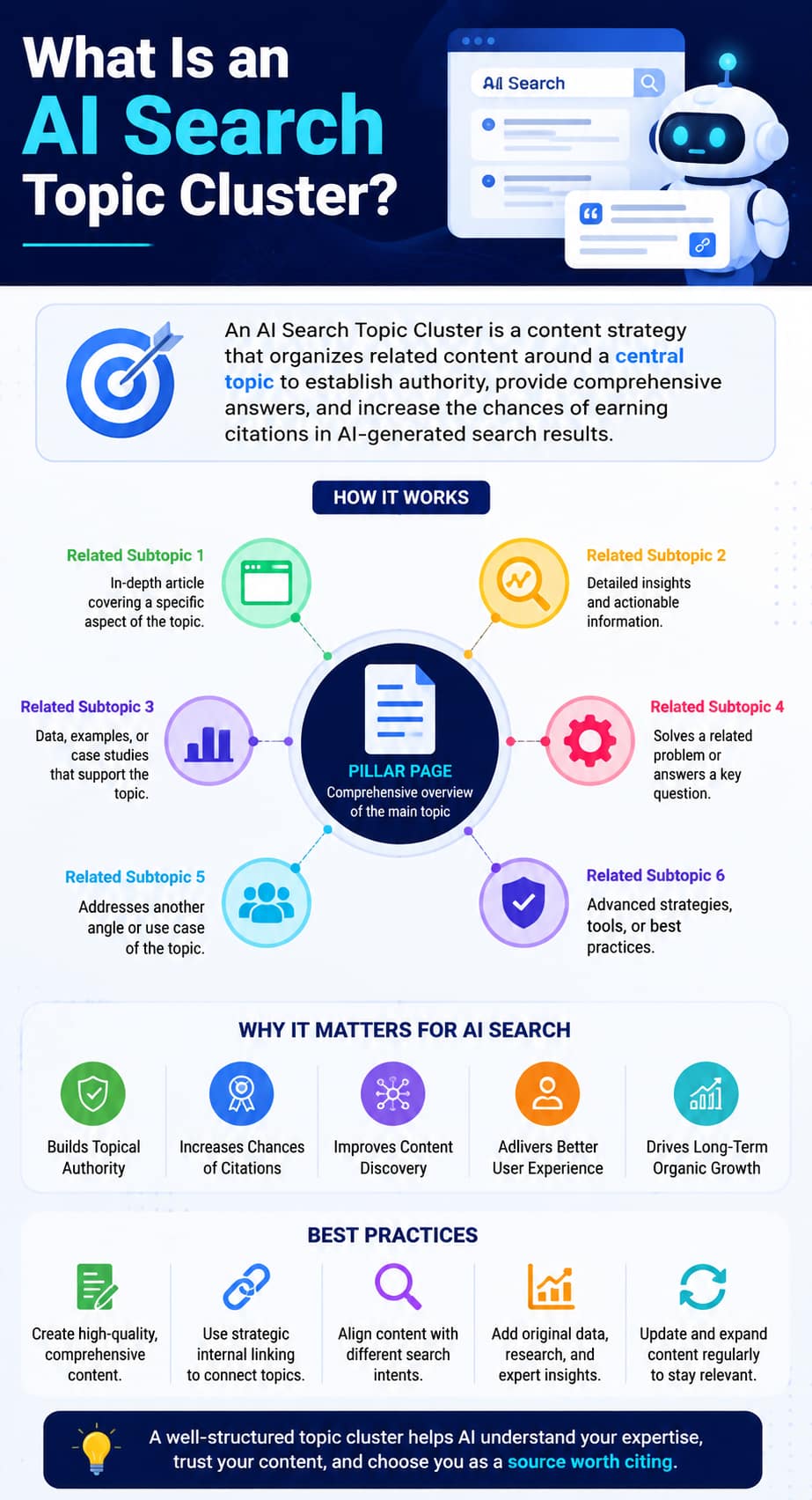
An AI search topic cluster is a group of interconnected pages organized around a broad subject and its related subtopics.
A typical structure looks like this:
Pillar Topic → Core Subtopics → Specific Questions → Examples → Comparisons → Practical Solutions
For example, suppose a website specializes in SEO.
The pillar topic could be:
AI Search Optimization
Supporting topics might include:
- What is AI search optimization?
- How do AI search engines generate answers?
- How does citation-based search work?
- How to optimize content for AI Overviews
- Entity optimization for AI search
- Semantic SEO
- Topical authority
- Structured data
- AI search analytics
- Brand mentions and citations
- Measuring AI visibility
Those supporting pages can then connect to more specific questions.
This creates a structured information architecture rather than a collection of unrelated blog posts.
Why Topic Clusters Matter More in AI Search
Traditional search often evaluates a page against a query.
AI search has a broader challenge: it needs to identify reliable information that can be combined into an answer.
That means a website with only one article about a subject may have less contextual depth than a website containing dozens of logically connected resources.
Consider two websites.
Website A
Publishes:
“What Is AI SEO?”
That’s the only page covering the subject.
Website B
Publishes:
- What Is AI SEO?
- AI SEO vs Traditional SEO
- How AI Search Works
- How to Optimize for AI Citations
- AI Search Content Structure
- Entity SEO for AI Search
- Topic Clusters for AI Search
- Measuring AI Visibility
- AI Search Examples
- AI Search Optimization Checklist
Website B provides a much stronger contextual network.
The important point is not that Website B has more URLs.
It has more meaningful relationships between concepts.
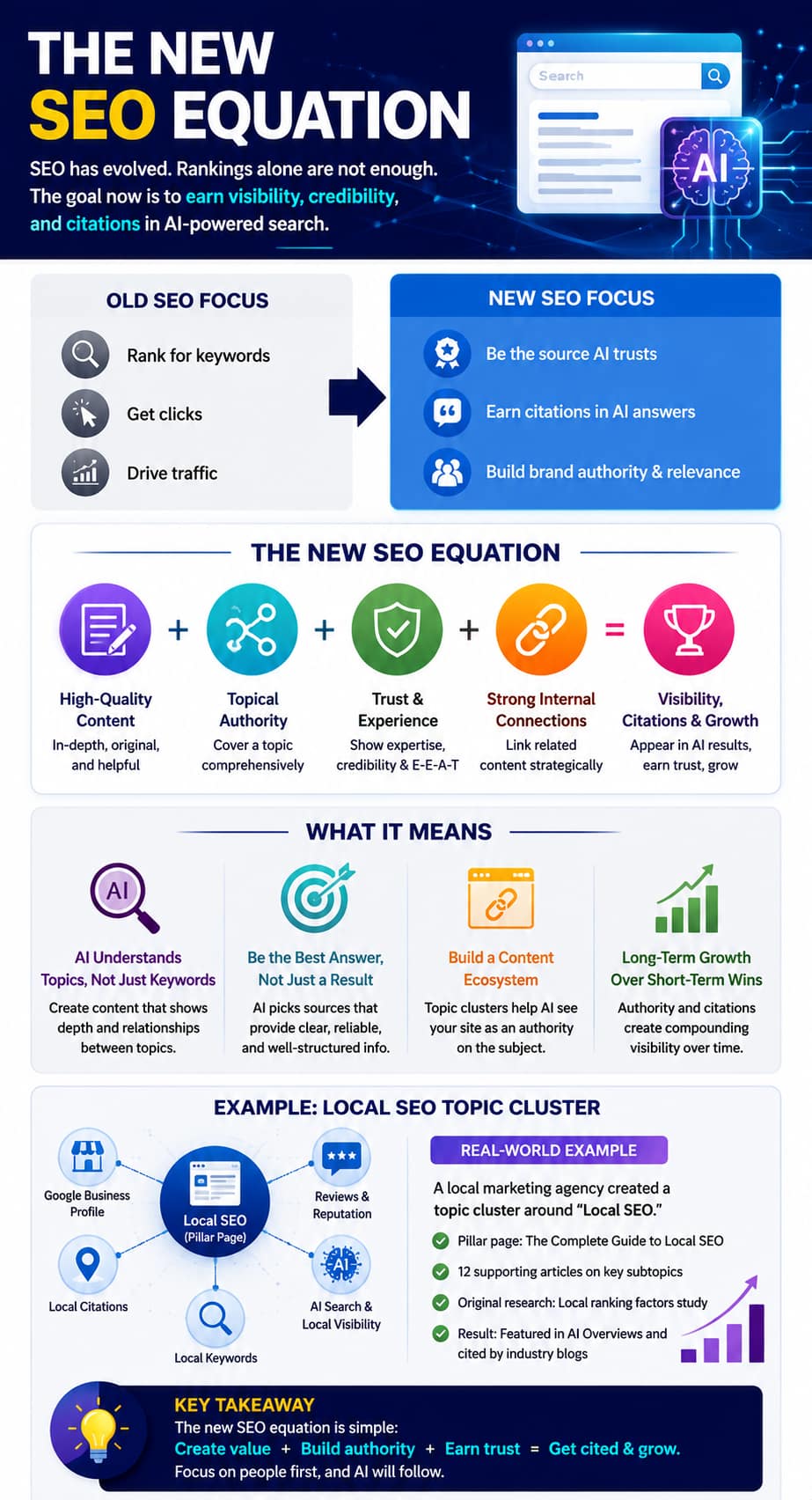
The New SEO Equation
A useful way to think about modern search visibility is:
Search Visibility = Relevance + Authority + Context + Evidence + Accessibility
Traditional SEO often emphasized:
Keyword → Page → Ranking
AI search increasingly rewards:
Topic → Knowledge Network → Evidence → Entity Understanding → Citation Opportunity
This doesn’t mean keywords have disappeared.
Keywords still help search systems understand language and intent.
But keywords alone are no longer a sufficient content strategy.
The Anatomy of a High-Performance Topic Cluster
A strong topic cluster generally contains six layers.
1. Pillar Page
The pillar page provides a comprehensive overview of the subject.
Example:
Complete Guide to AI Search Optimization
It should explain the major concepts while linking to deeper resources.
2. Core Supporting Pages
These pages cover important subtopics.
Examples:
- AI search ranking factors
- AI citations
- Semantic SEO
- Entity optimization
- Content structure
- Structured data
3. Long-Tail Question Pages
These target specific problems.
Examples:
- How do I optimize a page for AI search?
- Why isn’t my brand appearing in AI answers?
- How can I increase citations in AI-generated answers?
4. Evidence Pages
These demonstrate expertise.
Examples:
- Original research
- Experiments
- Case studies
- Surveys
- Benchmarks
- Data analysis
5. Comparison Pages
These capture decision-making intent.
Examples:
- AI Search vs Google Search
- Traditional SEO vs AI SEO
- Perplexity vs Google AI search
- Topic clusters vs single-keyword SEO
6. Practical Resources
These help users take action.
Examples:
- Checklists
- Templates
- Frameworks
- Calculators
- Examples
- Step-by-step guides
Together, these layers create a more complete topical ecosystem.
Example: Building an AI SEO Topic Cluster
Let’s build a hypothetical cluster for a digital marketing website.
Pillar
AI Search Optimization: The Complete Guide
Cluster 1: Fundamentals
- What is AI search?
- How AI search works
- AI search vs traditional search
- What are AI citations?
Cluster 2: Content Strategy
- How to write AI-friendly content
- How to structure content for AI answers
- How to build topical authority
- How to create answer-first content
Cluster 3: Technical SEO
- Structured data for AI search
- Internal linking
- Crawlability
- Indexing
- Canonicalization
Cluster 4: Authority
- Entity SEO
- Author authority
- Brand mentions
- Digital PR
- Original research
Cluster 5: Measurement
- How to measure AI visibility
- AI citation tracking
- Brand mentions in AI answers
- AI referral traffic
- Share of AI search visibility
Now connect the pages with deliberate internal links.
For example:
AI Search Optimization
↓
Topic Clusters
↓
Topical Authority
↓
Semantic SEO
↓
Entity Optimization
↓
AI Citations
↓
AI Visibility Measurement
This creates a semantic pathway through the website.
How Internal Linking Creates a Knowledge Graph
Internal linking is more than an SEO navigation technique.
It helps communicate relationships between concepts.
Imagine the following:
AI Search
connects to:
AI Citations
which connects to:
Source Selection
which connects to:
Content Quality
which connects to:
Original Research
The website is effectively telling search systems:
These concepts belong to the same subject ecosystem.
This is why random internal links are less useful than contextual links.
Instead of:
“Click here to learn more.”
Use descriptive connections such as:
“Our guide to AI citations explains how answer engines can select and reference supporting sources.”
The second version provides much more semantic context.
The Citation-Worthy Content Framework
Creating content isn’t enough.
If you want AI systems to cite your website, create content that provides something worth referencing.
A useful framework is:
Claim + Evidence + Explanation + Example + Source
Claim
State a clear answer.
Evidence
Support it with:
- First-party data
- Research
- Experiments
- Expert commentary
- Public documentation
- Original analysis
Explanation
Explain why the finding matters.
Example
Show how the concept works in the real world.
Source
Where appropriate, identify supporting references.
For example:
Weak content:
AI search is changing SEO.
Stronger content:
AI search changes the way users discover information because answer engines can synthesize multiple sources into a single response. For publishers, that creates a new optimization objective: becoming a useful source that can be selected and referenced when an AI system constructs an answer.
The second version provides a clearer conceptual statement.
Original Research Can Become a Citation Magnet
One of the most powerful ways to earn citations is to publish information other websites don’t have.
Instead of writing:
“SEO is important for businesses.”
Create a study.
For example:
AI Search Citation Study 2026
Analyze 1,000 AI-generated answers and record:
- Number of citations
- Source types
- Domain categories
- Content formats
- Brand mentions
- Research references
- Average cited-source position
Then publish the findings.
Other writers can reference your study.
That creates a citation loop:
Original Research → Your Article → Other Publications → More Mentions → More Discovery
Example: From Generic Article to Citation Asset
Generic Article
“10 Tips for AI SEO”
This is easy to produce.
But it is also easy to replicate.
Citation Asset
“We analyzed 5,000 AI-generated search responses: Here’s what gets cited most often.”
Now you have:
- Original data
- A methodology
- Findings
- Charts
- Tables
- Analysis
- Unique statistics
That is much harder to replace.
Use Data to Strengthen Topic Clusters
Graphs can make research easier to understand and easier for publishers to reference.
For example, an illustrative internal analysis could compare citation potential across content types:
Important: These values are an illustrative framework, not a claim about measured industry-wide citation rates.
The lesson is simple:
The more unique and verifiable your information is, the more useful it can become as a reference.
Build Topic Clusters Around Search Intent
A common mistake is creating clusters entirely around keywords.
Instead, organize them around search intent.
A useful model contains four major intent categories.
Informational
The user wants to understand something.
Examples:
- What is AI search?
- What is topical authority?
- What are AI citations?
Commercial
The user is evaluating solutions.
Examples:
- Best AI SEO tools
- AI search optimization platforms
- SEO tools for AI visibility
Transactional
The user is ready to take action.
Examples:
- Buy an AI SEO platform
- Hire an AI SEO consultant
- Start AI search monitoring
Navigational
The user wants a specific resource or brand.
Examples:
- AI search dashboard
- Google Search Console
- AI visibility platform
A healthy topic cluster should cover multiple stages of the customer journey.
The 70/20/10 Content Model
You can also use a simple publishing framework.
70% — Evergreen Educational Content
Examples:
- Guides
- Tutorials
- Definitions
- Explanations
20% — Authority Content
Examples:
- Research
- Case studies
- Experiments
- Expert interviews
10% — Experimental Content
Examples:
- New AI search trends
- Emerging platforms
- New content formats
- Early-stage experiments
This prevents a website from becoming dependent on trend-driven articles.
Build a Topic Map Before Publishing
Before creating dozens of articles, create a topic map.
Example:
| Level | Example |
|---|---|
| Core topic | AI Search |
| Pillar | AI Search Optimization |
| Subtopic | AI Citations |
| Supporting topic | Citation-worthy content |
| Long-tail question | How do AI engines choose sources? |
| Evidence | AI citation research |
| Practical asset | AI citation checklist |
This hierarchy helps prevent keyword cannibalization and content duplication.
Avoid Keyword Cannibalization
Suppose you publish these pages:
- What Is AI SEO?
- AI SEO Guide
- Complete AI SEO Guide
- AI SEO Explained
- Beginner’s Guide to AI SEO
These pages may overlap heavily.
Instead, assign each page a distinct purpose.
Pillar
Complete Guide to AI SEO
Supporting Page
How AI Search Engines Select Sources
Supporting Page
How to Increase AI Citations
Supporting Page
How to Measure AI Search Visibility
Now every URL has a clearer job.
The 5-Question Test for Every New Article
Before publishing, ask:
1. What unique question does this page answer?
If you can’t answer this clearly, the topic may be too broad.
2. Who is the page for?
Beginner, marketer, developer, business owner, SEO professional, etc.
3. What evidence does it contain?
Examples, research, data, screenshots, experiments, or expert insight.
4. Which existing pages should link to it?
Every important article should have contextual relationships.
5. What makes this page worth citing?
If the answer is “nothing,” add something unique.
Create Content That AI Systems Can Easily Understand
AI-friendly content should be easy to parse.
That doesn’t mean writing for machines.
It means writing clearly for people.
Use:
- Descriptive headings
- Short paragraphs
- Direct answers
- Definitions
- Examples
- Tables
- Lists
- Clear terminology
- Relevant internal links
- Original research
- Author information
- Updated dates where appropriate
Avoid hiding the answer underneath unnecessary introductions.
For example:
Question
What is topical authority?
Answer
Topical authority is the perceived depth and expertise a website demonstrates across a subject through comprehensive, interconnected, and useful content.
Then expand with examples.
This structure helps readers quickly understand the concept.
Use Entities, Not Just Keywords
Modern search increasingly depends on understanding entities and relationships.
Consider the topic:
Apple
A page should make clear whether it discusses:
- Apple Inc.
- Apple products
- Apple fruit
- Apple retail stores
- Apple software
For an SEO article, entities might include:
- Google Search
- AI Overviews
- ChatGPT
- Perplexity
- Microsoft Copilot
- Google Search Console
- Structured data
- Semantic SEO
- Topic clusters
Use entities naturally.
Don’t stuff names into paragraphs simply to appear relevant.
Add an Evidence Layer to Every Cluster
A particularly effective strategy is to divide content into:
Explanation + Evidence + Application
For example:
Explanation
What is AI search?
Evidence
What do current studies and experiments show?
Application
How can a business optimize for it?
This makes the cluster useful to three audiences:
- Beginners
- Researchers
- Decision-makers
A Practical AI Search Content Funnel
A strong topic cluster can also function as a funnel.
Discovery
Broad topics attract new audiences.
Education
Detailed guides build understanding.
Evaluation
Comparisons and case studies help users make decisions.
Action
Products, services, demos, or contact pages convert interest.
Don’t Ignore Brand Authority
AI search optimization is not purely a content exercise.
A brand can publish excellent articles and still struggle to become a recognized source.
That’s why your strategy should also include:
- Digital PR
- Expert contributions
- Industry mentions
- Original research
- Author profiles
- Community participation
- Relevant backlinks
- Consistent brand information
The goal is to create a recognizable entity with a strong information footprint.
Build Author Expertise Into the Cluster
For high-value topics, author credibility matters.
Each major article should make it clear:
- Who wrote it
- What the author knows
- When it was updated
- What sources were consulted
- Whether original research was conducted
- How conclusions were reached
For research-heavy content, publish methodology.
For example:
Methodology
We reviewed 1,000 AI-generated responses across 50 commercial and informational queries. Each response was evaluated for cited domains, citation count, source type, and recurring source characteristics.
That is considerably stronger than simply presenting unexplained statistics.
Update Clusters, Not Just Articles
One of the biggest advantages of topic clusters is that they can be maintained as a system.
When a major change occurs, review:
- Pillar page
- Supporting articles
- Internal links
- Statistics
- Screenshots
- Examples
- FAQs
- References
If one page changes significantly, check whether related pages need updates.
This creates a living knowledge system.
How to Measure AI Search Visibility
Traditional SEO metrics remain useful, but they aren’t enough.
Track:
Traditional Metrics
- Organic impressions
- Clicks
- Rankings
- CTR
- Organic conversions
AI Search Metrics
- AI mentions
- Citation frequency
- Brand visibility
- Source inclusion
- Referral traffic
- Query coverage
- Sentiment/context of mentions
You can build an internal measurement model such as:
AI Visibility Score = Mention Coverage + Citation Coverage + Query Coverage + Brand Presence
Use the formula as a strategic framework rather than treating it as an industry-standard metric.
A 90-Day Topic Cluster Strategy
Days 1–30: Research
Identify:
- One primary subject
- Five to ten major subtopics
- User questions
- Search intent
- Competing content
- Evidence gaps
- Opportunities for original research
Then create your content map.
Days 31–60: Build
Publish:
- One comprehensive pillar page
- Several supporting articles
- At least one original research or data asset
- Comparison content
- Practical resources
Connect everything with contextual internal links.
Days 61–90: Strengthen
Analyze:
- Search performance
- User engagement
- Query coverage
- Internal-link opportunities
- Content gaps
- AI mentions
- Brand visibility
Then update the cluster.
Example Publishing Calendar
| Week | Content | Purpose |
|---|---|---|
| 1 | AI Search Optimization Guide | Pillar |
| 2 | What Is AI Search? | Education |
| 3 | How AI Citations Work | Education |
| 4 | AI Search vs Traditional Search | Comparison |
| 5 | How to Create Citation-Worthy Content | Practical |
| 6 | Entity SEO for AI Search | Authority |
| 7 | Original AI Citation Study | Evidence |
| 8 | AI Search Measurement Guide | Measurement |
| 9 | AI Search Optimization Checklist | Action |
| 10 | AI Search Case Study | Proof |
| 11 | Common AI SEO Mistakes | Problem solving |
| 12 | Complete Cluster Update | Optimization |
The Most Common Topic Cluster Mistakes
Mistake 1: Publishing for Volume
Twenty weak articles aren’t necessarily better than five exceptional resources.
Mistake 2: Targeting Only Keywords
A keyword list doesn’t automatically create topical authority.
Mistake 3: Ignoring Search Intent
The same keyword can represent different user needs.
Mistake 4: Weak Internal Linking
Unconnected content reduces the usefulness of the cluster.
Mistake 5: No Original Evidence
If every article repeats information already available elsewhere, there is little reason for others to cite it.
Mistake 6: Creating Nearly Identical Pages
This creates redundancy rather than topical depth.
Mistake 7: Forgetting Existing Content
A cluster should connect new content with your strongest historical resources.
Mistake 8: Writing Only for AI
Content should be created for humans first.
Readable, useful content is the foundation.
A Simple Topic Cluster Blueprint
Use this structure for almost any industry.
Pillar
Complete Guide to [Core Topic]
Supporting Guides
What Is [Topic]?
How Does [Topic] Work?
Benefits of [Topic]
Problems With [Topic]
Best Practices for [Topic]
Question Content
How do I [task]?
Why does [problem] happen?
What is the difference between [A] and [B]?
Authority Content
[Industry] Research Study
[Industry] Case Study
[Industry] Benchmark Report
Conversion Content
Best [Products/Services] for [Audience]
[A] vs [B]
[Service] Pricing Guide
This framework can be adapted to SaaS, ecommerce, healthcare, finance, local SEO, technology, education, and professional services.
The Future of Topic Clusters
The next stage of SEO isn’t simply about producing more pages.
It’s about producing better-connected information.
Search systems are becoming better at understanding:
- Topics
- Entities
- Relationships
- Context
- Intent
- Evidence
- Authority
That means websites should increasingly behave like organized knowledge bases.
The winning question isn’t:
“How many keywords can I rank for?”
A better question is:
“Can my website become one of the most useful sources for this subject?”
If the answer is yes, your content strategy becomes much more durable.
Final Takeaway
AI search doesn’t eliminate SEO.
It changes what successful SEO looks like.
The strongest strategy is to move from isolated keyword targeting toward connected topical ecosystems.
Build:
One strong pillar → multiple supporting resources → specific questions → original evidence → contextual internal links → authoritative references → continuous updates.
Most importantly, create information that provides genuine value beyond what already exists.
If your content contains original research, useful examples, clear explanations, trustworthy evidence, strong internal connections, and recognizable expertise, it has a much better chance of becoming a useful source for both people and AI-powered search experiences.
The future of search visibility belongs to websites that don’t just answer questions—they build the knowledge surrounding them.