
Introduction
Search is changing faster than at any point in the history of digital marketing.
For years, SEO professionals primarily focused on traditional search engine results pages (SERPs), keyword rankings, backlinks, organic traffic, featured snippets, and technical optimization. Those fundamentals remain important, but search behavior is increasingly influenced by artificial intelligence.
Google now uses generative AI in Search through features such as AI Overviews, while users are also asking complex questions through AI-powered platforms and conversational search experiences. Google describes AI Overviews as AI-generated snapshots that provide key information and links to help users explore a topic further. (Google Support)
This transformation has created a new strategic requirement for SEO teams:
It is no longer enough to know where a website ranks. SEO professionals increasingly need to understand how search engines and AI systems discover, interpret, mention, cite, and recommend information.
That is where a Search Intelligence Platform becomes valuable.
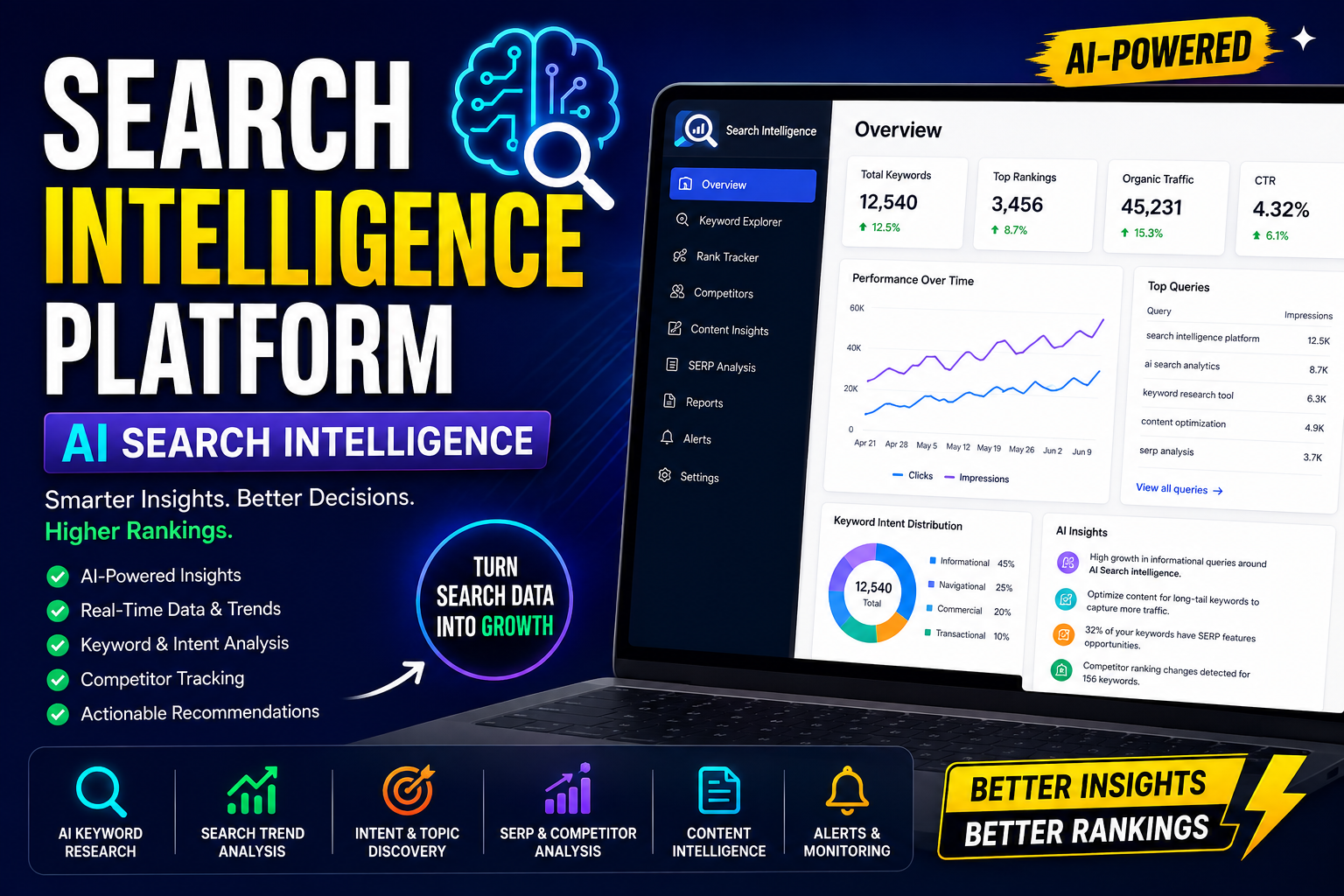
A Search Intelligence Platform combines search data, competitive intelligence, keyword analysis, content analysis, SERP monitoring, AI-search visibility, entity signals, and automated insights into a single environment.
This guide explains what a Search Intelligence Platform is, how AI Search Intelligence works, why it matters, what features SEO professionals should look for, how to implement one, and how businesses can use search intelligence to build visibility across traditional and AI-powered search.
What Is a Search Intelligence Platform?
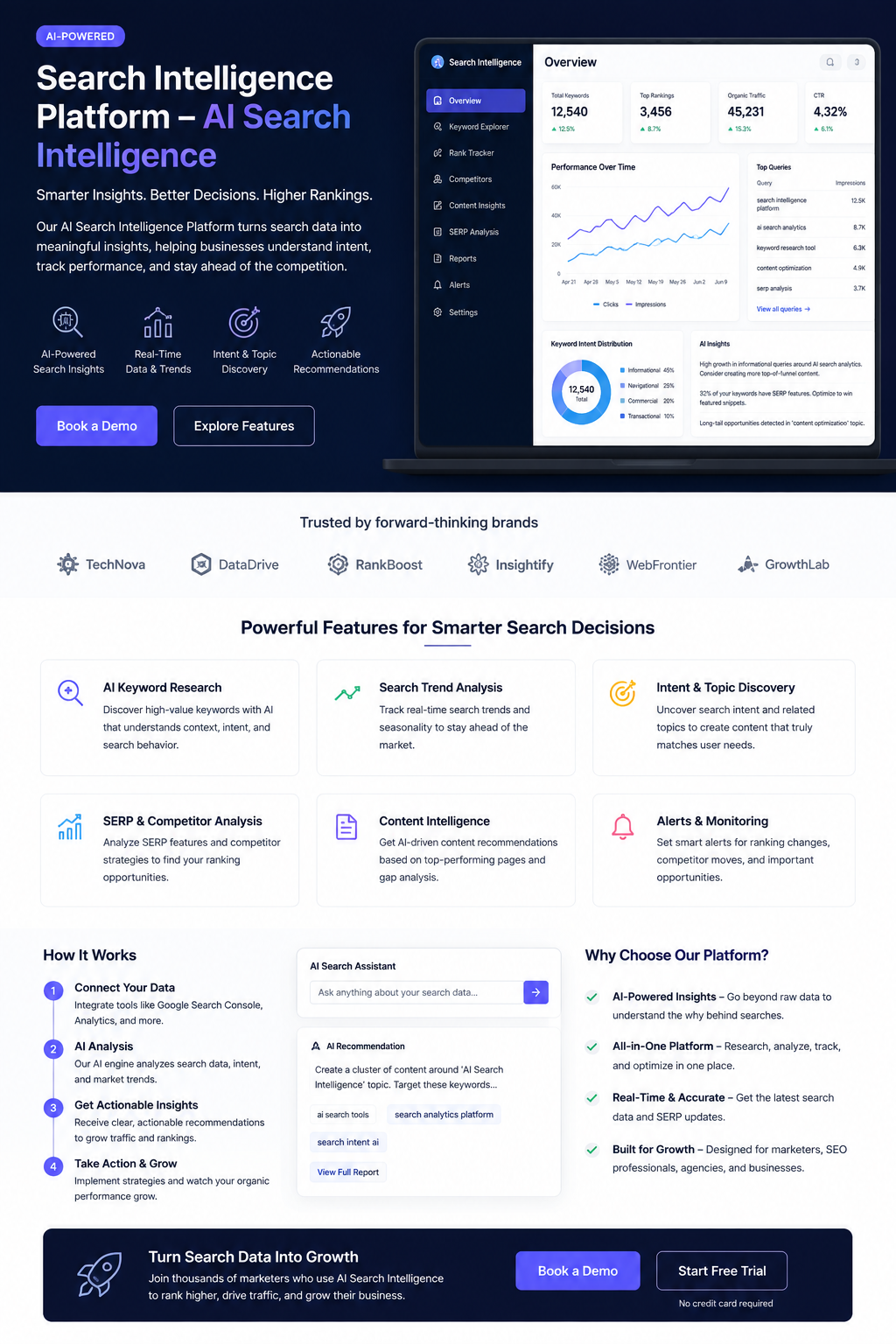
A Search Intelligence Platform is a technology system designed to collect, analyze, and interpret search-related data so SEO professionals can make better optimization decisions.
Traditional SEO tools often concentrate on individual tasks.
For example:
- One tool may perform keyword research.
- Another may monitor rankings.
- Another may analyze backlinks.
- Another may audit technical SEO.
- Another may analyze competitors.
- Another may monitor content.
- Another may provide AI-search visibility information.
A Search Intelligence Platform attempts to connect these datasets.
Instead of simply answering:
“What keyword does my page rank for?”
a search intelligence system attempts to answer broader questions:
- What topics does my website own?
- Which competitors dominate a search category?
- What entities are associated with my brand?
- Which pages are generating visibility?
- Which queries trigger AI-generated results?
- Which websites are cited by AI systems?
- Where is my brand mentioned?
- What content gaps exist?
- Which competitors are gaining visibility?
- What opportunities should the SEO team prioritize?
- Why is another website outperforming mine?
- What should be optimized next?
The goal is therefore not just rank tracking.
The goal is search understanding.
What Is AI Search Intelligence?
AI Search Intelligence is the process of using artificial intelligence, machine learning, large language models, natural-language processing, and search data to understand how brands and websites appear within modern search ecosystems.
Traditional SEO generally measures visibility through:
Keyword → SERP → Ranking → Click → Traffic
AI Search Intelligence expands that model:
Query → Search interpretation → Retrieval → AI synthesis → Source selection → Citation/Mention → User action
This is a major conceptual shift.
An AI-powered search experience may synthesize information from multiple sources instead of simply displaying ten blue links. Google says AI Overviews can provide an AI-generated snapshot with links to supporting information. (Google Support)
Consequently, SEO professionals need to monitor more than conventional rankings.
They should also consider:
- AI citations
- Brand mentions
- Source inclusion
- Entity recognition
- Topical authority
- Content relevance
- Query intent
- Semantic relationships
- Competitor visibility
- Search-result features
- AI-generated answers
- Conversational search journeys
Why Search Intelligence Matters in 2026
The traditional search landscape is becoming more complex.
A user may begin with a Google search, investigate a topic using an AI-powered result, ask a follow-up question, compare several products, visit a community discussion, and eventually make a purchase decision.
This means the modern search journey can involve multiple discovery surfaces.
Google itself says AI Overviews are designed to help users understand information quickly and explore the web through links. (Google Search – A new kind of help)
Recent academic research also suggests that AI-generated search results may retrieve a substantially different mix of sources from conventional Google results. One 2026 study comparing Google Search, AI Overviews, and Gemini found relatively low similarity between retrieved sources across these systems. (arXiv)
For SEO professionals, this creates an important question:
Can a brand be highly visible in traditional search but poorly represented in AI search?
Yes.
That is why search intelligence needs to evolve beyond traditional rank tracking.
Traditional SEO vs. Search Intelligence
| Traditional SEO | Search Intelligence |
|---|---|
| Keyword rankings | Search visibility ecosystem |
| Backlinks | Authority and source signals |
| Organic traffic | Visibility across search surfaces |
| SERP positions | SERP + AI visibility |
| Keyword volume | Search intent and topic relationships |
| Competitor rankings | Competitor search strategies |
| Content optimization | Content and entity optimization |
| Technical audits | Technical + search accessibility |
| Rank tracking | Visibility monitoring |
| Manual analysis | Automated intelligence |
| Historical reporting | Predictive and strategic insights |
Traditional SEO is still the foundation.
Search intelligence builds another analytical layer on top of it.
Core Components of a Search Intelligence Platform
A sophisticated Search Intelligence Platform should combine multiple capabilities.
1. Keyword Intelligence
Keyword intelligence remains essential.
A modern platform should analyze:
- Search volume
- Keyword difficulty
- Search intent
- Commercial intent
- Informational intent
- Transactional intent
- Navigational intent
- Long-tail queries
- Question keywords
- Related queries
- Semantic variations
- SERP features
- Ranking trends
However, advanced systems should go beyond individual keywords.
Instead of treating every keyword as an isolated phrase, they should identify topic clusters and relationships between queries.
For example:
Primary topic: SEO
Related concepts might include:
- SEO tools
- keyword research
- technical SEO
- link building
- content optimization
- local SEO
- semantic SEO
- AI SEO
- Google Search
- search intent
This creates a more realistic representation of how modern search engines understand topics.
2. SERP Intelligence
SERP intelligence analyzes what actually appears in search results.
A platform can monitor:
- Organic listings
- Featured snippets
- People Also Ask
- Images
- Videos
- News
- Local results
- Shopping results
- Reviews
- Forums
- AI-generated features
- Other SERP elements
This allows SEO professionals to determine what type of content Google prefers for a particular query.
For example, if the SERP repeatedly contains:
- comparison pages,
- product reviews,
- videos,
- forums,
- and detailed guides,
then publishing another generic 500-word article may not be the strongest strategy.
The SERP itself provides strategic information.
3. AI Search Visibility
One of the most important features of an AI Search Intelligence platform is the ability to monitor AI-generated search experiences.
The system can test relevant prompts and queries across supported AI search environments and determine:
- Whether the brand appears
- Whether competitors appear
- Which sources are cited
- How often the brand is mentioned
- What claims are associated with the brand
- Which pages are referenced
- What competitors are recommended
- Whether the brand is described positively, neutrally, or inaccurately
This creates a new measurement category:
AI Search Visibility.
A business may rank #2 for a keyword but never be mentioned in an AI-generated answer.
Another business might rank lower traditionally but become highly visible in AI-generated recommendations.
Understanding this difference is increasingly important.
4. Generative Engine Optimization Intelligence
Generative Engine Optimization, commonly abbreviated as GEO, focuses on improving the likelihood that content and brands are represented in AI-generated answers.
A Search Intelligence Platform can support GEO analysis by monitoring:
- AI citations
- Brand mentions
- Entity relationships
- Source frequency
- Competitor citations
- Content coverage
- Factual consistency
- Topical authority
- Citation patterns
However, SEO professionals should avoid treating GEO as a completely separate replacement for SEO.
Strong technical SEO, crawlability, useful content, authority, relevance, and clear information architecture remain important foundations.
5. Competitor Intelligence
Competitor analysis becomes much more powerful when it includes both traditional and AI search.
A platform can compare:
Your brand vs. Competitor A vs. Competitor B
across:
- Keyword rankings
- Organic traffic estimates
- Content coverage
- Backlinks
- Domain authority signals
- SERP visibility
- Featured snippets
- AI mentions
- AI citations
- Brand entities
- Topic ownership
- Content freshness
The objective is not simply to identify who ranks higher.
It is to determine:
Why does the competitor have greater search visibility?
6. Content Intelligence
Content intelligence helps determine what content should be created, improved, expanded, consolidated, or removed.
A sophisticated system can analyze:
- Existing content
- Competitor content
- Search intent
- Topic coverage
- Content gaps
- Semantic relationships
- Entity coverage
- Internal links
- Content freshness
- SERP requirements
- AI citation opportunities
For example, suppose a website has 50 articles about digital marketing.
A content intelligence system might discover that the website has excellent coverage of:
- SEO basics
- keyword research
- backlinks
but weak coverage of:
- AI search
- semantic SEO
- entity optimization
- search intelligence
- AI citations
The system can then identify the missing topic cluster.
7. Entity Intelligence
Entity-based SEO is increasingly important in search intelligence.
Search engines do not only process individual words. They also attempt to understand relationships between people, organizations, products, places, concepts, and other entities.
Consider a technology company.
Its search ecosystem may include entities such as:
- Company name
- Product names
- Founder
- Industry
- Competitors
- Technologies
- Locations
- Services
- Customers
- Partners
A Search Intelligence Platform can analyze these relationships and identify whether the brand is consistently associated with the correct concepts.
This can help SEO professionals identify entity gaps and reputation inconsistencies.
8. Brand Mention Monitoring
Traditional SEO reporting often focuses heavily on links.
But modern search intelligence also needs to monitor mentions without links.
A brand may be mentioned in:
- News articles
- Blogs
- Forums
- Reddit discussions
- Reviews
- Social platforms
- Industry publications
- AI-generated answers
These references can contribute to the overall information ecosystem surrounding a brand.
However, SEO professionals should distinguish between legitimate editorial mentions and manipulative attempts to manufacture AI visibility.
Recent reporting has highlighted concerns about marketers attempting to manipulate AI search through artificial or stealthy mentions on community platforms. (The Verge)
The best strategy is therefore to build genuine authority rather than manufacture artificial mentions.
How a Search Intelligence Platform Works
A typical workflow can be represented as:
Data Collection → Data Processing → AI Analysis → Competitive Comparison → Opportunity Detection → Recommendations → Monitoring
Step 1: Collect Search Data
The platform gathers data from sources such as:
- Search engines
- SERPs
- Keyword databases
- Websites
- Competitor domains
- Backlink indexes
- Search APIs
- AI-search observations
- Content databases
Step 2: Normalize the Data
Raw search data can be difficult to analyze because different sources use different structures.
The platform normalizes information into comparable datasets.
For example:
Keyword → Intent → Topic → SERP → Ranking → Competitors → AI Visibility
Step 3: Apply AI Analysis
Machine-learning and AI models can identify patterns that would be difficult to discover manually.
For example:
Competitor X is gaining visibility because it has expanded content around three high-value topic clusters.
or:
Your website ranks well for informational queries but has weak commercial-intent coverage.
Step 4: Detect Opportunities
The system converts observations into opportunities.
Examples include:
- Missing topic clusters
- Declining rankings
- New competitors
- Content gaps
- AI citation opportunities
- Broken internal-link structures
- Weak entity associations
- SERP feature opportunities
Step 5: Prioritize Recommendations
Not every SEO issue deserves immediate attention.
An intelligent platform can prioritize opportunities based on:
Impact × Confidence × Effort
For example:
| Opportunity | Impact | Effort | Priority |
|---|---|---|---|
| Fix indexing problems | High | Low | Very High |
| Improve key landing page | High | Medium | High |
| Create missing topic cluster | High | High | High |
| Minor metadata improvement | Low | Low | Medium |
| Low-volume keyword | Low | Medium | Low |
This turns SEO from a list of tasks into a decision-making system.
Search Intelligence Platform Architecture
A powerful platform can be divided into several layers.
Data Layer
Collect:
- SERP data
- Keywords
- Backlinks
- Website content
- Competitor data
- AI search observations
Intelligence Layer
Analyze:
- Search intent
- Entities
- Topics
- Competitors
- Visibility
- Content gaps
- AI citations
AI Layer
Generate:
- Insights
- Recommendations
- Summaries
- Predictions
- Opportunity scores
Visualization Layer
Display:
- Dashboards
- Charts
- Reports
- Visibility scores
- Competitor comparisons
- Trend analysis
Action Layer
Convert insights into:
- Content briefs
- SEO tasks
- Optimization recommendations
- Technical fixes
- Monitoring campaigns
Important Search Intelligence Metrics
SEO professionals should establish clear metrics.
Organic Visibility
Measures how prominently a domain appears across tracked search queries.
Share of Search
Measures the percentage of visibility captured by a brand compared with competitors.
AI Mention Rate
Measures how frequently a brand appears in monitored AI responses.
AI Citation Rate
Measures how often the brand’s pages are used or cited as sources.
Competitive Visibility
Measures your visibility relative to selected competitors.
Topic Authority
Measures coverage and strength across important topic clusters.
Content Gap Score
Identifies important topics competitors cover that your site does not.
SERP Feature Coverage
Measures presence in features such as snippets, PAA, images, videos, local results, and other search elements.
Search Intelligence and AI Overviews
Google’s AI Overviews have changed the traditional SERP experience by placing AI-generated summaries alongside links to supporting information. Google also warns that generative AI can make mistakes, which means source quality and verification remain important. (Google Support)
For SEO professionals, this creates several questions:
Is ranking still important?
Yes.
Traditional organic visibility remains important because search systems still depend on web content, indexing, relevance, authority, and retrieval.
Is ranking alone enough?
No.
A brand needs to understand how it is represented across different search experiences.
Can AI search visibility be measured?
Yes, but measurement requires careful methodology because AI-generated responses can vary by query, context, location, language, model, and time.
A professional platform should therefore record the exact:
- Query
- Date
- Market
- Language
- Device/context where relevant
- AI system
- Response
- Sources
- Brand mentions
- Competitor mentions
This makes AI visibility measurement reproducible.
Why AI Search Tracking Is Different From Rank Tracking
Traditional rank tracking might report:
Keyword: best SEO tools
Position: 4
AI search tracking may need to report:
Prompt: What are the best SEO tools for an enterprise website?
Brand mentioned: Yes
Competitor mentioned: 4 competitors
Brand cited: No
Cited sources: 6
Brand recommendation: Moderate
This illustrates why AI visibility is multidimensional.
There may not be a single “position 1” equivalent.
Instead, visibility can include:
- Mention
- Citation
- Recommendation
- Source inclusion
- Entity association
- Comparative presence
Search Intelligence for Content Strategy
A Search Intelligence Platform can transform content planning.
Instead of publishing articles based only on keyword volume, SEO teams can build content around complete search ecosystems.
For example:
Core Topic
AI SEO
Supporting Topics
- AI search optimization
- AI Overviews
- Generative Engine Optimization
- Search Intelligence
- AI citations
- Entity SEO
- Semantic SEO
- AI search tracking
- Search visibility
- AI content optimization
Commercial Topics
- AI SEO tools
- Search intelligence platforms
- AI visibility software
- GEO platforms
- Enterprise AI SEO solutions
This approach creates topical depth rather than isolated keyword targeting.
Search Intelligence for Enterprise SEO
Enterprise websites often contain thousands or millions of URLs.
Manual analysis becomes difficult at scale.
A Search Intelligence Platform can help enterprise teams monitor:
- Large keyword sets
- Multiple countries
- Multiple languages
- Subdomains
- Product categories
- Competitors
- Content portfolios
- Technical issues
- AI visibility
- Brand mentions
Enterprise SEO teams can also create separate dashboards for:
- Product SEO
- Local SEO
- International SEO
- Content SEO
- Technical SEO
- Brand SEO
- AI Search
Search Intelligence for Agencies
SEO agencies can use search intelligence platforms to improve client reporting.
Instead of presenting a report containing dozens of disconnected metrics, agencies can tell a strategic story:
What changed?
Organic visibility increased 18%.
Why?
Three topic clusters gained rankings.
What did competitors do?
Competitor A published 27 pages in the same category.
What opportunity exists?
The client has 14 high-intent content gaps.
What should happen next?
Create and optimize the priority pages.
This type of reporting is more useful to decision-makers than simply showing keyword movements.
How to Choose a Search Intelligence Platform
SEO professionals should evaluate platforms using several criteria.
1. Data Quality
Ask:
- Where does the data come from?
- How frequently is it updated?
- Is the dataset large enough?
- Can rankings be segmented by country and device?
2. AI Search Monitoring
Check whether the platform supports:
- AI visibility
- AI citations
- Brand mentions
- Competitor monitoring
- Prompt tracking
- Source analysis
3. Competitive Analysis
Look for:
- Competitor discovery
- Competitor keyword overlap
- Content-gap analysis
- Visibility comparisons
- Historical trends
4. Technical SEO
A complete system should ideally connect search intelligence with:
- Crawling
- Indexation
- Canonicals
- Redirects
- Structured data
- Core Web Vitals
- Internal linking
5. Reporting
Look for:
- Custom dashboards
- Automated reports
- White-label reports
- API access
- Export options
- Historical data
6. Actionable Recommendations
The most important question is:
Does the platform tell me what to do next?
Data without interpretation creates more work.
Intelligence should reduce work.
How SEO Professionals Can Use Search Intelligence
A practical workflow could look like this.
Monday: Monitor Visibility
Check:
- Ranking changes
- AI mentions
- Competitor movement
- SERP changes
Tuesday: Analyze Opportunities
Identify:
- Content gaps
- Declining pages
- New keywords
- Emerging topics
Wednesday: Optimize Content
Improve:
- Search intent alignment
- Content depth
- Internal links
- Entities
- Structured information
Thursday: Build Authority
Develop:
- Editorial relationships
- High-quality references
- Digital PR
- Expert content
- Relevant mentions
Friday: Measure Results
Compare:
- Organic visibility
- AI visibility
- Traffic
- Conversions
- Share of search
- Competitor movement
This creates a continuous SEO intelligence cycle.
Search Intelligence and Semantic SEO
Semantic SEO is closely connected to search intelligence.
Traditional keyword optimization might focus on:
“AI SEO tools”
Semantic optimization expands the context around that concept.
Relevant entities and concepts may include:
- Search engine optimization
- Artificial intelligence
- Generative AI
- Search engines
- Large language models
- AI Overviews
- Content optimization
- Search visibility
- SEO software
- Digital marketing
A Search Intelligence Platform can identify these relationships and help determine whether a website has sufficient topical coverage.
Search Intelligence and Topical Authority
Topical authority means demonstrating comprehensive expertise around a subject.
Search intelligence helps identify whether a website has:
- Core topics
- Supporting topics
- Related questions
- Commercial subtopics
- Comparison content
- Definitions
- How-to content
- Expert explanations
For SEO professionals, this provides a measurable framework for content strategy.
Instead of asking:
“How many articles should we publish?”
ask:
“Which important concepts are missing from our topical ecosystem?”
That is a much stronger strategic question.
Challenges of AI Search Intelligence
AI Search Intelligence is powerful, but it has limitations.
AI Responses Can Change
AI-generated answers may change because of:
- Model updates
- Search-index changes
- Query changes
- Location
- Language
- Personalization
- Fresh information
Therefore, one observation should not be treated as permanent.
AI Visibility Is Difficult to Standardize
Different platforms may produce different responses.
A professional measurement system must define consistent testing conditions.
Citation Does Not Equal Traffic
Being cited by an AI system does not automatically mean a user will click through.
Recent research examining Google AI Overviews found that clicks to cited sources were relatively rare in the studied browsing sample, highlighting why SEO teams should measure visibility and business outcomes separately rather than assuming citations automatically produce traffic. (arXiv)
AI Systems Can Make Errors
Google explicitly warns that AI-generated responses may contain inaccuracies. (Google Support)
Therefore, brands should monitor incorrect or misleading representations of their products and services.
Future of Search Intelligence
The future of SEO measurement will likely become increasingly multidimensional.
Instead of one primary metric such as:
Google Ranking Position
SEO teams may monitor:
Search Visibility + AI Visibility + Brand Authority + Entity Strength + Content Coverage + Business Outcomes
Search intelligence platforms are likely to become more predictive.
For example, instead of saying:
“Your ranking dropped.”
a future system may explain:
“Your visibility is declining because three competitors have increased topical coverage, your most important page has become less competitive for commercial intent, and your brand is appearing less frequently in AI-generated recommendations.”
That is the difference between analytics and intelligence.
Search Intelligence Platform: Recommended SEO Workflow
A practical enterprise workflow is:
1. Connect Website
↓
2. Import Keywords
↓
3. Identify Competitors
↓
4. Analyze SERPs
↓
5. Monitor AI Search
↓
6. Map Topics and Entities
↓
7. Identify Content Gaps
↓
8. Detect Technical Problems
↓
9. Prioritize Opportunities
↓
10. Execute SEO Changes
↓
11. Monitor Visibility
↓
12. Measure Business Results
This creates a continuous feedback loop.
The Future of SEO Is Search Intelligence
SEO is not disappearing.
It is expanding.
The emergence of AI-powered search does not eliminate the fundamentals of search optimization. Instead, it introduces additional layers of complexity.
SEO professionals now need to understand:
- How users search
- How search engines retrieve information
- How AI systems synthesize information
- Which sources are selected
- How brands are represented
- How competitors gain visibility
- How content establishes authority
- How entities connect across the web
A Search Intelligence Platform brings these signals together.
The strongest platforms will not simply provide more dashboards or more data. They will help SEO professionals answer the questions that matter most:
Where are we visible?
Where are competitors visible?
Where are we missing?
Why are we missing?
What should we do next?
Did the change improve visibility and business performance?
That is the real purpose of AI Search Intelligence.
Conclusion
The modern search environment is becoming increasingly AI-driven, conversational, semantic, and competitive.
Google’s AI Overviews demonstrate how search engines can synthesize information and present users with AI-generated answers and supporting links. (Google Support) Research also indicates that AI-generated search experiences can retrieve and prioritize sources differently from traditional search results. (arXiv)
For SEO professionals, this means that traditional rank tracking alone provides an incomplete picture of search performance.
A Search Intelligence Platform provides a broader framework for analyzing search visibility across keywords, SERPs, competitors, content, entities, AI-generated answers, citations, and emerging search experiences.
The organizations that adapt fastest will not abandon traditional SEO.
They will combine proven SEO fundamentals with deeper search intelligence.
The future belongs to marketers who can understand not only where their pages rank, but also how search systems understand their brand, content, authority, and relevance.
Search intelligence is therefore becoming a strategic layer of modern SEO—not a replacement for SEO, but an evolution of how SEO is measured, analyzed, and executed.
Frequently Asked Questions
What is a Search Intelligence Platform?
A Search Intelligence Platform is software that collects and analyzes search, competitor, content, SERP, and AI-search data to help SEO professionals understand visibility and identify optimization opportunities.
What is AI Search Intelligence?
AI Search Intelligence is the analysis of how websites, brands, and content appear within AI-powered search experiences, including mentions, citations, source selection, recommendations, and contextual visibility.
Is Search Intelligence the same as SEO?
No. SEO is the broader discipline of optimizing websites for search visibility. Search intelligence is an analytical and strategic layer that helps SEO professionals understand search behavior, competitors, visibility, and opportunities.
Why is AI Search Intelligence important?
AI-powered search can summarize information and select sources differently from traditional search results. Monitoring AI visibility helps SEO teams understand whether their brands and content are being represented in these new search experiences.
What should a Search Intelligence Platform track?
A strong platform should ideally track keywords, rankings, SERPs, competitors, content gaps, entities, brand mentions, AI visibility, citations, technical SEO signals, and historical trends.
Can Search Intelligence improve organic rankings?
It can help improve SEO decision-making by identifying ranking opportunities, content gaps, technical problems, competitor strategies, and search-intent mismatches. The platform itself does not guarantee rankings.
What is the difference between SEO, AEO, and GEO?
SEO focuses broadly on search-engine visibility. AEO, or Answer Engine Optimization, focuses on making information useful and accessible for answer-oriented search experiences. GEO, or Generative Engine Optimization, focuses on visibility within generative AI search and answer systems. These areas overlap considerably.
Will traditional SEO become obsolete?
No. Traditional SEO fundamentals such as crawlability, indexing, relevance, useful content, technical quality, and authority remain important. Search intelligence adds additional measurement and analysis for increasingly complex search experiences.