

Google AdSense Begin-to-Render Update 2027: What Publishers Need to Know
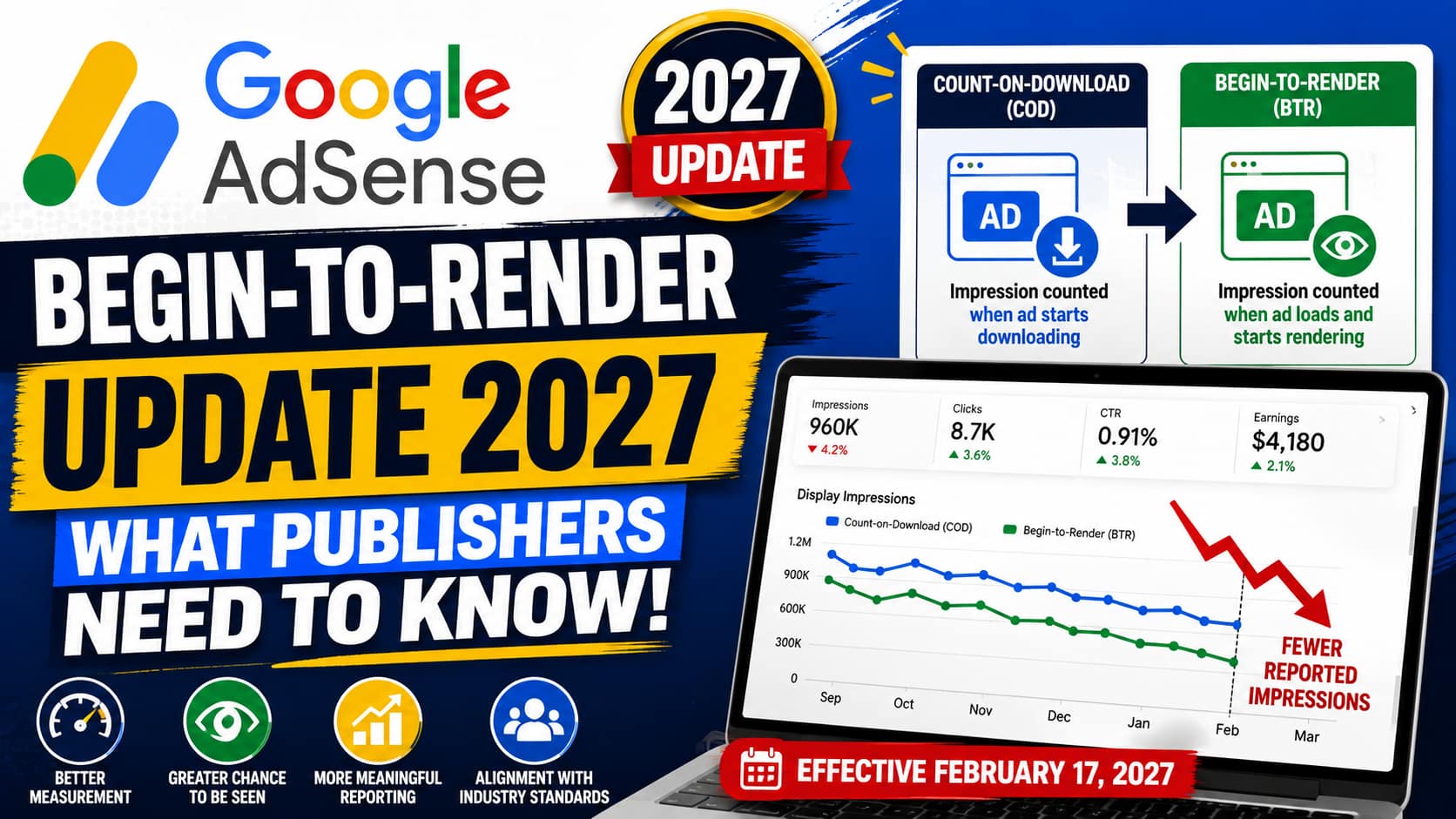
Google is preparing an important change to the way display ad impressions are measured across AdSense and Google Ad Manager. Beginning February 17, 2027, eligible display inventory will move from the existing Count-on-Download (COD) methodology to Begin-to-Render (BTR) impression counting. (support.google.com)
At first glance, this may sound like a small reporting adjustment. For publishers, however, it changes the point at which an ad officially becomes an impression.
Under the current approach, an impression can be recorded when an ad begins downloading to a visitor’s device. Under Begin-to-Render, the creative must successfully load and start rendering before the impression is counted.
The result is a stricter definition of a display impression. Publishers may consequently see fewer reported impressions after the transition, particularly on pages where users leave quickly, ads load slowly, or creatives fail to reach the rendering stage.
Importantly, Begin-to-Render does not mean that every counted ad was fully visible to the user. It means the creative successfully loaded and began rendering, bringing impression measurement closer to an actual opportunity to see the advertisement.
This guide explains what the AdSense Begin-to-Render update means, which ads are affected, how reporting could change, and what publishers can do before February 2027.
What Is Changing in Google AdSense?
At present, Google’s display impression measurement generally uses a methodology known as Count-on-Download.

An impression can be counted after an ad begins downloading to the user’s device.
Google’s new methodology moves the measurement point further into the ad-delivery process.
With Begin-to-Render, the impression is recorded when the ad creative has successfully loaded and has started rendering on the device. (support.google.com)
The difference can be illustrated simply:
Current process:
Ad request → Ad returned → Creative starts downloading → Impression counted → Creative renders
Beginning February 17, 2027:
Ad request → Ad returned → Creative downloads → Creative starts rendering → Impression counted
That additional requirement is important.
Imagine a visitor opens an article, an advertisement begins downloading, but the visitor immediately clicks another link or closes the browser tab.
Under Count-on-Download, that event may qualify as an impression because the creative began downloading.
Under Begin-to-Render, if the user leaves before the creative actually starts rendering, that impression will not be counted.
Google therefore describes BTR as a more rigorous measurement methodology than COD. (support.google.com)
When Will the Begin-to-Render Update Take Effect?
Google has scheduled the transition for:
February 17, 2027
On that date, Google AdSense and Google Ad Manager will begin moving applicable display inventory from Count-on-Download to Begin-to-Render measurement. Google says publishers do not need to take a specific action for the methodology change itself. (support.google.com)
Publishers should nevertheless use the months before implementation to understand their current advertising performance and investigate technical problems that could prevent ads from rendering efficiently.
Count-on-Download vs. Begin-to-Render
The easiest way to understand the update is to compare the two methodologies.
| Feature | Count-on-Download (COD) | Begin-to-Render (BTR) |
|---|---|---|
| When is an impression counted? | When the creative starts downloading | When the creative has loaded and starts rendering |
| Does the creative have to begin rendering? | No | Yes |
| Can an abandoned ad load potentially count? | Yes | Less likely |
| Measurement standard | Less strict | More rigorous |
| Opportunity for the ad to be seen | Lower threshold | Greater likelihood |
| Google display banner methodology after transition | Replaced | New methodology |
BTR essentially removes a group of impressions where the advertisement began downloading but never reached the rendering stage.
A Simple Example
Consider a website that currently records:
1,000,000 display impressions per month
Suppose 40,000 of those impressions come from situations where the ad begins downloading but never actually starts rendering.
Under the existing methodology, the publisher could record approximately:
1,000,000 impressions
Under a simplified BTR scenario:
1,000,000 − 40,000 = 960,000 BTR impressions
That would represent a:
4% decline in reported impressions
This is only an illustrative example. It is not Google’s forecast for the average publisher.
The actual difference will depend on factors such as website performance, user behavior, page speed, ad implementation, creative complexity, network conditions and how quickly advertisements render.
A highly optimized website might experience only a small difference, while another site with slow-loading or problematic ad inventory could experience a larger discrepancy.
Why Is Google Making This Change?
There are several reasons behind the move.
1. More Meaningful Impression Measurement
An ad merely beginning to download does not necessarily mean it reached a stage where the visitor had a realistic opportunity to see it.
BTR moves the measurement point closer to that opportunity.
Google says the methodology provides a greater likelihood that a user can view the advertisement. (support.google.com)
2. Alignment With Industry Standards
Google describes Begin-to-Render as the industry-standard and preferred methodology for impression counting.
The advertising industry has gradually moved through several stages of impression measurement:
Served → Downloaded → Begin-to-Render
A served impression has the lowest threshold because the ad server only needs to send the advertisement.
A downloaded impression requires the creative to start downloading to the device.
BTR goes further by requiring the creative to successfully load and begin rendering. (support.google.com)
3. More Consistency Across Google’s Advertising Ecosystem
Not every Google inventory type currently depends on Count-on-Download.
Google says native, app and video inventory already uses, or complies with, Begin-to-Render-style measurement. Moving display banners to BTR therefore creates a more consistent approach across inventory types. (support.google.com)
4. Better Alignment Between Publishers and Buyers
Google also says BTR aligns impression measurement more closely with demand-side platforms and can simplify publisher workflows. (support.google.com)
This matters because publishers, advertisers, agencies and programmatic buying platforms benefit when an impression means roughly the same thing throughout the advertising supply chain.
Which Ad Inventory Will Be Affected?
The most significant change applies to display banner inventory.
According to Google’s current documentation:
| Inventory | Current Measurement | Future Measurement |
|---|---|---|
| Display banners — mobile web | Count-on-Download | Begin-to-Render |
| Display banners — desktop | Count-on-Download | Begin-to-Render |
| Display banners — CTV | Count-on-Download | Begin-to-Render |
| Native and other applicable non-banner display | BTR compliant | BTR compliant |
| App | 1-pixel/BTR compliant | BTR compliant |
| Video | First-frame/BTR compliant | BTR compliant |
WebView impressions are also expected to follow mobile-web measurement and therefore move to BTR. (support.google.com)
Will AdSense Impressions Decrease?
For some publishers, probably.
Google specifically warns that publishers may notice a decrease in total display impressions because BTR counts an impression later in the ad-serving process. (support.google.com)
Consider what happens when a visitor:
- Opens a page.
- Triggers an ad request.
- Causes the advertisement to start downloading.
- Immediately leaves the page.
- Leaves before the advertisement starts rendering.
Count-on-Download may capture that impression.
BTR would not.
Therefore:
Old impression total = rendered impressions + some ads that began downloading but never rendered
Whereas, conceptually:
BTR impression total ≈ ads that actually reached the rendering stage
Publishers should not automatically interpret a post-transition decline as lost audience traffic.
If pageviews and users remain stable while display impressions decline around the transition, part of that difference could simply be the new measurement methodology.
Does Begin-to-Render Mean the Ad Was Viewable?
No. This distinction is extremely important.
Begin-to-Render is not the same thing as viewability.
BTR confirms that the creative successfully loaded and began rendering. It does not by itself prove that a user actually saw enough of the advertisement to satisfy a viewability standard.
An advertisement might start rendering below the fold, for example, while the visitor never scrolls far enough to see it.
Publishers should therefore avoid treating these terms as interchangeable:
Ad request ≠ downloaded impression ≠ BTR impression ≠ viewable impression
Each represents a different stage of the advertising experience.
Google’s existing AdSense documentation separately references Active View for measuring viewable impressions. (support.google.com)
Will AdSense Revenue Decrease?
A lower impression count does not automatically mean revenue will decline by the same percentage.
This is where publishers need to separate reporting changes from actual monetization performance.
Suppose a site moves from:
1,000,000 COD impressions
to:
960,000 BTR impressions
That does not necessarily mean the website suddenly lost 40,000 valuable advertising opportunities.
Some of those 40,000 impressions may have represented creatives that never reached the rendering stage in the first place.
Google’s Authorized Buyers documentation says it expects the stricter billable methodology to increase the effectiveness of in-scope impressions. (support.google.com)
Actual publisher revenue will still depend on many variables, including:
- advertiser demand;
- geography;
- niche;
- traffic quality;
- auction competition;
- ad formats;
- device mix;
- viewability;
- seasonality;
- user engagement;
- advertiser bidding strategies.
Publishers should therefore evaluate the change using several metrics rather than looking only at raw impression totals.
Could RPM or CTR Change?
Potentially.
Whenever the denominator of a performance metric changes, the reported rate can also change.
Consider CTR:
CTR = Clicks ÷ Impressions × 100
Imagine a publisher records:
- 1,000,000 impressions
- 5,000 clicks
CTR:
5,000 ÷ 1,000,000 × 100 = 0.50%
Now suppose BTR measurement removes 40,000 non-rendered impressions while clicks remain the same:
- 960,000 impressions
- 5,000 clicks
New CTR:
5,000 ÷ 960,000 × 100 ≈ 0.52%
The CTR appears slightly higher even though the publisher did not generate additional clicks.
This is why historical comparisons around February 2027 will require context.
Impression-based monetization metrics could also move because the underlying impression count is changing. Publishers should be particularly careful when comparing periods before and after the migration.
Why Website Speed Becomes Even More Important
The BTR transition strengthens the connection between technical performance and advertising measurement.
An advertisement that downloads but fails to begin rendering may no longer produce a counted display impression under BTR.
That means publishers should pay close attention to:
Page performance → Ad download → Creative rendering → Counted impression
Slow websites can introduce friction at several stages.
Large JavaScript files, excessive third-party scripts, overloaded pages, poor hosting performance and complicated ad-tech chains can all contribute to delayed rendering.
Improving performance is therefore useful not only for user experience and SEO but also for creating a more reliable environment in which advertising creatives can load and render.
Creative Complexity Can Matter
Google notes that the number of assets associated with a creative can influence Begin-to-Render measurement.
A creative containing more assets may require additional downloading time.
The longer the creative takes to become render-ready, the greater the opportunity for a user to navigate away before rendering begins.
Script behavior matters as well.
Google explains that synchronous creative scripts can create serialized loading, while asynchronous execution can allow assets to load in parallel, improving the likelihood of reaching the BTR stage efficiently. (support.google.com)
For publishers using Google Ad Manager and complex programmatic setups, creative performance deserves closer attention before the transition.
Ad-Tech Supply Chain Complexity Can Also Matter
Another important factor is the number of steps between the original ad request and the final creative.
Google notes that additional supply-chain “hops” can increase loading time and potentially result in fewer creatives reaching Begin-to-Render. (support.google.com)
A simplified delivery chain might look like:
Website → Ad platform → Buyer → Creative → Render
A more complicated chain could involve several intermediaries before the creative reaches the browser.
Every additional stage can introduce latency.
Publishers with sophisticated programmatic monetization setups should therefore investigate unnecessary complexity, particularly when reporting shows a large difference between downloaded and rendered impressions.
Lazy Loading and Lazy Rendering Need Attention
Lazy loading is widely used to improve webpage performance by delaying resources until they are closer to the user’s viewport.
For advertising, however, publishers need to distinguish between lazy loading and lazy rendering.
Google explains that lazy loading settings can affect both COD and BTR measurement, while lazy rendering has a direct relationship with BTR because it determines when creative assets begin rendering. (support.google.com)
Google specifically mentions settings such as:
renderMarginPercentfetchMarginPercent
Increasing these margins can cause ads to fetch or render earlier.
However, earlier loading is not automatically better.
It can increase network consumption and resource demands on the user’s device.
The objective should therefore be balance:
Fast enough to create a good advertising experience, but not so aggressive that ads consume unnecessary resources.
Publishers should test rather than blindly changing lazy-loading configurations simply to maximize impression counts.
Heavy Ads Could Become More Relevant
Creative quality is another area publishers should monitor.
Google points out that Chrome can disable advertisements that consume excessive network bandwidth or CPU resources under its heavy-ad criteria. Such behavior can interfere with creative downloads and rendering. (support.google.com)
Publishers should consequently investigate creatives that repeatedly fail to render instead of assuming every discrepancy is caused by the new measurement methodology.
How Google Ad Manager Publishers Can Estimate the Impact
Google has provided Ad Manager publishers with a useful way to estimate the potential difference before the transition.
Publishers can compare current ad-server impressions with Begin-to-Render impression metrics in reporting.
Google recommends using historical reporting with a start date after August 12, 2026 when conducting this analysis. (support.google.com)
Relevant dimensions can include:
- Demand channel
- Inventory format
- Inventory type
- Device category
Google also identifies metrics such as:
- Ad server impressions
- Ad server begin-to-render impressions
Additional BTR-related metrics are expected to become available.
A simplified calculation is:
Estimated impression difference = COD impressions − BTR impressions
For example:
| Metric | Impressions |
|---|---|
| Current COD impressions | 2,000,000 |
| Begin-to-Render impressions | 1,940,000 |
| Difference | 60,000 |
| Estimated difference | 3% |
Again, this does not guarantee that the publisher’s February 2027 impression count will fall exactly 3%.
It provides a baseline for understanding the potential scale of the measurement change.
The detailed reporting procedure in Google’s announcement specifically applies to Google Ad Manager publishers, so AdSense-only publishers should not assume that every Ad Manager reporting metric will be available in their AdSense dashboard.
What Publishers Should Do Before February 17, 2027
Google says no action is required to activate the transition itself, but preparation is still worthwhile.
1. Establish a Performance Baseline
Record your current:
- display impressions;
- pageviews;
- sessions or users;
- clicks;
- CTR;
- viewability;
- ad revenue;
- device distribution;
- major traffic sources.
A baseline will make post-transition changes easier to diagnose.
2. Improve Page Performance
Review slow pages and templates.
Pay particular attention to:
- excessive JavaScript;
- unnecessary third-party scripts;
- large resources;
- poor server response;
- overloaded ad placements;
- layout instability.
3. Test Mobile Performance
Mobile users frequently experience more variable network conditions than desktop users.
Because mobile-web display banners are moving to BTR, publishers should test ad behavior under realistic mobile and slower-network conditions rather than only on high-speed desktop connections.
4. Review Lazy-Loading Configuration
Make sure ads are not being rendered unnecessarily late.
At the same time, avoid forcing every advertisement to load immediately if doing so harms performance.
5. Investigate Problem Creatives
For Google Ad Manager publishers, compare impression and BTR reporting by creative or buyer where possible.
Google recommends checking whether a steep discrepancy is isolated to particular creatives or buyers. (support.google.com)
6. Avoid Making Extreme Changes Too Early
Google says its measurement heuristics will continue evolving and that it plans optimizations intended to reduce miscounting issues.
Publishers therefore should not redesign their entire ad setup solely because an early BTR comparison looks unusual. (support.google.com)
7. Annotate February 17, 2027 in Analytics
Create an internal reporting annotation for the transition date.
When comparing:
January 2027 vs. February 2027
or:
February 2026 vs. February 2027
remember that impression measurement itself changed.
Without this context, a publisher could incorrectly conclude that traffic, ad demand or monetization suddenly deteriorated.
What the Update Means for Advertisers
Although much of the discussion focuses on publishers, the change also matters to advertisers.
Under BTR, an impression has passed a stricter technical threshold before being counted.
Instead of paying or reporting against an advertisement that merely started downloading, applicable display impressions are tied more closely to creatives that actually reached the rendering stage.
That does not guarantee engagement, visibility, clicks or conversions.
It does, however, remove some low-quality events where an advertisement never progressed far enough to render.
This can make impression measurement more meaningful across the advertising ecosystem.
What the Update Does Not Mean
Publishers should avoid several common misunderstandings.
BTR does not mean every impression was viewed.
It means the creative started rendering.
BTR does not mean your website lost traffic if impressions decline.
The counting methodology itself is changing.
BTR does not guarantee higher RPM or CTR.
Metrics can move for many reasons.
BTR does not guarantee revenue will decrease.
A reduction in counted impressions is not necessarily equivalent to a proportional loss in monetizable opportunities.
BTR does not require publishers to manually enable a new AdSense setting.
Google says no action is required for the transition. (support.google.com)
Before and After: A Publisher Scenario
Consider a fictional content website with the following monthly performance before BTR:
| Metric | Before BTR |
|---|---|
| Pageviews | 600,000 |
| COD display impressions | 1,500,000 |
| Rendered display impressions | 1,440,000 |
| Difference | 60,000 |
| Rendering gap | 4% |
After BTR becomes the measurement methodology, the site’s reported display impressions could move closer to the rendered total, assuming similar traffic and technical conditions.
A publisher who only looks at the headline impression number might see:
1.50 million → 1.44 million
and conclude:
“My ad traffic dropped 4%.”
That could be misleading.
If pageviews, users and engagement remain stable, the more accurate explanation may be:
“The platform stopped counting some ads that began downloading but never started rendering.”
That distinction will be essential for interpreting advertising reports in 2027.
Frequently Asked Questions
What is Begin-to-Render in Google AdSense?
Begin-to-Render, or BTR, is an impression measurement methodology in which an eligible display impression is counted when the advertising creative has successfully loaded and begins rendering on the user’s device. (support.google.com)
When will Google AdSense switch to Begin-to-Render?
Google says the transition for applicable display inventory will begin February 17, 2027. (support.google.com)
What is Count-on-Download?
Count-on-Download, or COD, records an impression when the advertisement starts downloading to the user’s device.
Will my AdSense impressions decrease?
They may. Google warns that total display impressions can decrease because ads that start downloading but never reach the rendering stage will no longer qualify under the new methodology. (support.google.com)
Will my AdSense earnings decrease?
Not necessarily. The change can reduce the number of reported impressions, but revenue depends on advertising demand, pricing, auction performance, traffic quality, viewability, geography and numerous other factors. Publishers should monitor actual revenue rather than assuming it will move in direct proportion to impression counts.
Is BTR the same as a viewable impression?
No. BTR means the creative has started rendering. Viewability is a separate measurement concept.
Do publishers need to change their AdSense code?
Google currently says no action is required for the transition itself. (support.google.com)
Does the update affect mobile websites?
Yes. Google’s documentation identifies applicable mobile-web display banner inventory as moving from COD to BTR. WebView impressions will also follow mobile-web measurement. (support.google.com)
Does it affect Google Ad Manager?
Yes. The February 2027 transition applies to applicable display inventory across both Google Ad Manager and AdSense. (support.google.com)
Final Thoughts
The Google AdSense Begin-to-Render update represents more than a cosmetic reporting change.
It changes what qualifies as a display impression.
Instead of counting an advertisement as soon as it begins downloading, Google will require the creative to successfully load and start rendering before recording the applicable impression.
For publishers, the most visible consequence may be a reduction in total reported display impressions after February 17, 2027. That decline should not automatically be interpreted as a loss of website traffic or an equivalent reduction in revenue.
The bigger objective is more meaningful impression measurement.
Publishers now have time to prepare by establishing reporting baselines, optimizing page and ad performance, reviewing lazy-loading behavior, identifying problematic creatives and understanding the gap between downloaded and rendered impressions.
When the transition arrives, publishers who understand that distinction will be in a much better position to interpret their AdSense and Ad Manager data correctly.
For Google’s technical explanation and future updates, publishers should monitor the official Google AdSense Begin-to-Render documentation.


