
Introduction
Paid search advertising is entering a new phase.
For years, PPC campaigns were built around a relatively simple model: identify keywords, create tightly themed ad groups, write relevant ads, assign bids, and send visitors to optimized landing pages.
AI-powered search is changing that model.
Search engines are increasingly capable of understanding intent, context, conversation, entities, and the relationship between multiple queries rather than simply matching a user’s exact words with advertiser-selected keywords. At the same time, advertisers are using AI for campaign creation, audience analysis, bidding, creative generation, forecasting, and optimization.
This creates an important question for PPC professionals:
If search behavior becomes more conversational and AI systems make more decisions automatically, should PPC campaign structures still be built around traditional keyword groups?
The answer is increasingly no.
Modern PPC structures are moving toward intent-based campaigns, broader thematic groupings, high-quality first-party signals, automated bidding, creative variety, and conversion-focused measurement.
This article explains how AI search trends are changing PPC campaign structures and how advertisers can adapt without losing control of their accounts.

What Is AI Search?
AI search refers to search experiences that use artificial intelligence to understand questions, interpret intent, summarize information, generate responses, and help users complete tasks.
Traditional search often works like this:
User → Query → Search results → Website → Conversion
AI-assisted search can look more like:
User → Complex question → AI interpretation → Multiple sources/signals → Answer or recommendation → Action
This difference is extremely important for PPC.
A user may no longer search for:
“best accounting software”
Instead, the user might ask:
“I run a small business with five employees. What accounting software is affordable, supports invoicing, and makes tax reporting easier?”
The second query contains considerably more context.
The PPC challenge is therefore shifting from:
“What keyword did the user type?”
to:
“What problem is the user trying to solve?”
Why AI Search Is Changing PPC
AI is influencing PPC at several levels:
- Search behavior
- Query length
- Keyword targeting
- Ad creation
- Campaign automation
- Audience signals
- Bidding
- Landing-page experiences
- Conversion tracking
- Performance analysis
Advertisers that continue building campaigns exclusively around thousands of exact keyword variations may create unnecessary complexity.
The future structure is more likely to organize campaigns around business objectives and customer intent.
Traditional PPC Campaign Structure
A traditional Google Ads account might look something like this:
Campaign
│
├── Ad Group: Running Shoes
│   ├── running shoes
│   ├── buy running shoes
│   ├── running shoes online
│
├── Ad Group: Nike Running Shoes
│   ├── nike running shoes
│   ├── nike shoes online
│
├── Ad Group: Trail Running Shoes
│   ├── trail shoes
│   ├── trail running shoes
│
└── Ad Group: Men's Running Shoes
    ├── men's running shoes
    ├── running shoes for men
This approach provides control, but it can become difficult to manage when search behavior generates thousands of related variations.
The New AI-Driven PPC Structure
An AI-oriented campaign may instead focus on broader intent categories:
Campaign: Running Shoes

│
├── High-Intent Purchase
│
├── Product/Category Intent
│
├── Brand Intent
│
├── Problem/Solution Intent
│
└── Remarketing / Customer Signals
The emphasis moves from individual keyword variations toward intent clusters.
1. Keyword-Centric PPC Is Becoming Intent-Centric
One of the biggest changes AI introduces is the declining importance of thinking about every query as a separate targeting opportunity.
Consider these searches:
- best running shoes
- best running shoes for beginners
- running shoes for long-distance running
- comfortable running shoes
- shoes that reduce foot fatigue
- best shoes for marathon training
A traditional account might separate many of these into different ad groups.
An AI-driven approach can recognize that many of these queries represent a related underlying need:
Finding suitable running footwear.
This means advertisers should increasingly organize campaigns around intent clusters.
Example intent framework
| Intent | Example Search | PPC Approach |
|---|---|---|
| Informational | Best running shoes for beginners | Educational messaging |
| Commercial | Best running shoes 2026 | Comparison/value messaging |
| Transactional | Buy running shoes online | Strong purchase CTA |
| Brand | Nike running shoes | Brand-specific messaging |
| Problem-based | Shoes for foot fatigue | Solution-focused messaging |
The keyword still matters, but intent becomes the organizing principle.
2. Long-Tail Searches Are Becoming More Important
AI search encourages users to ask detailed questions.
Instead of typing:
“CRM software”
someone might search:
“What CRM is best for a small sales team that needs WhatsApp integration and automated follow-ups?”
That creates longer and more specific queries.
Long-tail searches often reveal valuable information about:
- Customer needs
- Budget
- Industry
- Product requirements
- Purchase stage
- Problems
- Preferences
For PPC marketers, this creates an opportunity to develop ads and landing pages around specific problems and outcomes.
3. Campaigns Need Stronger Intent Segmentation
A useful modern structure can divide campaigns into several intent levels.
Awareness
Users are discovering a problem.
Examples:
- how to improve website speed
- why websites lose traffic
- how PPC advertising works
Consideration
Users are researching solutions.
Examples:
- best PPC agency
- SEO vs PPC
- best keyword research tools
Transaction
Users are ready to act.
Examples:
- buy SEO software
- PPC agency pricing
- hire PPC expert
Retention
Existing customers are looking for additional products or services.
Examples:
- upgrade plan
- premium features
- customer support
Instead of treating every query equally, PPC campaigns should increasingly reflect the customer journey.
4. AI Makes Broad Targeting More Valuable
Historically, advertisers often preferred highly controlled keyword targeting because broad targeting could introduce irrelevant traffic.
AI has improved the ability of advertising platforms to interpret signals beyond the exact keyword.
These signals can include:
- Search intent
- User behavior
- Conversion history
- Location
- Device
- Audience characteristics
- Previous interactions
- Website activity
- First-party data
- Conversion patterns
This does not mean advertisers should blindly turn everything to broad targeting.
Instead, broad targeting becomes more useful when it is combined with:
Good conversion tracking + strong creative + sufficient data + smart bidding + appropriate exclusions.
5. Campaign Structure Is Becoming Simpler
AI automation creates an interesting contradiction.
AI can make campaigns more sophisticated while campaign structures themselves become simpler.
Instead of creating:
50 campaigns × 20 ad groups × hundreds of keywords
advertisers may increasingly use:
Fewer campaigns × stronger signals × broader themes × more creative variations
This reduces management complexity and gives automated systems more data to learn from.
Illustrative Graph: Traditional vs AI-Driven Account Complexity
The following graph is an illustrative model, not industry benchmark data.
The point is not that every account should have exactly 45 management units. The principle is that simplification can allow automation to work with stronger data signals.
6. Creative Variety Is Becoming More Important
AI search does not only affect keywords.
It also changes how advertisers think about ads.
When campaigns cover broader intent groups, advertisers need multiple creative angles.
For example, a software company might create messaging around:
Cost
Reduce your monthly software costs.
Productivity
Automate repetitive tasks and save hours every week.
Ease of use
Manage your business from one simple dashboard.
Integration
Connect your existing business tools.
Security
Keep business information protected.
Instead of writing one ad for one keyword, marketers can create a portfolio of messages designed to appeal to different motivations.
7. PPC Landing Pages Must Match Intent
AI-driven search makes landing-page relevance even more important.
Imagine a user searches:
“best accounting software for freelancers”
Sending that user to a generic homepage creates unnecessary friction.
A better destination could be:
/accounting-software-for-freelancers/
The page can address:
- Freelancer-specific features
- Pricing
- Invoicing
- Tax-related workflows
- Ease of use
- Integrations
- Customer reviews
- FAQs
- Call-to-action
The lesson is simple:
Broader targeting does not mean generic landing pages.
In fact, broader targeting can make intent-aware landing pages even more valuable.
8. Search Terms Become a Strategic Research Tool
Search-term analysis remains important.
But its purpose changes.
Instead of asking only:
“Which keywords should I add?”
PPC marketers should ask:
- What problems are customers describing?
- What language do customers use?
- Which objections appear repeatedly?
- What features matter most?
- What questions indicate buying intent?
- Which queries generate conversions?
- Which searches reveal new audience segments?
Search terms become a form of customer intelligence.
9. Negative Keywords Still Matter
AI automation does not eliminate the need for account controls.
Negative keywords remain useful for excluding irrelevant intent.
For example, a company selling premium accounting software may want to exclude searches containing:
- free
- jobs
- careers
- course
- tutorial
- definition
However, negative keyword strategies should be developed carefully.
Overusing exclusions can prevent an automated campaign from discovering valuable new searches.
The goal should be:
Block genuinely irrelevant traffic without unnecessarily restricting useful discovery.
10. First-Party Data Becomes More Valuable
AI systems need signals.
Advertisers that provide high-quality conversion information can give automated bidding systems better feedback.
Important first-party signals may include:
- Qualified leads
- Purchases
- Subscription upgrades
- High-value customers
- Repeat purchases
- Phone calls
- Form submissions
- Offline conversions
- Customer lifetime value
Consider two lead-generation businesses.
Business A
Tracks:
Form submitted
Business B
Tracks:
Form submitted → Sales-qualified lead → Customer → Revenue
Business B can potentially provide a much more meaningful optimization signal.
The future of PPC is therefore increasingly connected to CRM and business data.
11. Conversion Tracking Is Becoming the Foundation
AI automation is only as good as the signals it receives.
If the account reports the wrong conversions, automated bidding may optimize toward the wrong outcome.
For example:
A company wants customers.
But its campaign is optimized for:
Page views
The system may find users who generate page views rather than users who are likely to purchase.
A better hierarchy might be:
Click
   ↓
Landing-page visit
   ↓
Lead
   ↓
Qualified lead
   ↓
Sales opportunity
   ↓
Customer
   ↓
Revenue
The closer the optimization signal gets to real business value, the more useful the data becomes.
12. PPC and SEO Are Becoming More Connected
AI search blurs the traditional boundary between paid and organic search.
SEO teams study:
- Search intent
- Entities
- Questions
- Topics
- Customer language
- Content gaps
PPC teams study many of the same things.
This creates an opportunity to combine data.
For example:
PPC search terms → SEO content ideas
and:
Organic search queries → PPC messaging ideas
A strong search-marketing strategy therefore treats PPC and SEO as complementary sources of search intelligence.
13. AI Search Changes Keyword Research
Traditional keyword research often focuses on:
- Search volume
- Competition
- Cost per click
- Keyword difficulty
These metrics remain useful, but modern keyword research should add:
- Intent
- Context
- Problem
- Audience
- Buying stage
- Conversion potential
- Semantic relationships
For example:
| Query | Volume | Intent | Potential |
|---|---|---|---|
| CRM | High | Ambiguous | Medium |
| CRM software | High | Commercial | High |
| CRM for small business | Medium | Commercial | Very high |
| CRM with WhatsApp integration | Lower | High commercial intent | Very high |
The lowest-volume query may produce the strongest business result.
14. AI Changes How Advertisers Think About Ad Groups
The old question was:
“Which keywords should go into this ad group?”
A better question is:
“Which users have the same underlying intent and can be served by the same message?”
This is a major conceptual shift.
Old structure
Keyword → Ad group → Ad
Emerging structure
Intent → Audience signal → Creative → Landing page → Conversion
This structure is more aligned with AI-driven advertising systems.
15. Automated Bidding Requires Better Data
AI-based bidding can evaluate large numbers of signals faster than a human can manually adjust bids.
But automation does not remove strategy.
Advertisers still need to decide:
- What counts as a conversion?
- Which conversions matter most?
- What CPA is profitable?
- What ROAS is acceptable?
- Which locations should be targeted?
- Which products deserve more budget?
- Which customers have greater lifetime value?
Automation handles optimization.
Humans still define the business objective.
16. Budget Allocation Is Becoming More Dynamic
Traditional PPC planning may assign fixed budgets to campaigns.
For example:
- Campaign A: $1,000
- Campaign B: $1,000
- Campaign C: $1,000
An AI-oriented approach may instead allow budget to move toward campaigns, products, audiences, or intent areas generating better business outcomes.
The principle becomes:
Budget should follow incremental value, not historical structure.
Illustrative Budget Allocation Graph
The following is a hypothetical example showing how a budget could shift after performance data is evaluated.
The important lesson is not the exact numbers.
It is the idea that budget allocation should reflect business value and conversion quality.
17. PPC Managers Are Becoming Search Strategists
AI can automate many repetitive tasks:
- Keyword expansion
- Bid adjustments
- Ad variations
- Performance summaries
- Audience analysis
- Forecasting
- Search-term categorization
This means PPC professionals can spend more time on:
- Strategy
- Positioning
- Offer development
- Customer research
- Landing-page optimization
- Conversion architecture
- Data quality
- Business profitability
The role of the PPC manager is therefore moving from manual campaign operator to marketing strategist and data analyst.
18. A Recommended AI-Ready PPC Campaign Structure
A practical structure for many advertisers could look like this:
ACCOUNT
│
├── Brand
│
├── Core Product / Service
│   ├── High-intent demand
│   └── General commercial demand
│
├── Problem / Solution
│
├── Competitor / Alternative
│
├── Remarketing / Existing Customers
│
└── Testing
Inside each campaign:
Campaign
│
├── Intent Theme
│
├── Multiple Creative Angles
│
├── Relevant Landing Pages
│
├── Strong Conversion Signals
│
└── Negative / Exclusion Controls
This approach balances automation and control.
19. How to Build an AI-Ready PPC Campaign Step by Step
Step 1: Define the business objective
Start with the result.
Examples:
- Online sales
- Qualified leads
- App installations
- Subscriptions
- Phone calls
- Revenue
Do not begin with keywords.
Step 2: Map customer intent
Create groups such as:
- Problem
- Research
- Comparison
- Purchase
- Brand
- Retention
Step 3: Build thematic campaign structures
Group related queries around shared intent rather than creating an individual campaign for every keyword variation.
Step 4: Improve conversion tracking
Track meaningful actions.
Where possible, connect advertising data with CRM and revenue data.
Step 5: Create multiple creative angles
Develop messages around:
- Price
- Benefits
- Features
- Trust
- Speed
- Convenience
- Results
- Customer problems
Step 6: Create intent-specific landing pages
Match the landing-page content to what the user is actually trying to accomplish.
Step 7: Use automation carefully
Use automated bidding and campaign features when the account has:
- Reliable conversion data
- Clear objectives
- Appropriate exclusions
- Sufficient monitoring
Step 8: Analyze search terms
Look for new:
- Questions
- Problems
- Product requirements
- Objections
- Audience segments
Step 9: Test incrementally
Do not rebuild the entire account overnight.
Test:
- Campaign structure
- Match types
- Creative
- Landing pages
- Bidding
- Audiences
- Budget distribution
20. Metrics That Matter in AI-Driven PPC
Traditional metrics such as CTR and CPC remain useful, but they are not enough.
Modern PPC analysis should consider:
Click-Through Rate
Measures how frequently users click an ad after seeing it.
Cost Per Click
Shows the average cost of a click.
Conversion Rate
Measures how effectively traffic generates conversions.
Cost Per Acquisition
Shows the cost of acquiring a customer or lead.
Return on Ad Spend
Measures revenue generated relative to advertising spend.
Qualified Lead Rate
Important for lead-generation campaigns.
Customer Acquisition Cost
Connects marketing spend with customer growth.
Customer Lifetime Value
Helps determine how much a customer is actually worth.
Incremental Revenue
Measures additional revenue attributable to advertising activity.
21. The Biggest Mistakes to Avoid
Mistake 1: Creating too many campaigns
More campaigns do not automatically mean better control.
Excessive segmentation can fragment data.
Mistake 2: Optimizing for clicks instead of business outcomes
A cheap click is meaningless if it never becomes a customer.
Mistake 3: Giving AI poor conversion signals
Bad data produces bad optimization.
Mistake 4: Using one generic landing page
Different intents often require different experiences.
Mistake 5: Eliminating human oversight
Automation is powerful, but strategy remains essential.
Mistake 6: Overusing negative keywords
Aggressive exclusions can prevent useful discovery.
Mistake 7: Ignoring search-term insights
Search terms reveal what customers actually want.
22. The Future of PPC Campaign Architecture
The PPC account of the future is likely to become increasingly centered around:
Intent + Data + Creative + Automation + Business Value
rather than:
Keywords + Manual Bids + Highly Fragmented Ad Groups
This does not mean keywords disappear.
Instead, their role changes.
Keywords become signals for understanding demand, while campaigns increasingly focus on broader customer needs.
AI Search PPC Framework
A useful framework is:
CUSTOMER PROBLEM
       ↓
SEARCH INTENT
       ↓
AI / SEARCH SIGNALS
       ↓
CAMPAIGN THEME
       ↓
CREATIVE VARIATIONS
       ↓
INTENT-SPECIFIC LANDING PAGE
       ↓
CONVERSION
       ↓
CRM / REVENUE DATA
       ↓
AI OPTIMIZATION
       ↓
BETTER CAMPAIGN DECISIONS
This creates a feedback loop.
The better the data becomes, the better advertisers can understand demand.
What PPC Professionals Should Do Now
If you’re managing PPC campaigns today, focus on five priorities:
1. Simplify unnecessarily complex accounts
Look for campaigns and ad groups that exist only because of tiny keyword differences.
2. Organize around intent
Ask what the user wants rather than simply what they typed.
3. Improve conversion data
Feed platforms meaningful business outcomes.
4. Build stronger creative systems
Create multiple messages instead of relying on one generic ad.
5. Connect PPC with broader search intelligence
Use PPC search-term data alongside SEO, website analytics, CRM, and customer research.
Frequently Asked Questions
Will keywords disappear because of AI search?
No. Keywords remain useful for understanding demand and controlling targeting. However, advertisers are increasingly relying on intent, contextual signals, audiences, conversion data, and automation in addition to individual keywords.
Should every PPC campaign use broad targeting?
No. The appropriate targeting approach depends on the account, conversion volume, objectives, industry, and level of control required.
Does AI eliminate the need for PPC managers?
No. AI can automate many repetitive activities, but humans remain responsible for strategy, positioning, business objectives, data quality, profitability, and oversight.
Are exact-match keywords still useful?
Yes. Exact matching and tightly controlled targeting can remain valuable for important high-intent searches, brand terms, and situations where advertisers need greater control.
What is the most important PPC metric in the AI era?
There is no universal single metric. For many businesses, meaningful conversions, qualified leads, revenue, profit, CAC, ROAS, and customer lifetime value are more important than clicks alone.
Should PPC and SEO teams work together?
Yes. Both teams can benefit from sharing search-intent information, customer language, content opportunities, conversion insights, and search-term data.
Conclusion
AI search is not simply changing the way people search.
It is changing the way advertisers should structure, measure, and optimize PPC campaigns.
The traditional PPC model was heavily focused on keywords and manual segmentation. The emerging model places greater emphasis on search intent, customer problems, first-party data, creative diversity, conversion quality, automation, and business outcomes.
The biggest opportunity for PPC professionals is not to compete with AI.
It is to use AI intelligently.
The strongest advertisers will combine machine-driven optimization with human strategy. They will build simpler campaign structures, provide better conversion signals, understand customer intent more deeply, and create advertising experiences that match the user’s actual needs.
In the AI-search era, the winning question is no longer:
“Which keyword should I bid on?”
It is:
“What does this customer want, what signal can I provide, and how can my campaign help them take the next step?”
That shift—from keyword management to intent management—is one of the most important changes happening in PPC today.
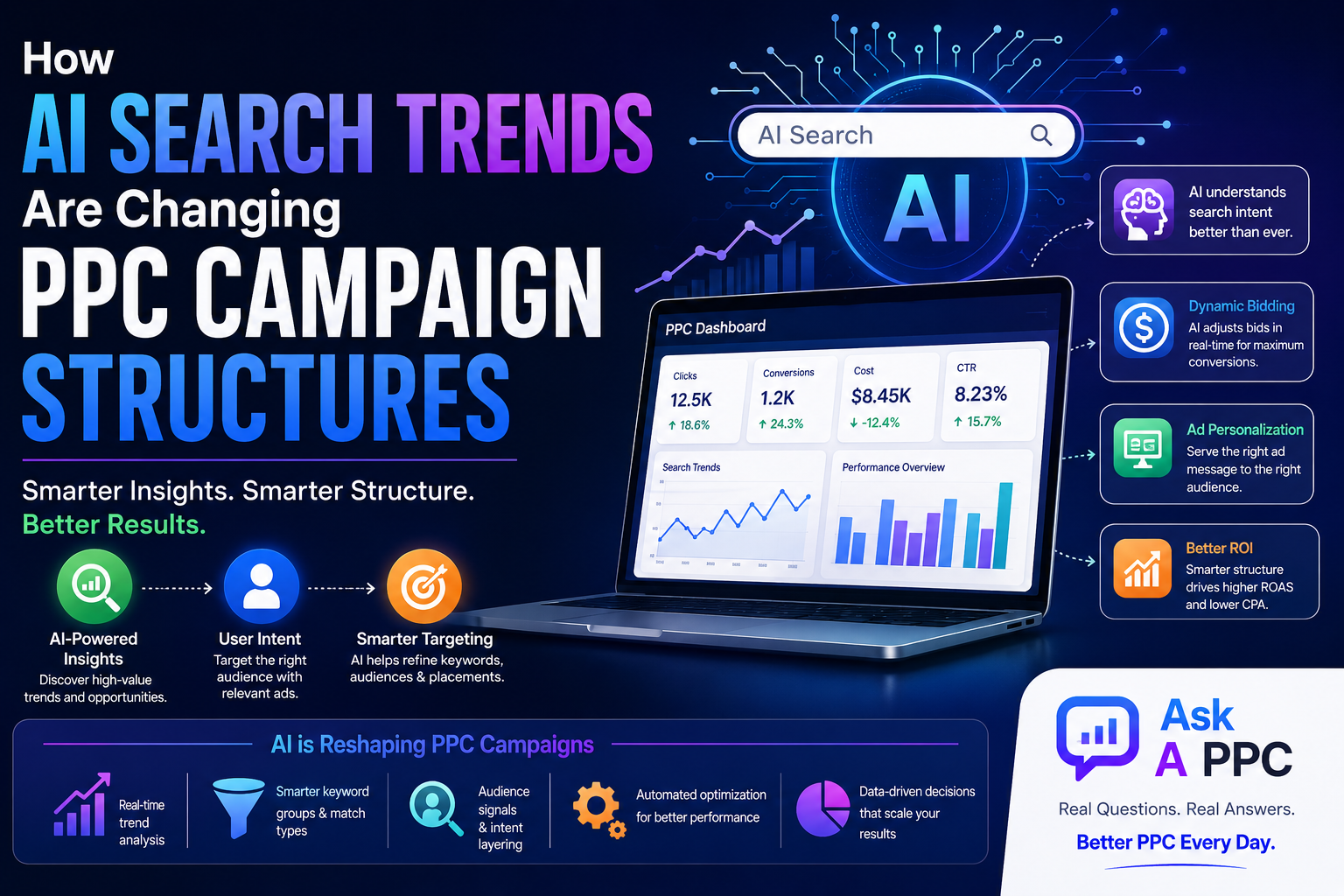
Featured Image Caption:
How AI search is transforming traditional keyword-based PPC campaigns into intent-driven advertising structures.
Illustrative PPC account complexity
A conceptual comparison of campaign-management complexity between traditional keyword-heavy and AI-oriented structures.
| structure | managementUnits |
|---|---|
| Traditional keyword-heavy | 100 |
| AI-oriented intent structure | 45 |
Illustrative PPC budget allocation
Example of a hypothetical budget shift toward higher-value intent segments.
| intent | budget |
|---|---|
| Awareness | 1,200 |
| Consideration | 2,200 |
| High purchase intent | 4,200 |
| Remarketing | 1,600 |