
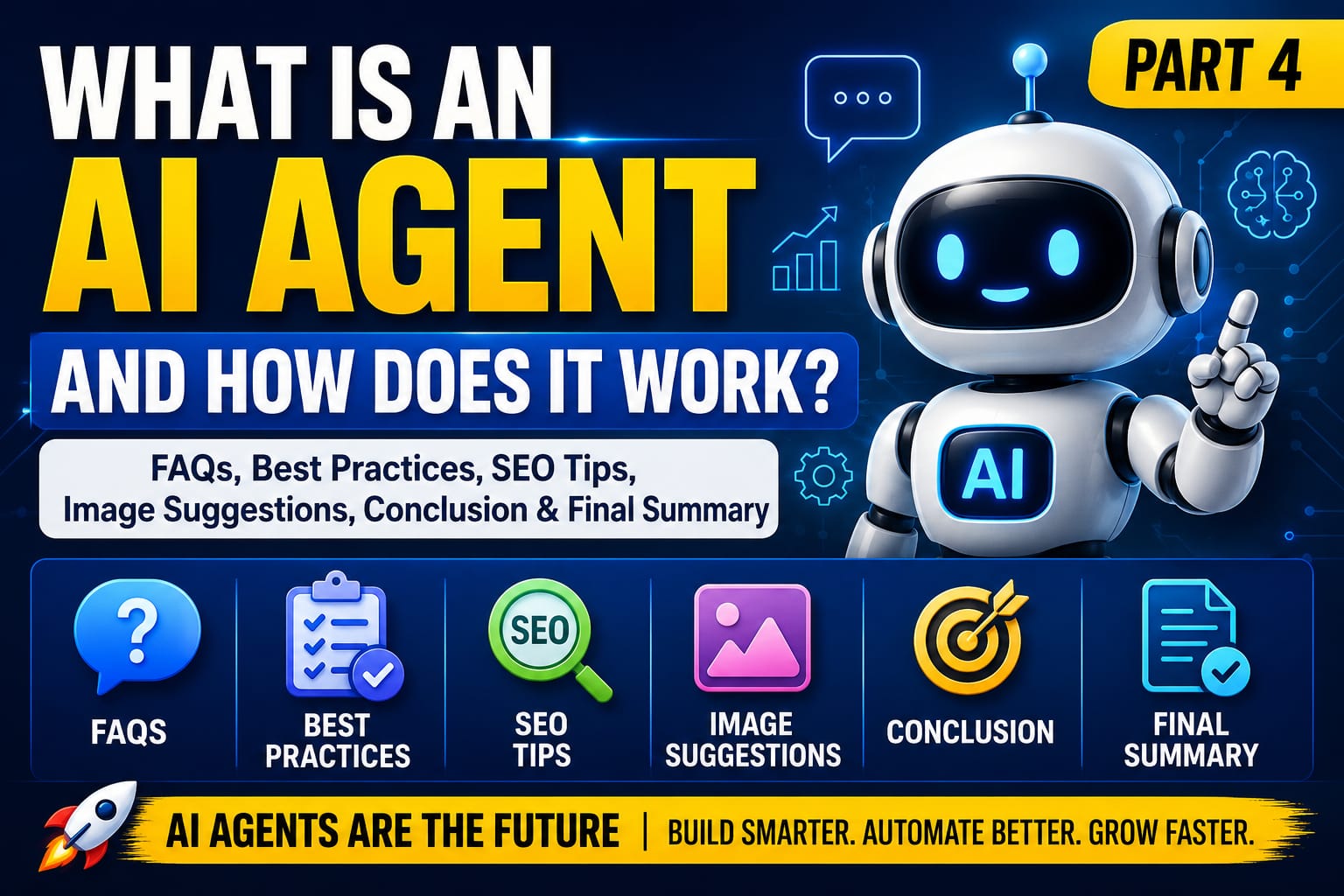
Here’s Part 4 in a reusable writing block.
Part 4: FAQs, Best Practices, Seoul Tips, Image Suggestions, Conclusion, and Final Summary
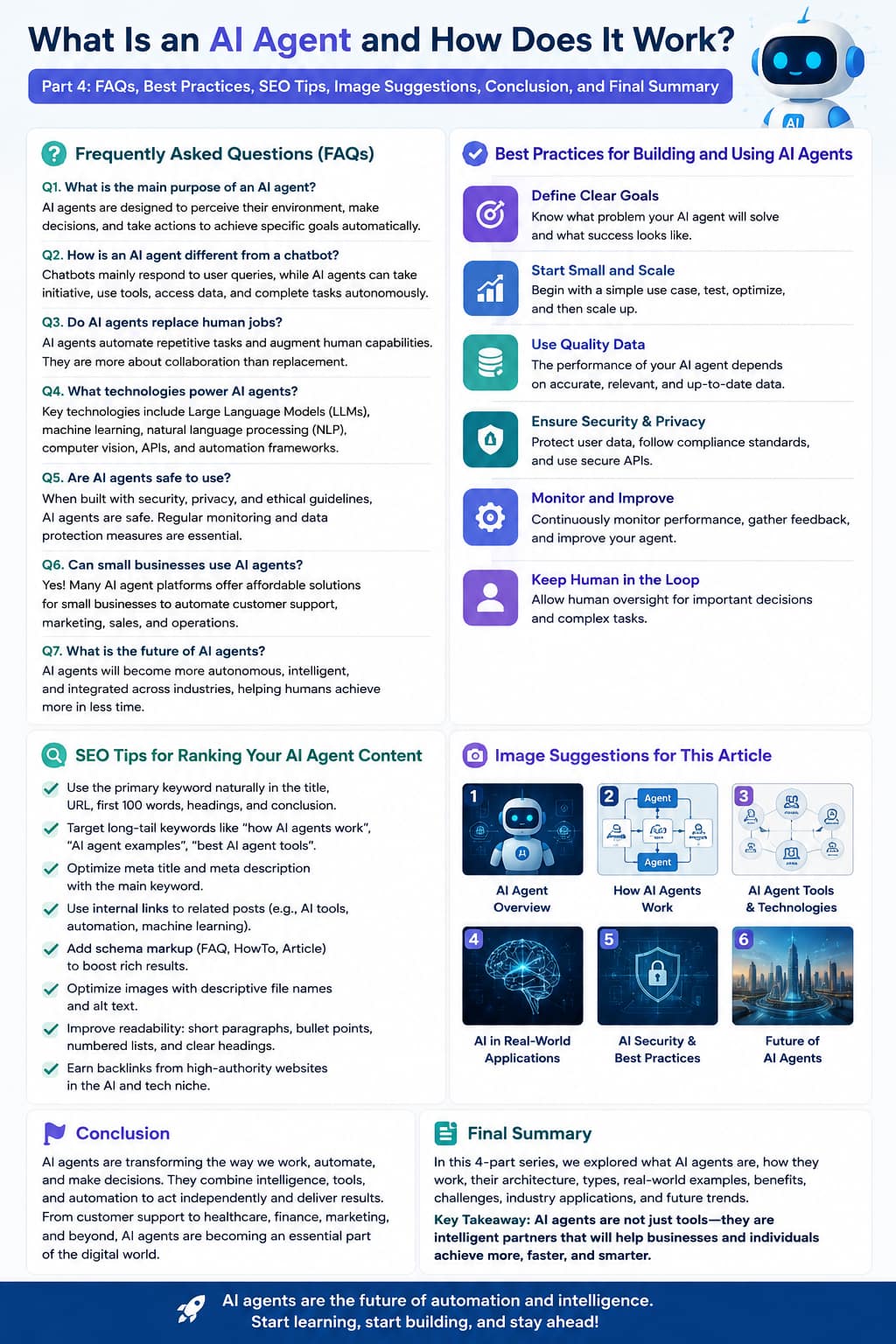
Best Practices for Building AI Agents
Creating a successful AI agent requires more than choosing a powerful AI model. A well-designed agent should be reliable, secure, efficient, and aligned with user needs.
1. Define a Clear Goal
Every AI agent should have a specific purpose.
Examples include:
- Answering customer questions
- Automating document processing
- Scheduling meetings
- Detecting fraud
- Managing inventory
- Assisting software developers
A clearly defined objective helps improve accuracy and simplifies development.
2. Use High-Quality Data
AI agents learn from data. Poor-quality or biased data can lead to incorrect decisions and unreliable performance.
To improve results:
- Remove duplicate records.
- Validate information before training.
- Keep datasets up to date.
- Include diverse examples.
- Monitor data quality continuously.
3. Combine AI with Human Oversight
Even advanced AI agents can make mistakes. For important decisions involving healthcare, finance, legal matters, or public safety, human review should remain part of the workflow.
4. Protect User Privacy
AI agents often process personal or confidential information. Developers should:
- Encrypt sensitive data.
- Limit access using role-based permissions.
- Store only necessary information.
- Comply with applicable privacy regulations.
- Regularly audit security controls.
5. Monitor Performance
Track key performance indicators (kips), such as:
- Response accuracy
- Task completion rate
- User satisfaction
- Processing time
- Error rate
- Operational cost savings
Monitoring helps identify areas for improvement.
Common Misconceptions About AI Agents
Myth 1: AI Agents Think Like Humans
Reality: AI agents analyze data and generate outputs based on algorithms and learned patterns. They do not possess human consciousness or emotions.
Myth 2: AI Agents Will Replace Every Job
Reality: AI is more likely to automate repetitive tasks while creating new opportunities that require human creativity, critical thinking, communication, and oversight.
Myth 3: AI Agents Never Make Mistakes
Reality: AI systems can produce incorrect, incomplete, or biased results. Careful testing and human review remain essential.
Myth 4: Every chat bot Is an AI Agent
Reality: Many chat bots follow predefined conversation rules. AI agents typically have broader capabilities, such as planning, reasoning, memory, and the ability to use external tools.
Frequently Asked Questions (FAQs)
What is an AI agent?
An AI agent is an intelligent software system that observes its environment, processes information, makes decisions, performs actions, and learns from experience to achieve specific goals.
How does an AI agent work?
An AI agent follows a continuous cycle:
- Receive input
- Understand the request
- Gather information
- Plan a solution
- Make a decision
- Perform the action
- Learn from the outcome
What is the difference between an AI agent and a chat bot?
A chat bot mainly answers questions through conversation, while an AI agent can reason, plan, use tools, complete multi-step workflows, and adapt based on experience.
Where are AI agents used?
AI agents are used in:
- Healthcare
- Banking
- Education
- Retail
- Manufacturing
- Transportation
- Marketing
- Customer support
- Cybersecurity
- Software development
Can AI agents learn over time?
Yes. Many AI agents use machine learning techniques to improve their performance based on new data, user feedback, and previous outcomes.
Are AI agents safe?
AI agents can be safe when organizations implement strong security, privacy protections, monitoring, and human oversight. Like any technology, they should be deployed responsibly.
Will AI agents replace human workers?
AI agents are expected to automate many repetitive tasks, but human expertise remains essential for creativity, leadership, ethics, strategic planning, and complex decision-making.
Internal Linking Ideas
To strengthen your website’s SEO and improve user navigation, consider linking this article to related content such as:
- What Is Artificial Intelligence (AI)?
- Machine Learning Explained
- Deep Learning vs Machine Learning
- Natural Language Processing (NLP)
- What Is Generative AI?
- What Is a Large Language Model (LLM)?
- AI in Healthcare
- AI for Digital Marketing
- AI Tools for Businesses
- Future of Artificial Intelligence
Key Takeaways
- AI agents are intelligent systems designed to achieve goals autonomously.
- They observe, reason, plan, act, and learn continuously.
- Modern AI agents combine machine learning, natural language processing, memory, and external tools.
- AI agents are transforming industries by improving efficiency, reducing costs, and enabling intelligent automation.
- Responsible AI development requires strong security, privacy protection, fairness, transparency, and human oversight.
Final Conclusion
AI agents represent one of the most significant advancements in modern artificial intelligence. Unlike traditional software that follows fixed instructions, AI agents can perceive their environment, analyze information, make informed decisions, execute actions, and improve through continuous learning.
Their impact is already visible across healthcare, finance, education, retail, manufacturing, logistics, cybersecurity, and many other industries. As AI models become more capable and connected to external tools and services, AI agents will increasingly automate complex workflows, assist professionals, and enhance everyday digital experiences.
However, successful adoption depends on responsible development. Organizations should prioritize data quality, privacy, security, transparency, fairness, and human oversight to ensure AI agents are both effective and trustworthy.
Whether you are a student, developer, business owner, or technology enthusiast, understanding how AI agents work provides valuable insight into the future of intelligent automation. As this technology continues to evolve, AI agents will play an even greater role in shaping how people work, communicate, innovate, and solve complex problems.
Final Summary
AI agents are autonomous, goal-oriented systems that combine artificial intelligence, reasoning, memory, planning, and learning to perform tasks with minimal human intervention. They go beyond simple chat bots by using external tools, adapting to changing environments, and executing multi-step workflows. As businesses increasingly adopt AI-driven automation, AI agents are becoming a cornerstone of digital transformation, enabling smarter decisions, greater efficiency, improved customer experiences, and scalable innovation across virtually every industry.