
GOOGLE SEO POLICY UPDATE 2026
Google has made an important change to its Site Reputation Policy, creating new considerations for publishers, affiliate websites, news organizations, SEO professionals, and businesses that publish third-party content.
The update was announced by Google Search Central on August 28, 2026, with key enforcement changes taking effect from August 30, 2026. One of the biggest changes is that enforcement now works differently for users inside the European Economic Area (EEA) compared with users outside the EEA.
At the same time, Google has provided significantly more detail about how its human reviewers may evaluate third-party sections of established websites.
For publishers, this means that simply asking whether content is “good” is no longer enough. Website owners should also understand who created the content, how it is integrated into the website, who is editorially responsible for it, whether it appears elsewhere, and whether the primary purpose of publishing it is to benefit users or exploit the host domain’s existing search reputation.
This guide explains the Google Site Reputation Policy Update 2026, what changed, which websites may be affected, how affiliate and sponsored content is treated, and what publishers can do to reduce their SEO risk.
What Is Google’s Site Reputation Policy?
Google’s Site Reputation Policy is designed to address situations where third-party content is placed on an established website mainly to benefit from the search ranking signals that the website has already earned.
In simple terms, imagine that a respected website has spent years building authority around technology. A separate company then publishes unrelated commercial pages on that website primarily because those pages may rank more easily on the strong domain than they would on a new independent website.
That is the type of practice Google’s policy is intended to address.
Google explains that third-party content can include content produced by entities separate from the established host site, including freelancers, users, white-label providers and people who are not directly employed by the publisher. However, the presence of third-party content by itself does not automatically violate the policy.
The important issue is the purpose and relationship between that content and the host website’s established ranking signals.
Why Did Google Introduce the Policy?
The original policy was introduced in 2024 as part of Google’s broader effort to reduce search manipulation.
Google wanted to prevent marketers from effectively “renting” the ranking strength of established domains.
For example, an authoritative education website might rank strongly for educational queries because it has published useful educational material for years. If an unrelated third party places payday-loan reviews on the website mainly to leverage its strong domain reputation, users may encounter content that does not reflect what made the website trustworthy in the first place.
Google considers this harmful to search quality because the third-party page may rank because of the reputation of its host rather than because the page itself deserves that position.
What Changed in the August 2026 Update?
There are two major parts of the latest update.
First, Google changed how enforcement affects searches performed within the European Economic Area.
Second, Google published more detailed guidance about the factors human reviewers may consider when evaluating whether third-party content is sufficiently integrated into the main website.
These clarifications make the policy much easier for publishers to analyze practically.
1. Different Treatment Inside and Outside the EEA
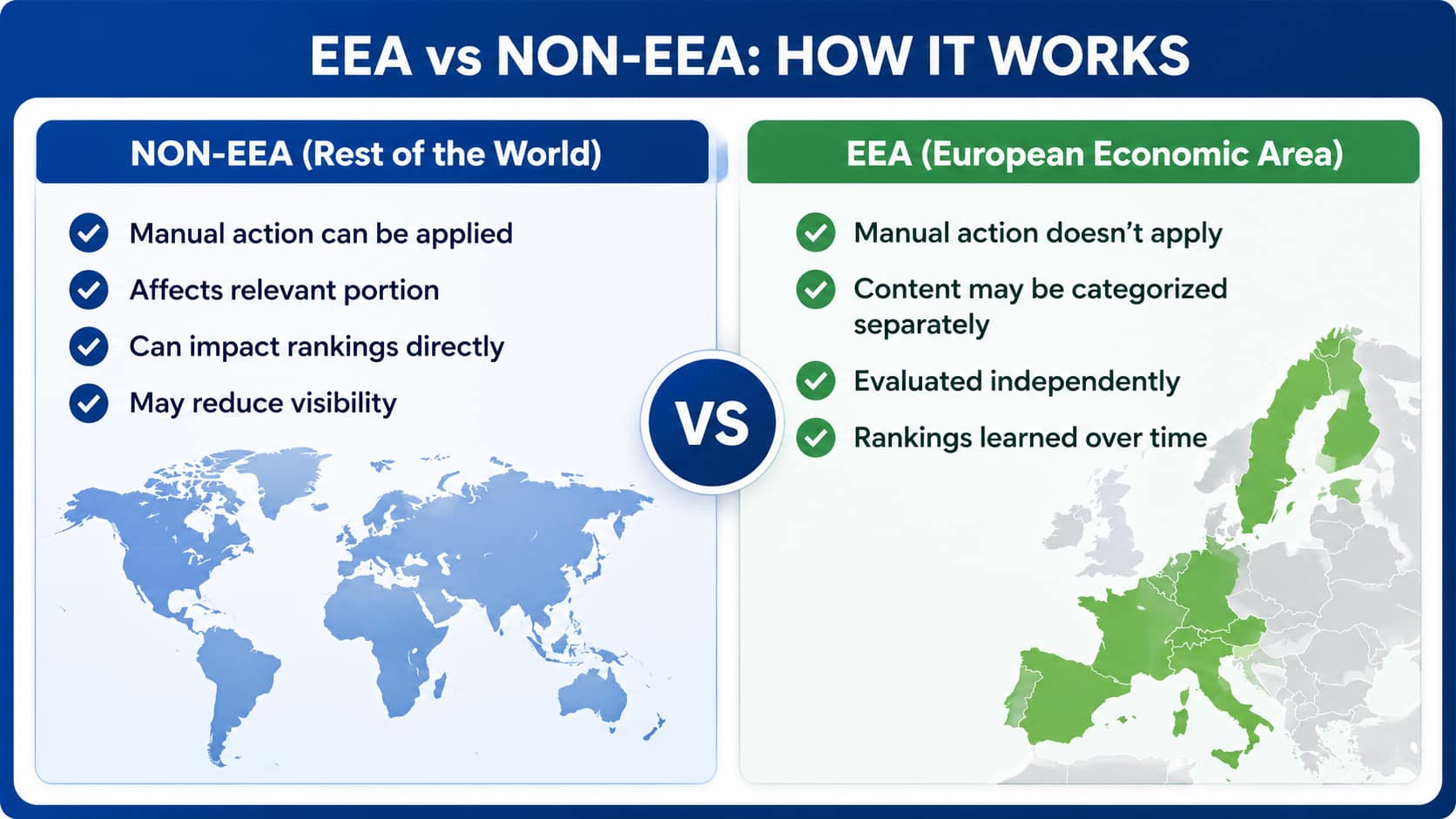
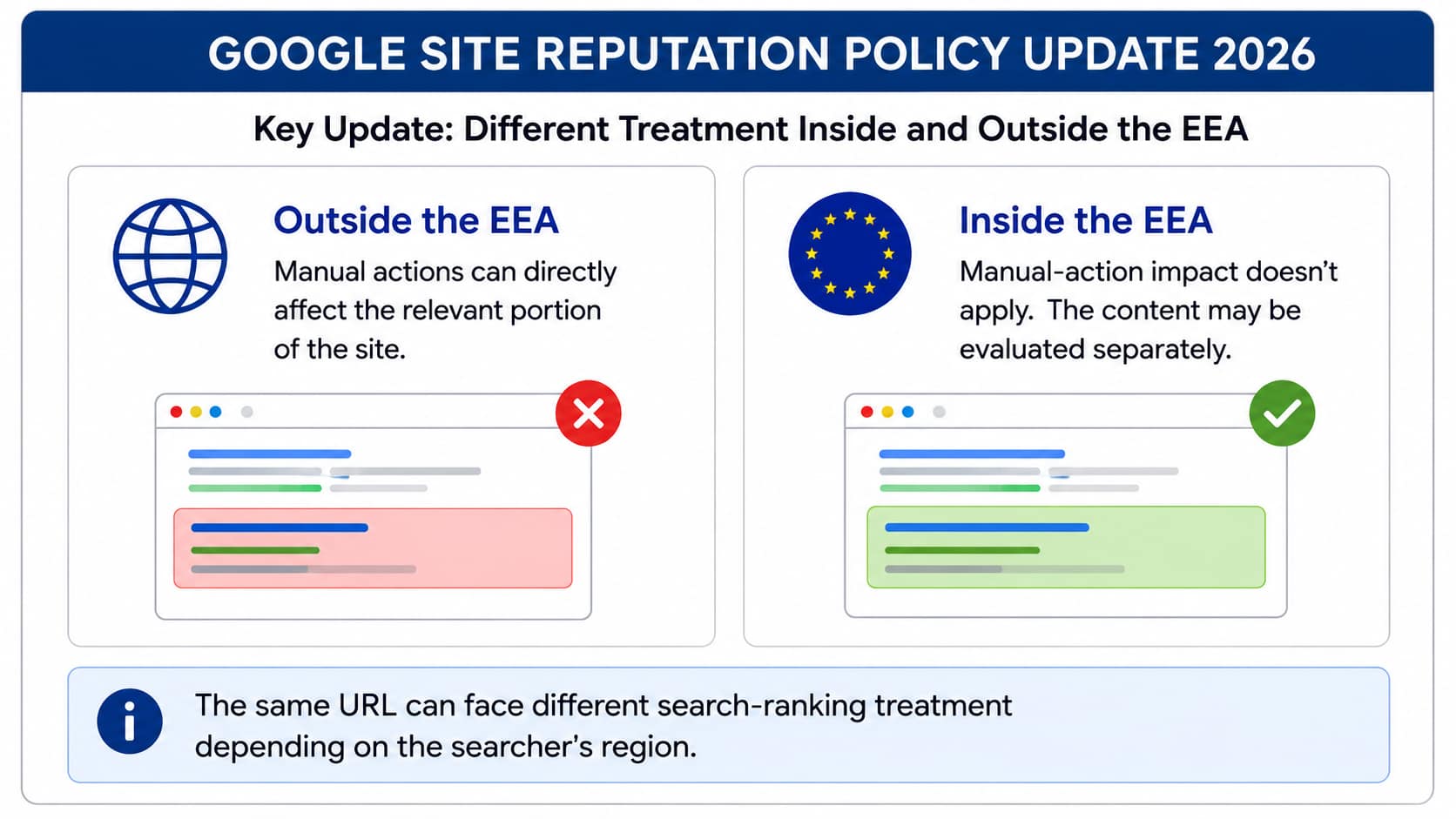
Beginning August 30, 2026, the effect of a Site Reputation Policy manual action depends on where the person performing the Google search is located.
Outside the EEA
For searchers outside the European Economic Area, affected pages or sections can continue to be directly impacted by a manual action.
Importantly, Google says the action can apply to the affected portion rather than automatically penalizing the entire website.
This means an offending affiliate or commercial section could lose visibility without necessarily causing every legitimate page on the domain to disappear.
Repeated problems, however, should not be treated lightly.
Inside the EEA
The situation is different for searches shown to users inside the EEA.
Google says the manual-action impact itself does not apply there. Instead, the affected portion of a website may be categorized separately from the main domain so that Google’s systems can increasingly evaluate and rank that section independently.
In other words, the questionable section may no longer receive the same assumed relationship with the quality and reputation of the main domain.
This does not necessarily mean that the section instantly loses every ranking signal associated with the website. Google explains that its systems can learn over time to rank the separated portions independently.
Why the EEA Difference Matters
This creates an unusual situation where the same URL could effectively face different search-ranking treatment depending on the searcher’s region.
A page could have a Site Reputation Policy manual action affecting its visibility outside the EEA while the manual-action impact itself does not apply to results shown inside the EEA.
For global publishers, reporting therefore becomes more complicated.
If traffic drops after a manual action, publishers should investigate performance by country rather than looking only at total organic traffic.
SEO teams may also need to compare:
- EEA traffic
- United States traffic
- Asian traffic
- Middle Eastern traffic
- individual landing-page performance
- affected directories or content sections
This can help determine whether a ranking decline is regional or global.
2. Google Clarified How Human Review Works
Perhaps the most useful part of the 2026 update is Google’s new detailed guidance regarding human review.
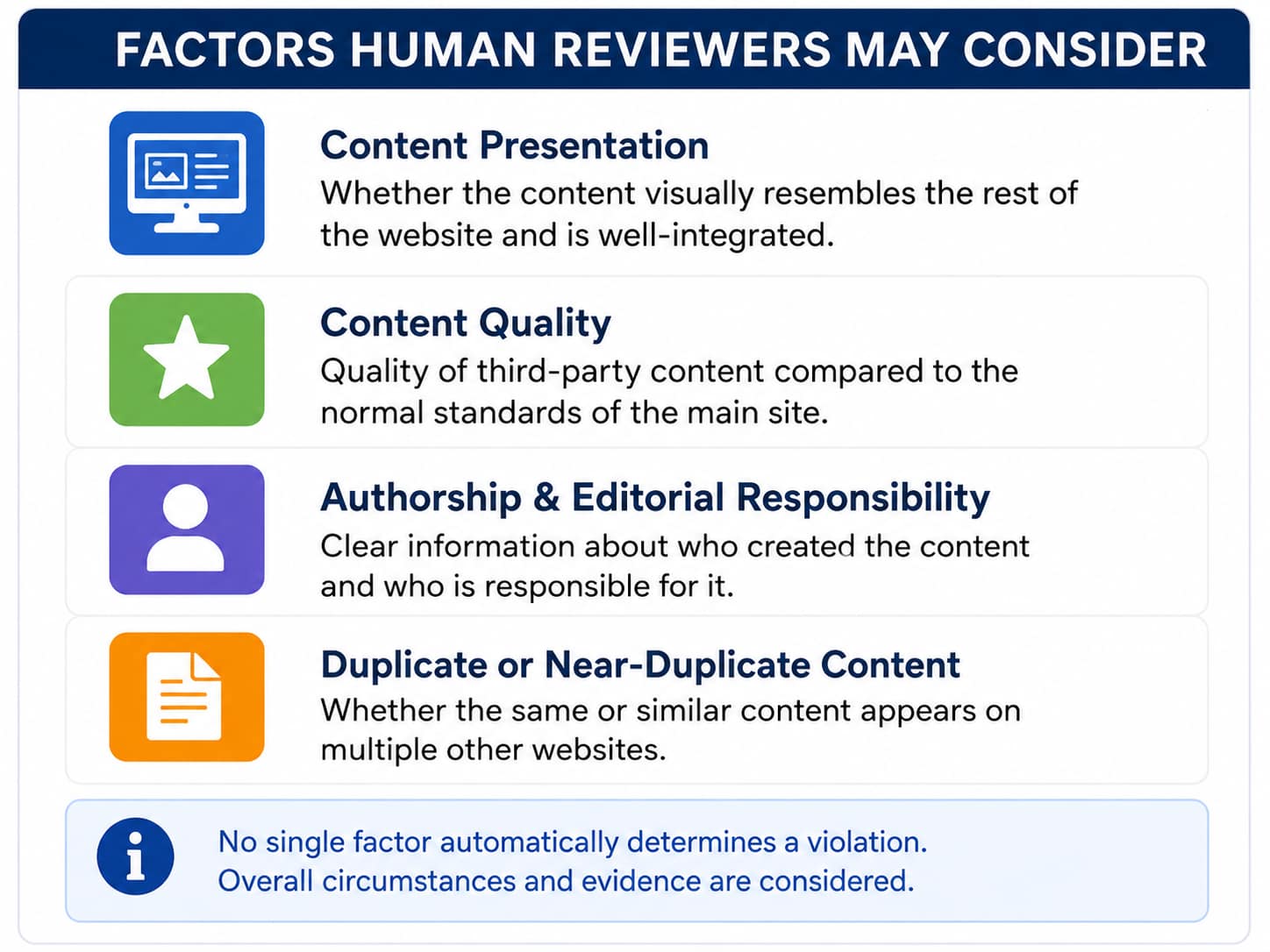
Google says the overall goal is to determine whether the content within a section has enough host-site input, editorial oversight or contribution to be considered genuinely integrated with the website.
Google lists several factors that may be considered.
Content Presentation
Reviewers may consider whether the third-party content visually resembles the rest of the website.
Questions publishers should ask include:
Does it use the same design?
Does it use the same navigation?
Does it follow the site’s normal typography?
Can visitors naturally reach the section from the main website?
Does the user experience feel like part of the publication?
A commercial section that appears to be a completely separate website placed inside a subfolder may attract more scrutiny than content naturally integrated with the publication.
Content Quality
Google may also compare the quality of the third-party content against the normal quality standards of the main domain.
For example, suppose a website normally publishes carefully researched 2,000-word technology tutorials with named authors and original screenshots.
If a new directory suddenly contains hundreds of short commercial reviews with thin descriptions, generic wording and no real editorial value, that difference may matter.
Google specifically lists differences in page quality as one of the factors its reviewers may consider.
Authorship and Editorial Responsibility
Publishers should make it clear who created the content and who is responsible for it.
Anonymous commercial content may create more questions than clearly authored material that has gone through the same editorial process as the rest of the website.
Useful signals may include:
- author names
- author profile pages
- editor information
- disclosure statements
- affiliate disclosures
- sponsored-content labels
- editorial policy pages
- contact information
Transparency does not automatically make every commercial page compliant, but it helps demonstrate genuine editorial responsibility.
Duplicate or Near-Duplicate Content
Another important factor is whether the same content appears across multiple websites.
Google specifically says reviewers may examine whether third-party material appears elsewhere in identical or nearly identical form.
This can be particularly important for white-label content.
Imagine an affiliate company creates one “Best Hosting Providers 2026” article and places nearly identical versions on 30 high-authority websites.
Even if every publisher changes the logo and a few headings, the fundamental content may still look like syndicated commercial material designed primarily to capture search traffic.
Publishers should therefore avoid treating their domain as merely another distribution endpoint.
Important: No Single Factor Automatically Determines a Violation
Website owners should not interpret the new guidance as a simple checklist where failing one item automatically creates a penalty.
Google explicitly says that no single factor is necessarily sufficient or required by itself. The overall circumstances and available evidence matter.
That distinction is important.
A freelancer writing an article does not automatically mean site reputation abuse.
Using affiliate links does not automatically mean site reputation abuse.
Publishing sponsored content does not automatically mean site reputation abuse.
Working with another company does not automatically mean site reputation abuse.
The central question remains whether third-party content is being placed on the host primarily to exploit ranking signals already earned by the host domain.
Examples of Content That Could Cause Problems
Google provides examples to illustrate the policy.
One example involves an educational website carrying third-party sponsored payday-loan reviews distributed across multiple websites.
Another involves a medical website publishing unrelated low-quality casino advertising content primarily to benefit from the medical site’s ranking strength.
These examples reveal an important theme: topical mismatch combined with commercial intent and limited editorial integration can be risky.
For example, consider a respected WordPress tutorial website.
Publishing:
“Best WordPress Hosting Providers”
could reasonably fit its audience.
But suddenly publishing:
“Top Online Casinos With Fast Withdrawals”
would be difficult to explain based on reader needs.
If that casino content was produced and controlled by a separate commercial company primarily seeking access to the site’s rankings, the risk becomes much greater.
Are Affiliate Articles Banned?
No.
Affiliate marketing itself is not banned by Google’s Site Reputation Policy.
Google’s current documentation lists appropriately handled affiliate links among examples that are not automatically inconsistent with the policy.
A legitimate affiliate article can still provide significant value.
For example, a technology website might:
test ten laptops,
take original photos,
measure performance,
compare battery life,
publish original benchmark data,
identify the reviewer,
clearly disclose affiliate relationships,
and recommend products based on actual testing.
That is very different from accepting a ready-made “Best Laptops” page from an affiliate company simply because the company wants to rank through the publisher’s domain.
The difference is editorial value and purpose.
Google’s Freelancer Example Is Important
The 2026 guidance gives publishers another useful example.
Google describes a scenario in which a news website builds a cooking section containing affiliate links. A freelancer creates original content specifically for the publication, the website maintains editorial oversight, authorship is clearly identified, branding remains consistent and editorial responsibility is transparent.
Google indicates that this type of scenario would be unlikely to trigger action.
This provides useful reassurance for legitimate publishers.
You do not necessarily need every writer to be a full-time employee.
What matters more is whether the content genuinely belongs to the publication and serves its users.
What About Sponsored Content and Advertorials?
Sponsored content can also be legitimate.
Google’s policy documentation specifically recognizes advertorial and native advertising content where the purpose is to share content with the publication’s readers rather than manipulate Google rankings.
Publishers should nevertheless maintain clear disclosure.
Readers should be able to understand when there is a commercial relationship.
Strong editorial standards are especially important when money changes hands.
Coupon Websites and Deal Sections
Coupon sections have historically been one of the most discussed examples associated with site reputation abuse.
Google’s new documentation offers a useful scenario where a publisher operates a coupon section together with a specialist provider.
The example includes characteristics such as clear editorial responsibility, integration into the main publication, navigation from the website, publisher-specific organization and genuine curation.
Google indicates that a well-integrated section like this may be unlikely to receive action.
The lesson is that outsourcing technology or receiving third-party assistance does not automatically create a policy problem.
A white-label section created primarily to borrow ranking strength is the greater concern.
What Happens If Google Takes Manual Action?
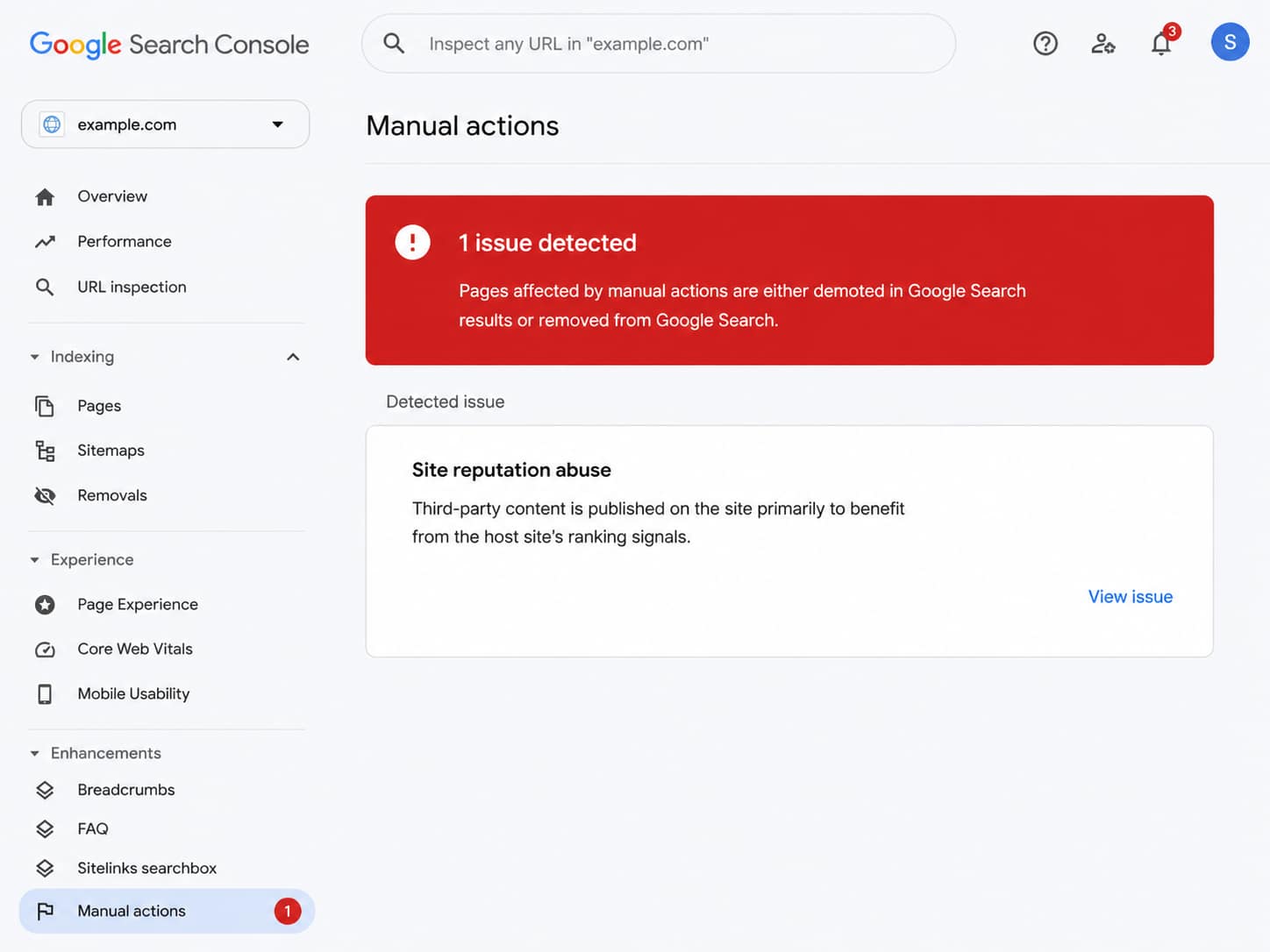
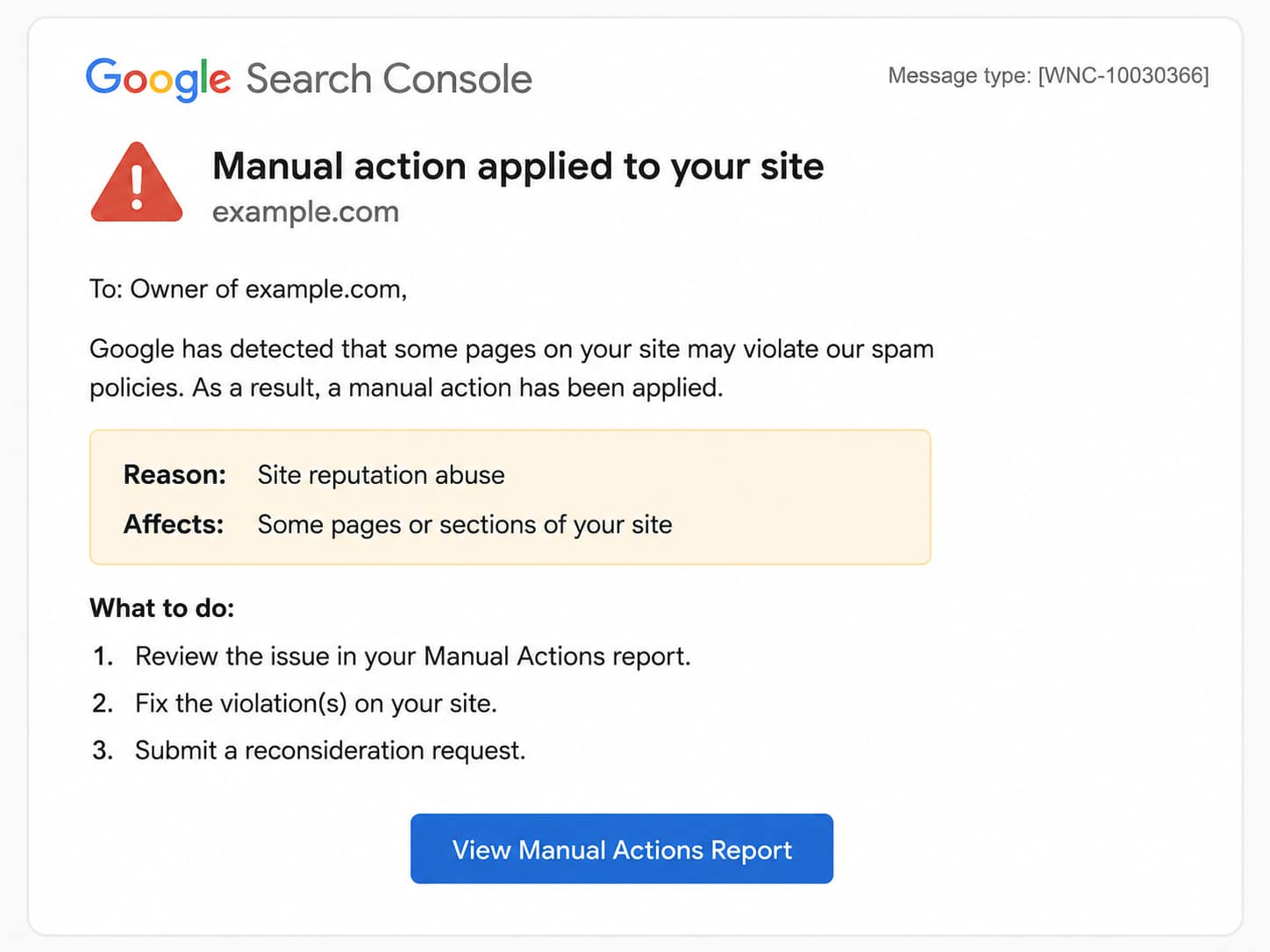
Google notifies affected website owners through the Search Console Manual Actions report and message center.
Website owners can then investigate which pages or patterns are involved.
If the website owner believes the problem has been corrected—or believes the action was incorrect—they can submit a reconsideration request.
Google reviews the request and can revoke the manual action if the site is no longer inconsistent with its spam policies.
Eligible EEA websites may also have access to an alternative dispute-resolution or mediation process after the reconsideration stage.
How to Audit Your Website for Site Reputation Risk
Publishers should review third-party and commercial content before a problem appears.
Start by identifying sections of your website that were not produced entirely by your internal editorial team.
Look especially at:
affiliate content,
sponsored articles,
coupon directories,
partner pages,
guest contributions,
product-comparison pages,
white-label tools,
third-party marketplaces,
commercial landing pages,
and old subdomains or folders managed by external companies.
Next, ask several questions.
Who wrote this content?
Who edited it?
Who owns it?
Why is it published on this domain?
Would we publish it if Google traffic did not exist?
Is it useful to our normal audience?
Can readers reach it naturally through the site?
Does it follow our editorial standards?
Does the same article appear on other websites?
Is there a clear commercial disclosure?
If several answers raise concerns, the section deserves a deeper review.
What Publishers Should Do in 2026
The safest long-term strategy is to make third-party content genuinely part of your publication rather than simply hosting it.
Maintain real editorial control.
Require original content.
Identify authors.
Review commercial claims.
Add unique research and experience.
Avoid accepting mass-distributed articles.
Make commercial relationships transparent.
Ensure the content serves your existing audience.
Integrate useful sections into your navigation where appropriate.
Keep visual presentation consistent.
Most importantly, do not sell access to your domain’s Google reputation.
A strong domain should be used to build better content—not as an SEO shortcut for unrelated third parties.
How AI-Generated Content Fits Into the Picture
AI content is not automatically site reputation abuse because the Site Reputation Policy focuses primarily on the relationship between third-party content and host-site ranking signals.
However, AI content can create additional problems under Google’s separate scaled-content-abuse rules.
Google’s spam documentation says generating many pages with generative AI or similar tools without adding meaningful value can qualify as scaled content abuse when the purpose is manipulating search rankings.
Publishers using AI should therefore focus on editorial improvement rather than volume alone.
AI can assist with research, outlining and drafting, but the final article should ideally include human verification, original insight, relevant examples, accurate sources and meaningful editorial input.
Does This Mean Domain Authority No Longer Matters?
Not exactly.
Google’s policy itself demonstrates that established sites can possess ranking signals that third parties may try to exploit.
However, SEO professionals should be careful about treating third-party “Domain Authority” or “Domain Rating” scores as if they were Google metrics.
Google’s actual ranking systems use many signals, and commercial SEO metrics are estimates created by external tools.
The Site Reputation Policy is fundamentally designed to prevent a page from gaining an unfair advantage simply because it has been placed on an established domain.
Implications for SEO Agencies
SEO agencies should review any strategy involving publishing commercial pages on third-party websites.
Traditional guest posting is not automatically prohibited.
Digital PR is not automatically prohibited.
Sponsored content is not automatically prohibited.
Affiliate publishing is not automatically prohibited.
The danger appears when the strategy effectively becomes:
“Find a powerful domain, place unrelated third-party pages on it, and use its existing ranking strength to rank content that would struggle independently.”
That model is increasingly risky.
Agencies should focus instead on genuine editorial partnerships, expert contributions, useful PR, original research and audience-relevant content.
Implications for News Publishers
Large publishers should pay particular attention because established news domains often have valuable visibility across many topics.
Before launching a new commercial vertical, publishers should ensure that it fits their audience and editorial structure.
New sections should ideally have:
clear ownership,
real editors,
named writers,
unique content,
publisher-level quality standards,
transparent disclosures,
consistent user experience,
and meaningful integration with the publication.
This can make it easier for both users and search engines to understand that the section is a genuine part of the publication rather than rented SEO space.
What the Update Means for Small Websites
Small publishers may actually benefit from stronger enforcement.
If high-authority websites can rank unrelated third-party pages simply because they have stronger domains, smaller specialist websites can struggle to compete even when their content is better.
Google says the purpose of the policy is to improve search quality and allow content to compete more fairly on its own merits.
For smaller websites, the best opportunity remains specialization.
Build expertise around a clear set of topics.
Create genuinely useful tutorials.
Add screenshots.
Publish first-hand comparisons.
Answer specific user questions.
Update old content.
Build topical depth.
Over time, a focused specialist site can compete on relevance and usefulness rather than attempting to mimic giant publishers.
Final Thoughts
The Google Site Reputation Policy Update 2026 is more than a technical change for European search results.
It gives publishers a clearer picture of what Google expects from third-party content.
The most important lesson is simple:
Third-party content itself is not the problem.
The problem arises when content is published primarily to exploit ranking strength that the host website earned through unrelated first-party work.
From August 30, 2026, enforcement differs between the EEA and the rest of the world, but the broader direction remains consistent: Google wants pages to rank based more closely on their own value, quality, integration and relevance.
Website owners should therefore audit affiliate, sponsored, freelance, white-label and partnership content now.
Clear authorship, genuine editorial oversight, original value, consistent presentation and strong audience relevance are becoming increasingly important.
Publishers that build content for users first should be in a much stronger position than those simply renting out their domain reputation.
Frequently Asked Questions
What is Google Site Reputation Abuse?
Site reputation abuse generally describes third-party content being published on an established website primarily so that the content can benefit from ranking signals the host domain has already earned. Third-party content itself is not automatically a violation.
When did Google’s latest Site Reputation Policy update take effect?
Google announced the update on August 28, 2026. The new regional treatment of manual actions began on August 30, 2026.
Does the policy affect the entire website?
Not necessarily. Outside the EEA, Google says a Site Reputation Policy manual action can directly affect the relevant portion of the site while leaving the rest unaffected.
Are affiliate articles against Google’s rules?
No. Affiliate links and affiliate content are not automatically inconsistent with the Site Reputation Policy. Problems arise when third-party content is placed primarily to exploit the ranking signals of an established host site.
Are freelance writers considered third parties?
Google lists freelancers among examples of third-party content creators, but freelancer-created content is not automatically problematic. Original content created specifically for a publication with clear authorship and genuine editorial oversight can be acceptable.
Can sponsored content rank on Google?
Sponsored or native advertising is not automatically prohibited. Publishers should focus on transparency, editorial responsibility, usefulness and avoiding publication primarily for search-ranking manipulation.
What should I do if I receive a manual action?
Check the Manual Actions report in Google Search Console, identify the affected content, correct the issue and submit a reconsideration request when you believe your site complies with Google’s policies.
Does a manual action outside the EEA affect EEA rankings?
Google says Site Reputation Policy manual actions applied outside the EEA do not directly apply to search results shown to users inside the EEA. The affected content may instead be evaluated separately from the main domain.
Is AI-generated content affected by this policy?
AI content is not automatically Site Reputation Policy abuse. However, generating large numbers of low-value pages primarily to manipulate rankings can violate Google’s separate scaled-content-abuse policy.
How can publishers protect their websites?
Maintain genuine editorial control, publish original and audience-relevant material, identify authors, disclose commercial relationships, avoid mass-distributed third-party articles and regularly review affiliate, sponsored and white-label sections.


