
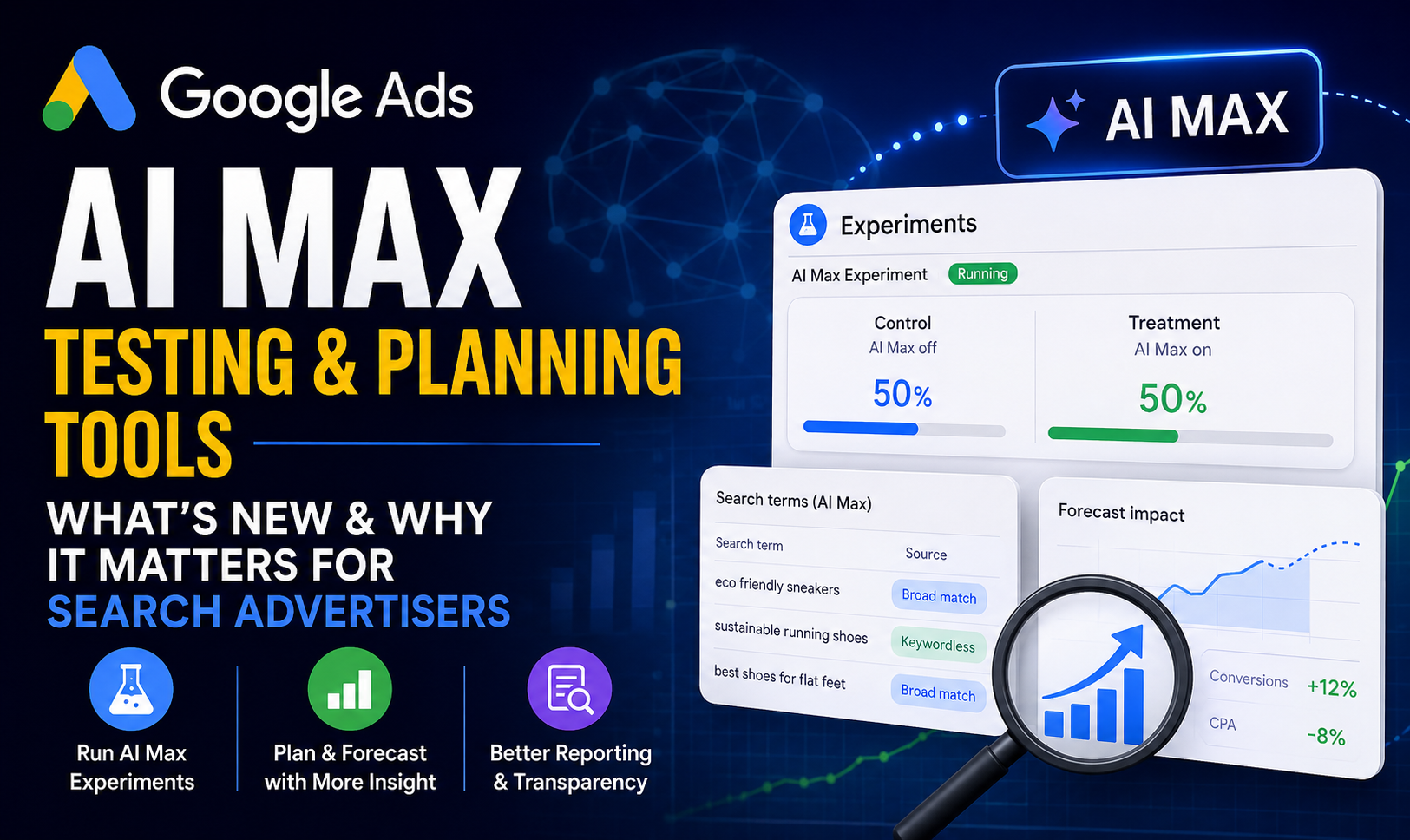
Google is giving Search advertisers more ways to evaluate AI Max before making it a broader part of their paid-search strategy. The latest testing and reporting capabilities are designed to make AI-driven Search less of an all-or-nothing decision, allowing advertisers to measure incremental traffic, inspect how automation is matching queries and assess the effect of AI-generated assets before expanding adoption.(AI Max Testing)
For PPC managers and marketing teams, the significance is less about another AI feature appearing in Google Ads and more about the platform changing how advertisers are expected to evaluate automation. Instead of deciding whether to “turn on AI” based primarily on Google’s performance claims, advertisers can increasingly use experiments and richer reporting to build their own evidence.
AI Max is becoming the default direction for Search
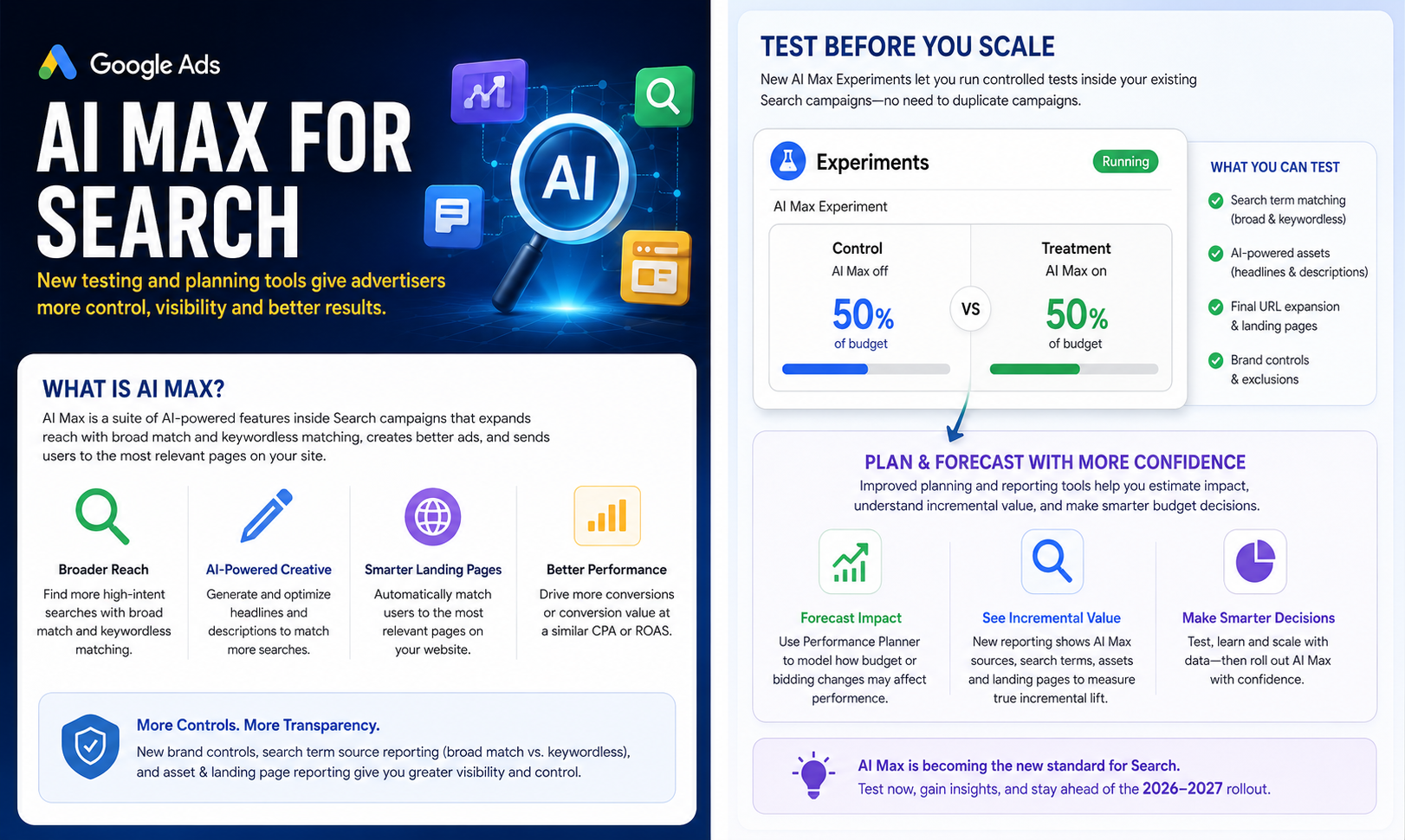
AI Max for Search is not a separate campaign type. Google describes it as an optimization layer that operates inside existing Search campaigns, combining automated search-term expansion with creative and landing-page optimization. Its targeting system can use broad-match expansion and keywordless matching to find additional queries, while text customization can generate ad copy based on signals from existing ads, landing pages and other campaign inputs. Final URL expansion can also route users to more relevant pages on an advertiser’s site. (Google Support)
That makes AI Max different from simply adding another match type to a conventional Search campaign. The system can influence several parts of the journey from query to ad to landing page, while advertisers retain controls such as brand settings, URL inclusions and exclusions, and location-of-interest settings. Google has also expanded reporting so advertisers can examine the search terms, assets and landing pages involved in AI Max traffic. (Google Support)
The broader direction is clear. Google has been moving AI Max from an experimental product toward the standard operating model for Search, while gradually folding older automation features into it.
There is an important timing correction to the commonly cited September deadline, however. Google originally announced that Dynamic Search Ads, automatically created assets and campaign-level broad match would move to AI Max beginning in September 2026. In June, Google delayed the automatic migration of Dynamic Search Ads until February 2027, while retaining the September 2026 transition for campaigns using automatically created assets and the campaign-level broad-match setting. (blog.google)
That distinction matters for advertisers planning the next several months. DSA users have more time to run controlled comparisons, but advertisers relying on automatically created assets or campaign-level broad match are still approaching a significant AI Max transition point.
The testing model is becoming much more practical
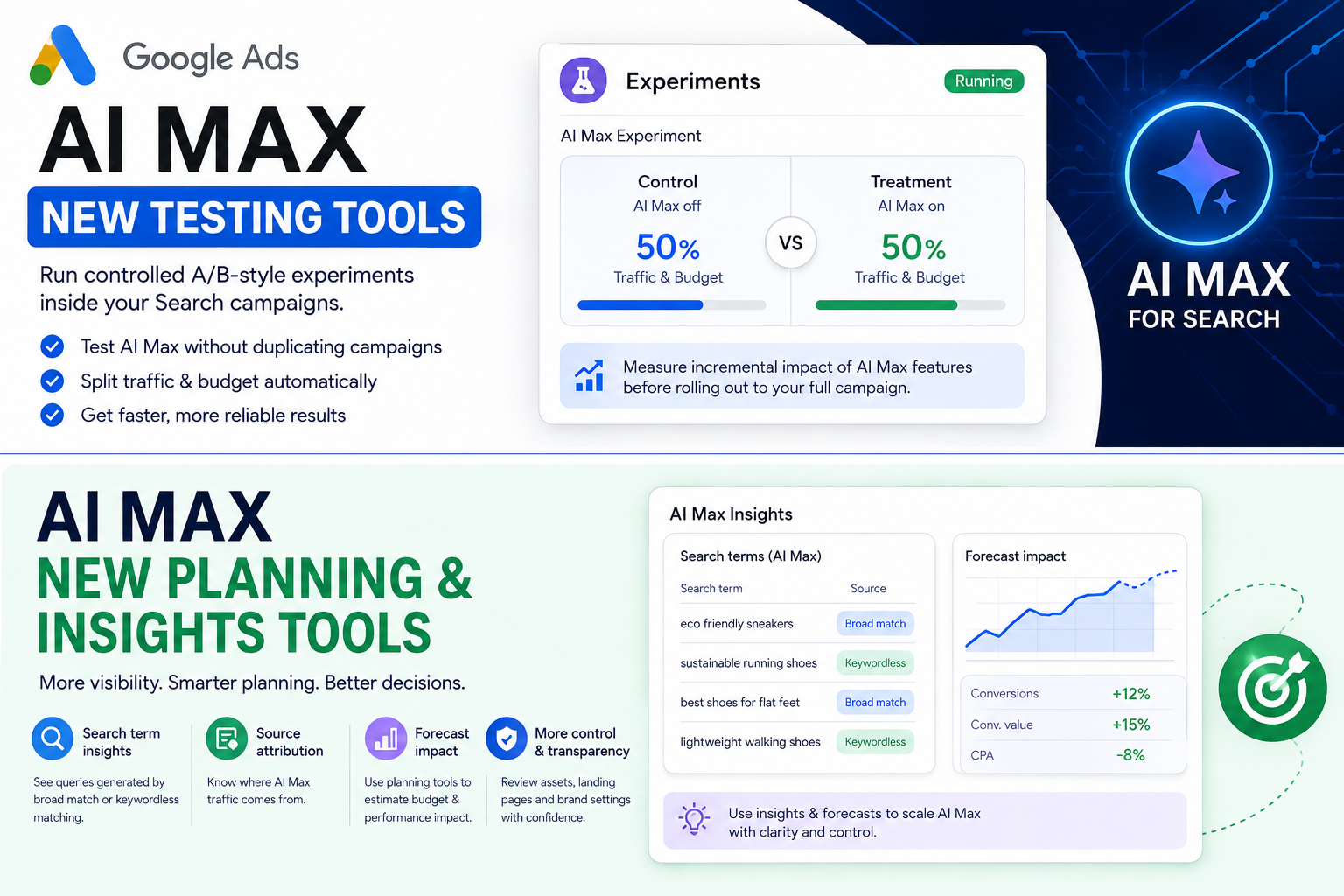
One of the most useful additions is AI Max experimentation. Google now provides a dedicated experiment type that can test AI Max settings within an existing Search campaign rather than requiring advertisers to create a conventional duplicate campaign for the treatment group. (Google Support)
AI Max Testing
The basic concept is straightforward. A portion of the campaign acts as the control with AI Max turned off, while the remaining traffic operates with the selected AI Max features enabled. Google says the setup can split traffic and budget within the same campaign, reducing the duplication and synchronization issues that can occur when advertisers build separate control and test campaigns. (Google Support)
That may sound like an implementation detail, but it addresses a genuine problem with testing Search automation.
AI Max Testing AI Max Testing AI Max Testing AI Max Testing AI Max Testing AI Max Testing AI Max Testing
Traditional Google Ads experiments often require advertisers to duplicate campaign structures. That means duplicating ad groups, ads, keywords and targeting, then making sure the control and treatment versions remain comparable. Separate campaigns can also introduce differences in budgets, bidding behavior or campaign history that complicate interpretation.
The AI Max experiment approach is intended to reduce some of that friction. Google says keeping the test inside the existing campaign can shorten the learning period and reduce setup errors because the control and treatment remain within the same campaign environment. (Google Support)
The experiment can test AI Max’s core Search capabilities, including search-term matching and asset optimization. Advertisers can also adjust certain AI Max controls on the treatment side, giving teams an opportunity to evaluate automation without immediately committing the entire campaign to it. (Google Support)
For PPC teams, this changes the question from “Should we adopt AI Max?” to a more useful one: “What does AI Max actually add to this campaign?”
That is a much better question. AI Max Testing
Why controlled testing matters for AI-driven Search
The biggest challenge with Search automation is not necessarily that the technology performs badly. It is that performance can be difficult to interpret.
A campaign can produce more conversions after an automation feature is enabled, but that does not automatically prove that the feature generated incremental conversions. Some of the traffic may have come from searches that the campaign was already capable of capturing. Some conversions may have shifted between targeting mechanisms rather than representing genuinely new demand.
This is particularly important for AI Max because its matching system can extend beyond an advertiser’s explicitly selected keywords. Google’s reporting now distinguishes AI Max traffic and provides source information that can identify whether a match came from broad-match expansion or keywordless matching. (Google Support)
A proper control-versus-treatment test provides a stronger basis for judging incremental impact.
For example, suppose a non-brand Search campaign is already producing 500 conversions a month. Turning on AI Max and seeing 550 conversions does not, by itself, establish that AI Max created 50 incremental conversions. A controlled test gives the advertiser a much better opportunity to estimate what would have happened without the change.
That is especially valuable when automation can alter the distribution of existing traffic as well as uncover new searches.
Google’s own documentation recommends giving AI Max campaigns time to learn before making frequent changes. Its reporting guidance currently suggests waiting at least two weeks after activation before making certain optimization changes, although the appropriate test duration will depend on conversion volume, sales cycle and account volatility. (Google Support)
In other words, an experiment is not a substitute for statistical discipline. It is a better starting point.
Reporting is becoming part of the testing story
The second major development is the expansion of reporting around AI Max.
Google now provides an AI Max-oriented view of Search-term reporting that brings together the search query, headlines and landing pages associated with the customer’s ad journey. The Search terms report can also expose a source field showing whether AI Max matching originated from broad-match expansion or keywordless matching. (Google Support)
The Keywords report adds aggregate AI Max rows that separate traffic generated through expanded keyword matching from traffic associated with landing-page or asset-based matching. Meanwhile, the Landing Pages and Asset reports provide additional visibility into pages and creative generated or selected through AI Max. (Google Support)
This is important because automation without diagnostics is difficult to manage.
A PPC manager needs to know not only whether a campaign generated conversions, but also what kinds of searches produced those conversions, which creative was shown and where users were sent. AI Max does not eliminate that requirement. If anything, the more decisions the system makes automatically, the more valuable those diagnostics become.
The new reporting therefore serves two purposes.
First, it gives advertisers more operational control. Poorly aligned search terms, landing pages or generated assets can be identified and excluded.
Second, it improves the quality of strategic analysis. Advertisers can begin asking whether AI Max is expanding into valuable intent categories, whether it is finding genuinely new demand and whether the resulting creative and landing-page combinations are commercially useful.
That is a more sophisticated approach than simply watching CPA or ROAS.
What about planning and forecasting?
Planning is where expectations need to be separated from what Google has actually documented.
Google’s broader Google Ads planning infrastructure already includes Performance Planner, which can model how changes to budgets and bidding targets may affect campaign performance. Performance Planner supports Search and Performance Max among other campaign types, and Google says its forecasts incorporate conversion-delay estimates for relevant planning scenarios. (Google Support)
But advertisers should not treat a generic Google Ads forecast as a precise prediction of what AI Max will contribute.
AI Max changes the targeting and creative mix inside Search. Its incremental effect can therefore depend heavily on the existing campaign structure, conversion signals, brand/non-brand mix, keyword coverage, landing pages and available search demand.
The more useful planning exercise is to combine Google’s planning estimates with actual AI Max experiment data.
For example, a media buyer could establish a baseline for current conversions, CPA and spend; run an AI Max test; measure the incremental change; and then use the observed lift or deterioration as an input to a larger budget scenario. That is more defensible than extrapolating directly from a platform-generated forecast.
This is also where the distinction between planning tools and performance reporting matters. Reporting can tell advertisers what AI Max has already done. Planning tools help estimate what might happen if budgets or targets change. Neither should be confused with a guaranteed forecast of incremental AI Max performance.
Why advertisers should care now
The timing makes these tools more consequential.
Google’s AI Max strategy is not simply an optional experiment sitting alongside traditional Search forever. Google has said AI Max is moving out of beta, and its transition plans increasingly make the technology part of the standard Search experience. (blog.google)
Google has also said that AI Max campaigns using the full feature set have produced an average 7% increase in conversions or conversion value at similar CPA or ROAS compared with campaigns using search-term matching alone. That is Google’s own internal figure for non-Retail advertisers, not an independent industry benchmark, so advertisers should treat it as a platform-reported performance claim rather than a universal expectation. (blog.google)
Independent testing has produced a more complicated picture. A Search Engine Land analysis of 23 tests across 16 advertisers found that AI Max results varied according to the features being used and the account context. (Search Engine Land)
That variation is precisely why testing matters.
An automation feature does not need to be universally good or bad to be strategically important. It needs to work well enough in a particular account to justify the trade-offs involved.
For an enterprise advertiser with strict brand requirements, a small increase in conversion volume may not compensate for unsuitable generated copy or questionable query expansion. For a lead-generation advertiser with strong conversion-quality signals and significant untapped search demand, the same automation may provide substantial upside.
The account—not the product announcement—should determine the decision.
What PPC managers should do next
1. Start with a non-brand campaign that has enough conversion volume
The safest starting point is generally a stable, non-brand Search campaign where conversion quality is well understood.
Avoid making your first AI Max experiment on a strategically sensitive brand campaign or a campaign with highly volatile conversion volume. A non-brand campaign with established conversion tracking provides a cleaner environment for judging whether automation is finding useful incremental demand.
The objective is not simply to generate more traffic. It is to establish whether additional traffic produces commercially valuable conversions at an acceptable efficiency.
2. Define the test before turning anything on
Decide in advance which metrics will determine success.
CPA and ROAS should usually be included, but they should not be the only metrics. Track conversion volume, conversion value, spend, search-term categories, new query themes and lead quality where applicable.
For lead-generation accounts, this distinction is critical. A campaign can appear to improve on platform-reported CPA while generating a larger share of low-quality inquiries.
Likewise, an ecommerce campaign should look beyond conversion count to revenue and margin where those data are available.
3. Inspect the search-term and asset reports throughout the test
Do not treat the experiment as a black box.
Use the AI Max reporting views to examine which searches are being captured, where traffic is landing and which generated assets are serving. Google’s reporting tools now make it easier to distinguish AI Max traffic sources and inspect search-term, headline and URL combinations. (Google Support)
This is where brand and creative governance becomes particularly important.
If protecting branded traffic is a priority, review the available brand controls and exclusions before launching the test. Google provides campaign- and, in some cases, ad-group-level brand controls intended to give advertisers more precision over brand-related matching. (Google Support)
4. Treat the result as evidence, not a verdict
A single test should not become an automatic justification for account-wide deployment.
If AI Max produces a positive result, examine where the improvement came from. Was it incremental non-brand demand? Better landing-page selection? More relevant creative? A shift in traffic allocation? Or simply additional volume from queries the existing campaign was already positioned to capture?
The same scrutiny should apply to a negative result.
A weak AI Max test does not necessarily mean the technology is unsuitable everywhere. It may indicate that the campaign lacks sufficient conversion data, has weak landing-page coverage, uses unsuitable creative inputs or has a search mix that does not benefit from broader automation.
AI Max is moving PPC management from configuration to experimentation
The most significant change may therefore be methodological.
Traditional Search management has often revolved around campaign structure, keyword selection, match types, bids and negatives. As Google automates more of those decisions, the PPC manager’s role shifts toward setting constraints, supplying strong signals, validating outputs and measuring incremental business impact.
That makes experimentation more—not less—important.
The same principle is already visible in Performance Max, where Google continues to add testing, asset and reporting capabilities intended to make an increasingly automated system easier to evaluate. Google’s broader Ads ecosystem is moving toward a model in which marketers guide machine learning rather than manually controlling every auction-level decision. (Search Engine Land)
AI Max fits that trajectory.
For advertisers, the goal should not be to preserve every historical Search-control mechanism indefinitely. Nor should it be to accept Google’s automation simply because it promises more conversions.
The practical middle ground is controlled adoption.
Run the experiment. Establish a baseline. Watch the query mix. Review the generated creative. Check the landing pages. Measure incremental outcomes. Then decide whether the additional automation deserves more budget.
What to watch next
Google has already indicated that AI Max will continue to evolve. The company has expanded reporting, added experiments, broadened creative controls and continued work on features such as text guidelines intended to give advertisers more influence over AI-generated messaging. (blog.google)
That suggests the current collection of AI Max controls should not be viewed as a finished product.
For PPC managers, that is both an opportunity and a warning. More measurement and experimentation can make automation easier to govern, but every new control can also change how existing tests should be interpreted.
The immediate priority is therefore not to predict exactly where AI Max will end up. It is to build a testing framework that can keep pace with it.
Advertisers approaching the September 2026 transition should audit which legacy settings are affected, identify suitable campaigns for controlled AI Max tests and establish their reporting baselines now. DSA advertisers have additional runway because Google’s automatic DSA migration is now scheduled for February 2027, but the strategic direction is unchanged: Search is becoming more automated, and the ability to measure that automation is becoming a core PPC skill. (blog.google)
For media buyers and marketing directors, that is ultimately the value of Google’s new AI Max testing and planning approach. It does not remove the risk of automation. It gives advertisers a better way to quantify that risk—and, where the evidence supports it, make the case for scaling AI Max with confidence.
I’d recommend using this as the publication draft, with the September 2026 vs. February 2027 DSA distinction preserved because Google changed that timeline in June. (Google Ads Developer Blog)