
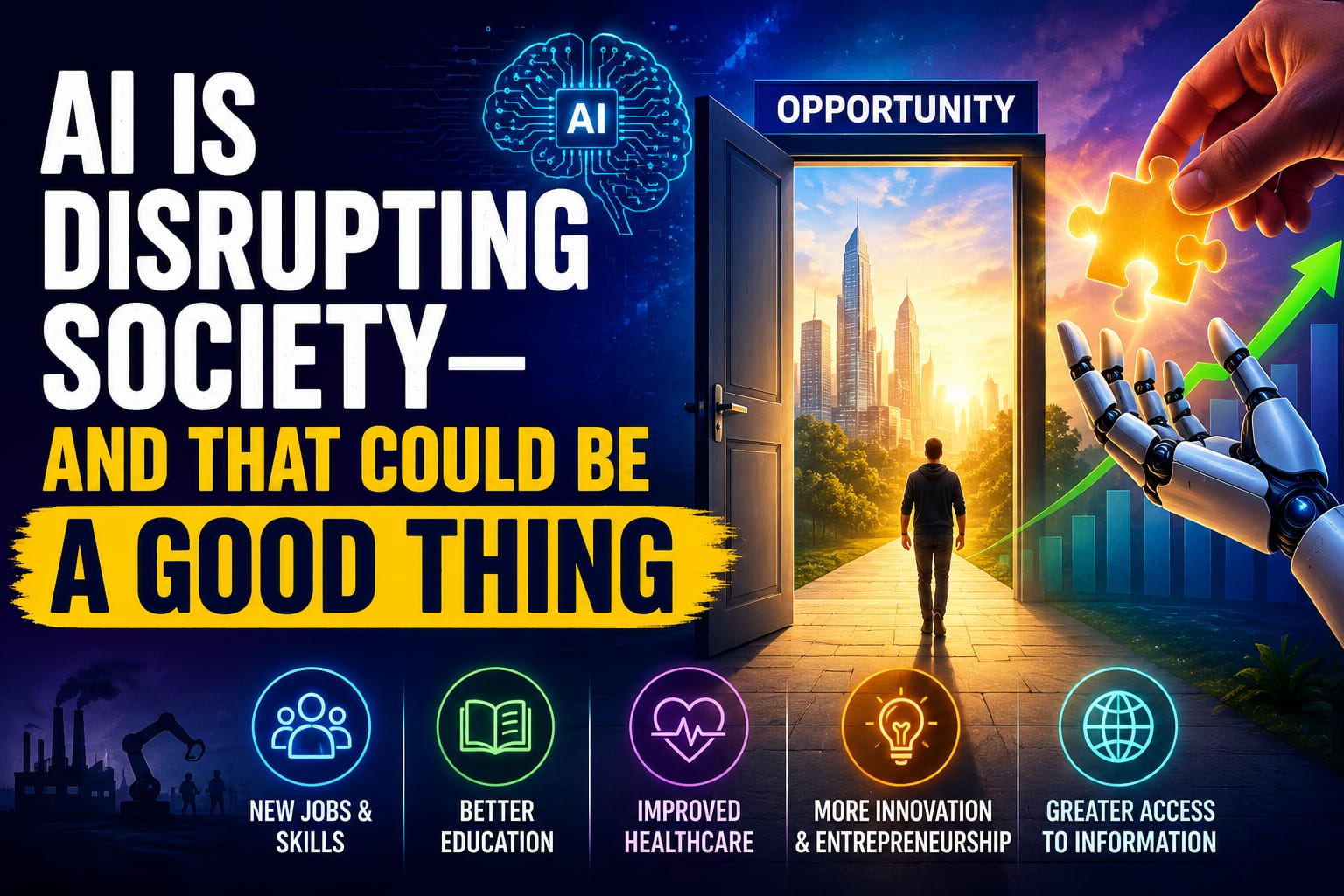
For the past few years, the conversation around artificial intelligence has been dominated by anxiety. Headlines warn of vanishing jobs, deepfakes eroding trust, and algorithms quietly reshaping how people think, vote, and spend. The unease is understandable —
few technologies have moved this fast or touched this many corners of daily life at once. But disruption and disaster are not the same thing. History suggests that the periods when society feels most unsettled by a new technology are often the same periods in which that technology delivers its greatest long-term gains. AI may be no exception.

This is not a claim that everything about the current moment is fine, or that the people losing jobs, income, or a sense of stability should simply wait patiently for the upside to arrive. It’s a more specific argument: that the underlying pattern of disruption followed by adaptation followed by broad benefit has repeated often enough, across enough different technologies, that it deserves to be taken seriously as a lens for understanding what’s happening right now — rather than dismissed in favor of either blind techno-optimism or blanket doom.
Disruption Is the Price of Progress, Not a Sign of Failure
Every transformative technology has forced a period of painful adjustment before its benefits became obvious. The printing press upended the Church’s monopoly on knowledge and fueled religious wars. The steam engine emptied out agrarian villages and packed people into grim industrial cities. Electricity made entire trades — lamplighters, ice deliverymen — disappear within a generation. In each case, the disruption was real, and the people living through it rarely got the comfort of knowing how the story would end.
Consider the automobile. When cars began replacing horses in American cities in the early twentieth century, entire industries — blacksmiths, stable owners, carriage manufacturers, feed suppliers — collapsed within a couple of decades. Cities that had been built around the logistics of horse transportation, including networks of watering troughs and manure removal services employing thousands of people, had to be physically reorganized. The transition was disorienting and it destroyed livelihoods that had existed for generations. And yet the automobile also created entirely new categories of work — mechanics, road construction, insurance, motels, suburban development — that employed vastly more people than the industries it replaced, while also collapsing travel times and opening economic opportunity to people who had previously been geographically isolated.
Or consider the personal computer and, later, the internet. In the 1980s and 1990s, critics warned that computers would hollow out the middle class by automating clerical and administrative work. Some of that did happen — the well-paid typing pool and the switchboard operator are gone. But the same technology created software engineering, digital marketing, e-commerce logistics, and an entire creator economy that didn’t exist before. The net effect, measured over decades rather than years, was an economy that employed more people in higher-skilled, higher-paying work than the one it displaced — though that net gain was cold comfort to the specific individuals whose specific jobs disappeared in the meantime, a tension that any honest account of technological change has to sit with rather than explain away.
What’s different with AI is the pace. Earlier technologies diffused over decades, giving institutions — schools, labor markets, legal systems — time to adapt gradually. The automobile took roughly forty years to go from novelty to ubiquity in American life. The internet took about fifteen. AI’s capabilities are compounding on a timescale of months, which means the disruption feels more concentrated and more visible. That visibility is often mistaken for severity. A faster transition is not necessarily a worse one; it just compresses the discomfort into a shorter, more noticeable window, which makes the adjustment harder to plan for and puts far more pressure on institutions — legislatures, school boards, corporate HR departments — that are not built to move quickly.
This speed differential matters enormously for how the disruption should be managed, even if it doesn’t change the basic shape of the historical pattern. A slow-moving disruption gives workers time to retrain gradually, gives lawmakers time to study effects before legislating, and gives cultural norms time to catch up organically. A fast-moving one requires those same adaptations to happen deliberately and quickly, which is a much harder trick to pull off — and it’s the central reason why so much of the current anxiety about AI is legitimate, even for people who are otherwise optimistic about where the technology eventually leads.
Where the Disruption Is Actually Landing
It’s worth being specific about where AI is genuinely upending existing structures, because the vague fear of “robots taking over” obscures more concrete and, in some cases, more hopeful shifts.
Work is being restructured, not simply erased. Routine cognitive tasks — first-pass drafting, basic data entry, elementary customer support — are increasingly automated. But the pattern emerging in most sectors isn’t wholesale job elimination; it’s task reallocation. Radiologists now spend less time squinting at scans for anomalies and more time on complex diagnoses and patient consultations, using AI-flagged regions of interest as a starting point rather than a replacement for their judgment. Paralegals spend less time on document review and more on case strategy, client communication, and the parts of legal work that require an actual read on how a judge or opposing counsel will react. Software engineers increasingly describe their jobs shifting away from writing boilerplate code and toward architecture decisions, code review, and figuring out what to build in the first place — the parts of the job that were always more valuable but got crowded out by the sheer volume of routine implementation work.

The jobs that survive and grow tend to shift toward judgment, relationship-building, and the messy, context-heavy problems that resist automation. This is visible in customer service, where AI now handles the high-volume, low-complexity tickets — password resets, order status checks, basic troubleshooting — while human agents are increasingly routed toward the emotionally charged or genuinely novel cases that require empathy and improvisation. Companies that have tried to fully automate customer service, cutting out the human layer entirely, have frequently had to walk the decision back after customer satisfaction cratered; the pattern that has actually stuck is augmentation, not replacement.
It’s also worth noting which jobs are proving stubbornly resistant to automation, because the pattern is instructive. Skilled trades — electricians, plumbers, HVAC technicians — require physical dexterity in unpredictable environments that current AI and robotics can’t match, and demand for these roles has if anything increased as fewer young people enter the trades. Elder care and childcare, which depend on trust, patience, and physical presence, remain almost entirely outside AI’s reach. And roles that depend on personal reputation and relationships — sales, consulting, therapy, high-end hospitality — are proving durable precisely because the human relationship is the product, not just the delivery mechanism for it. Looking across these examples, a rough principle emerges: the more a job depends on repeatable pattern recognition applied to structured information, the more exposed it is to disruption; the more it depends on physical presence, trust, or judgment under genuine uncertainty, the more insulated it tends to be.
Education is being forced to confront a decades-old flaw. For generations, schools have optimized for tasks — essay writing, problem sets, memorized recall — that AI can now perform passably well. Rather than a threat, this is arguably a long-overdue audit. If a five-second prompt can produce a passing essay, the assignment was measuring the wrong thing all along; it was testing a student’s ability to produce a certain shape of text, not their ability to think, and AI has simply made that gap impossible to ignore any longer.

The panic response — banning AI tools outright, reverting to closed-book, pen-and-paper exams for everything — treats the symptom rather than the underlying problem, and most educators who have looked closely at the issue have concluded it’s not sustainable as a long-term strategy. Institutions that respond instead by shifting toward oral exams, in-class writing under observation, project-based assessment, and explicit instruction in how to use AI tools critically and transparently are seeing more encouraging results. Some university programs have started requiring students to submit their AI chat logs alongside finished work, turning the tool into a visible part of the process rather than a hidden shortcut — which incidentally teaches a skill, prompting and critically evaluating AI output, that students will need in almost any knowledge-work career they enter.
There’s a broader argument here too: the traditional model of education as a one-time credentialing event — attend school for a fixed number of years, receive a degree, apply that knowledge for a career — was already strained by how quickly industries change. AI accelerates that strain, but it also offers a partial remedy. Personalized tutoring, once available only to wealthy families who could afford private tutors, is becoming accessible to far more students through AI systems that can adapt explanations to an individual student’s pace and gaps in understanding. Early studies on AI-assisted tutoring in math and reading have shown meaningful gains for students who were previously falling behind, particularly in under-resourced schools where one teacher might be responsible for thirty or more students at wildly different levels. None of this replaces good teachers — the evidence consistently shows AI tutoring works best as a supplement to, not a substitute for, a human teacher who provides structure, motivation, and accountability — but it does mean the gap between a well-resourced student and an under-resourced one may start to narrow rather than widen.
Information gatekeeping is fragmenting. Traditional media, academic publishing, and expert institutions have lost some of their control over how information reaches the public, and AI-generated content has made that landscape noisier and, in places, more polluted with misinformation. This is a genuine and serious problem — synthetic text and images have made it cheaper than ever to flood public discourse with convincing falsehoods, and the institutions responsible for fact-checking and content moderation have struggled to keep pace with the volume.
But the same disruption is also democratizing access to expertise in ways that matter a great deal to people who were previously locked out of it. A small business owner can now get a first-pass read on a contract or a basic medical question without the cost of an attorney or a doctor’s visit — not a replacement for professional advice in complex situations, but a meaningful upgrade from having no accessible starting point at all. An immigrant navigating an unfamiliar bureaucracy can get help understanding a government form in their own language. A patient with a rare condition can quickly find and understand recent research that even a busy general practitioner might not have had time to read.
This fragmentation of expertise is genuinely double-edged, and it’s worth being honest about both sides rather than picking one. The same tool that helps a small business owner understand a contract can also produce a convincing but entirely wrong legal opinion with equal confidence, and the average user has no easy way to tell the difference without some baseline of media and AI literacy that most education systems have not yet caught up to teaching. What seems to distinguish societies that navigate this well from those that don’t is less about the technology itself and more about whether institutions invest early in the literacy and verification habits people need to use these tools responsibly — treating AI output as a draft or a starting point rather than a final answer, and knowing when a question is important enough to warrant a human expert’s judgment.
Healthcare: A Case Study in High-Stakes Disruption
Healthcare is perhaps the clearest place to see both the promise and the genuine risk of AI-driven disruption side by side, because the stakes of getting it wrong are so immediate and personal.
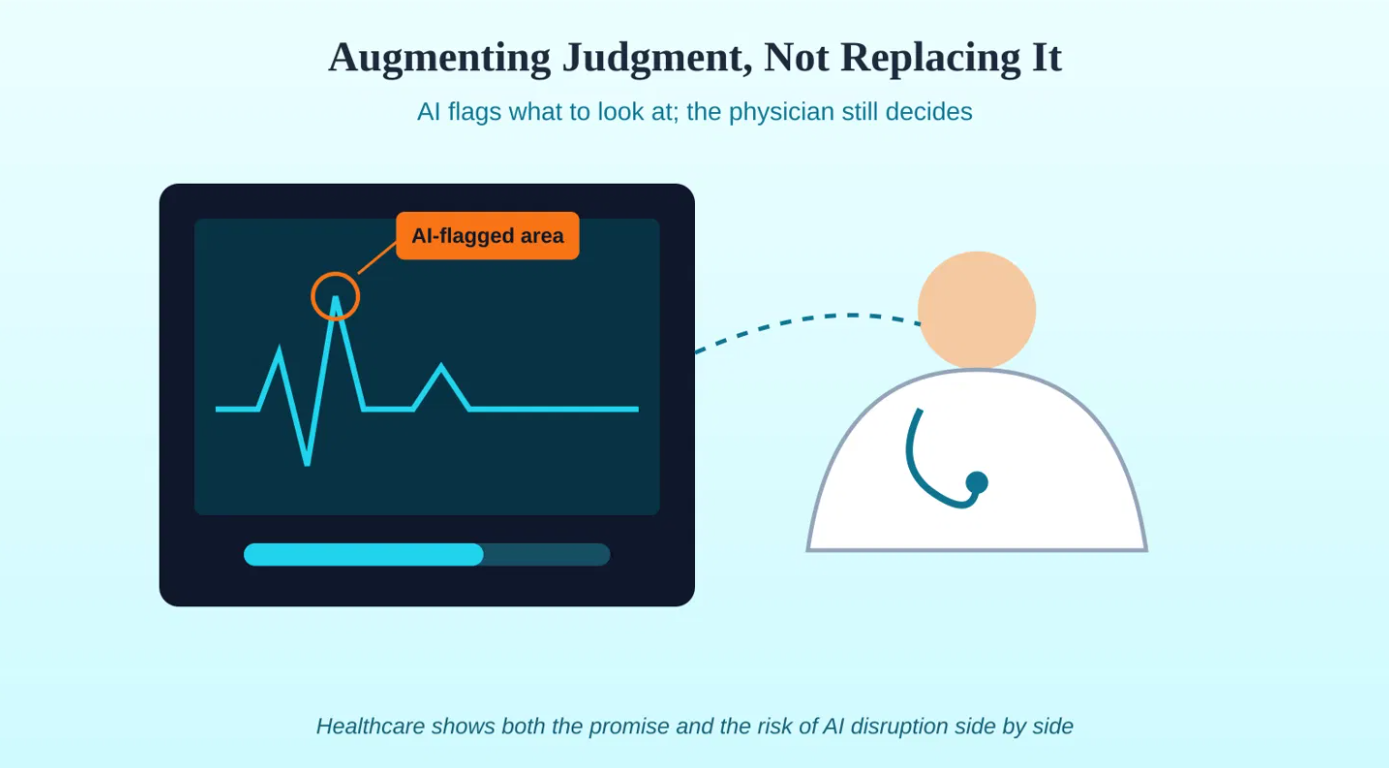
On the promising side, AI-assisted diagnostic tools are catching things human doctors sometimes miss, particularly in image-heavy specialties like radiology, dermatology, and pathology, where pattern recognition across thousands of prior cases can flag subtle anomalies that are easy for a fatigued human eye to overlook during a long shift. Drug discovery pipelines that used to take the better part of a decade to identify promising molecular candidates are being compressed as AI models predict protein structures and simulate drug interactions before a single physical trial begins. Administrative AI is cutting down the paperwork burden that has been widely cited as a leading driver of physician burnout, giving doctors more actual time with patients instead of screens.
On the risk side, the same technology raises hard questions that the industry has not fully answered. Algorithmic bias in training data has led to documented cases of diagnostic tools performing less accurately for patients from underrepresented demographic groups, which risks encoding and scaling existing healthcare disparities rather than fixing them. Overreliance on AI triage systems, especially in under-resourced hospitals looking to cut costs, could erode the clinical judgment and hands-on experience that doctors need to develop over years of training. And the sheer pace of new tools entering clinical settings has outstripped the regulatory infrastructure — bodies like the FDA — that exists to evaluate whether they’re actually safe and effective before widespread deployment.
The lesson from healthcare generalizes: AI’s disruption tends to be genuinely good where it augments human judgment with better information and worse where it’s used as a excuse to remove human judgment from the loop entirely, particularly in high-stakes decisions. Which of those two paths a given industry ends up on is not predetermined by the technology — it’s determined by the choices institutions make about how to deploy it.
The Case for Optimism
None of this dismisses the real costs of disruption — displaced workers deserve more than a paragraph about “long-term gains,” and the transition period matters enormously to the people living through it. But there are concrete reasons to believe the disruption is pointed toward a better equilibrium.
It is compressing expertise gaps. Skills that once took years of specialized training to acquire — basic coding, data analysis, drafting legal or technical documents — are becoming accessible to far more people. This doesn’t eliminate the value of deep expertise, but it does lower the floor, giving more people the tools to start businesses, advocate for themselves, or move into new fields. A solo entrepreneur can now build and launch a working product without hiring a development team. A freelance designer can offer copywriting and basic legal document review as add-on services. A community organizer can draft grant applications that once required an expensive consultant. None of these people become experts overnight, but the cost of getting competent, useful help on tasks outside their core skill set has dropped dramatically — and that drop matters most for people who previously couldn’t afford to pay for that help at all.
It is exposing inefficiencies that societies had learned to tolerate. Healthcare systems, legal processes, and government bureaucracies are full of friction that persisted mostly because no one had the tools to fix it cheaply, and because the people affected by that friction — patients, defendants, applicants for public benefits — often had the least power to demand change. AI is now cheap enough, and capable enough, to attack that friction directly — flagging medication errors before they reach a patient, catching contract loopholes before they’re signed, cutting processing times for public benefit applications from months to days. Several city and state governments have begun piloting AI tools to clear backlogs in unemployment claims processing and permit applications, areas where delays had disproportionately harmed lower-income residents who couldn’t afford to wait. This kind of quiet, unglamorous efficiency gain rarely makes headlines, but it may end up affecting more people’s daily lives than the flashier applications of the technology.
It is forcing overdue conversations about what humans actually value in work. As routine tasks get automated, the qualities that remain distinctly valuable — empathy, judgment, creativity, trust — are getting more attention, not less. Jobs centered on care work, teaching, negotiation, and craftsmanship may see rising status and pay precisely because they resist automation, and there are early signs of this shift already: nursing, skilled trades, and early-childhood education have seen renewed public and policy attention in several countries specifically framed around their resistance to automation. There’s also a cultural dimension worth naming — a society that has spent a century treating efficiency and output as the primary measures of a job’s worth may be pushed, by necessity, toward valuing the kinds of work that are slow, relational, and hard to measure, simply because those are the jobs that remain distinctly human.
It is accelerating scientific and medical progress. AI-assisted drug discovery, protein folding research, and materials science are shortening timelines that used to stretch across entire careers. Problems that once took a research team years of trial and error to narrow down — which molecular structures might treat a particular disease, which material compositions might yield a better battery — can now be pre-screened computationally, letting human researchers focus their limited lab time on the most promising candidates. The disruption to how research is conducted is real: grant structures, publication incentives, and scientific training are all built around an older, slower model of discovery, and adapting them is its own institutional challenge. But the payoff — faster treatments, better materials, more efficient energy systems — compounds for everyone downstream, including people who will never interact with an AI tool directly but will benefit from the medicine or technology it helped produce.
It is lowering the barrier to entrepreneurship and economic participation. Starting a small business has historically required either capital to hire specialized help — accountants, marketers, web developers — or the time to become a generalist yourself. AI tools are collapsing that requirement for a wide range of early-stage tasks: drafting a business plan, generating marketing copy, building a basic website, modeling simple financial projections. This doesn’t replace the deeper expertise a growing business eventually needs, but it means more people can get a venture off the ground with less upfront capital, which historically has been one of the biggest barriers to entrepreneurship for people without existing wealth or connections.
Taking the Skeptics Seriously
An honest article about AI’s potential upside has to grapple directly with the strongest versions of the counterarguments, rather than the weakest ones.
The first is concentration of power. Unlike earlier technological shifts, the infrastructure needed to build the most capable AI systems — enormous computing clusters, vast training datasets, specialized engineering talent — is concentrated in a small number of companies and countries. If the economic gains from AI accrue disproportionately to those who already control that infrastructure, the technology could widen inequality rather than narrow it, no matter how many individual users benefit at the margins. This is a real risk, and it’s one that market forces alone are unlikely to correct — it requires deliberate policy choices around antitrust enforcement, data governance, and possibly new models for distributing the economic gains of automation, such as adjustments to how capital versus labor is taxed.
The second is the transition cost itself. Even if the long-run outcome is positive in aggregate, aggregate gains are cold comfort to a fifty-five-year-old worker whose specific skill set has just become obsolete, with limited time or appetite to retrain into an entirely new field. Historically, societies have managed technological transitions unevenly, and the workers who bore the brunt of earlier disruptions — from displaced manufacturing workers in the late twentieth century to coal miners more recently — often never fully recovered their previous standard of living, even as the broader economy grew. Any honest optimism about AI has to acknowledge that “society benefits in the long run” and “this specific person is not harmed in the short run” are two different claims, and only real investment in retraining programs, income support, and transition assistance can bring the second closer to the first.
The third is the erosion of shared reality. As AI-generated text, images, and video become harder to distinguish from authentic content, the shared factual baseline that democratic societies depend on to function is under real strain. This is not a problem that resolves itself through market competition or user adaptation alone — it likely requires new norms around content provenance, platform accountability, and possibly regulation around synthetic media disclosure, developed faster than has historically been typical for technology policy.
Taking these concerns seriously doesn’t undermine the case for optimism; it sharpens it. The argument isn’t that AI’s disruption is automatically good. It’s that disruption of this kind has, across history, tended to resolve toward broad benefit when societies respond to it deliberately — and tended to resolve toward harm and concentrated power when they don’t. Which outcome AI produces this time is still an open question, and it will be decided by choices being made right now in legislatures, corporate boardrooms, and classrooms, not by the technology itself.
Disruption Well-Managed vs. Disruption Left Alone
The optimistic case for AI is not a claim that things will simply work out. It’s a claim that disruption, if actively managed, tends to produce better outcomes than the status quo it replaces — but the “actively managed” part is doing a lot of work. The Industrial Revolution eventually produced shorter workweeks, labor protections, and rising living standards, but only after decades of exploitation and organizing forced those changes into existence. Nothing about AI’s trajectory guarantees a similarly good ending; it guarantees only that the technology will keep reshaping incentives, and that human choices about policy, education, and corporate behavior will determine whether the disruption resolves toward broad benefit or narrow concentration of power.
That’s the more honest version of the “good thing” argument: not that disruption is inherently virtuous, but that a society willing to treat this moment as a genuine inflection point — rethinking how it trains people, distributes gains, and regulates powerful tools — has a real shot at coming out the other side stronger, more capable, and more equitably served than it went in.
Conclusion
Disruption is uncomfortable by design; it means old assumptions no longer hold and new ones haven’t yet solidified. AI’s disruption of work, education, and information is genuine, and dismissing the anxiety around it would be both dishonest and unhelpful to the people bearing its costs. But discomfort is not the same as decline. If history is any guide, the societies that treat this disruption as a prompt to rebuild outdated systems — rather than a threat to be resisted — are the ones that will look back on this period as the beginning of something better, not the end of something safe.


