
B2B advertising has never been simply about generating the largest possible number of form submissions. For companies with long sales cycles, multiple decision-makers, high customer acquisition costs, and complex buying journeys, the real objective is much more valuable: finding the right prospects and turning them into qualified opportunities and customers.
Google Ads is increasingly moving in that direction.
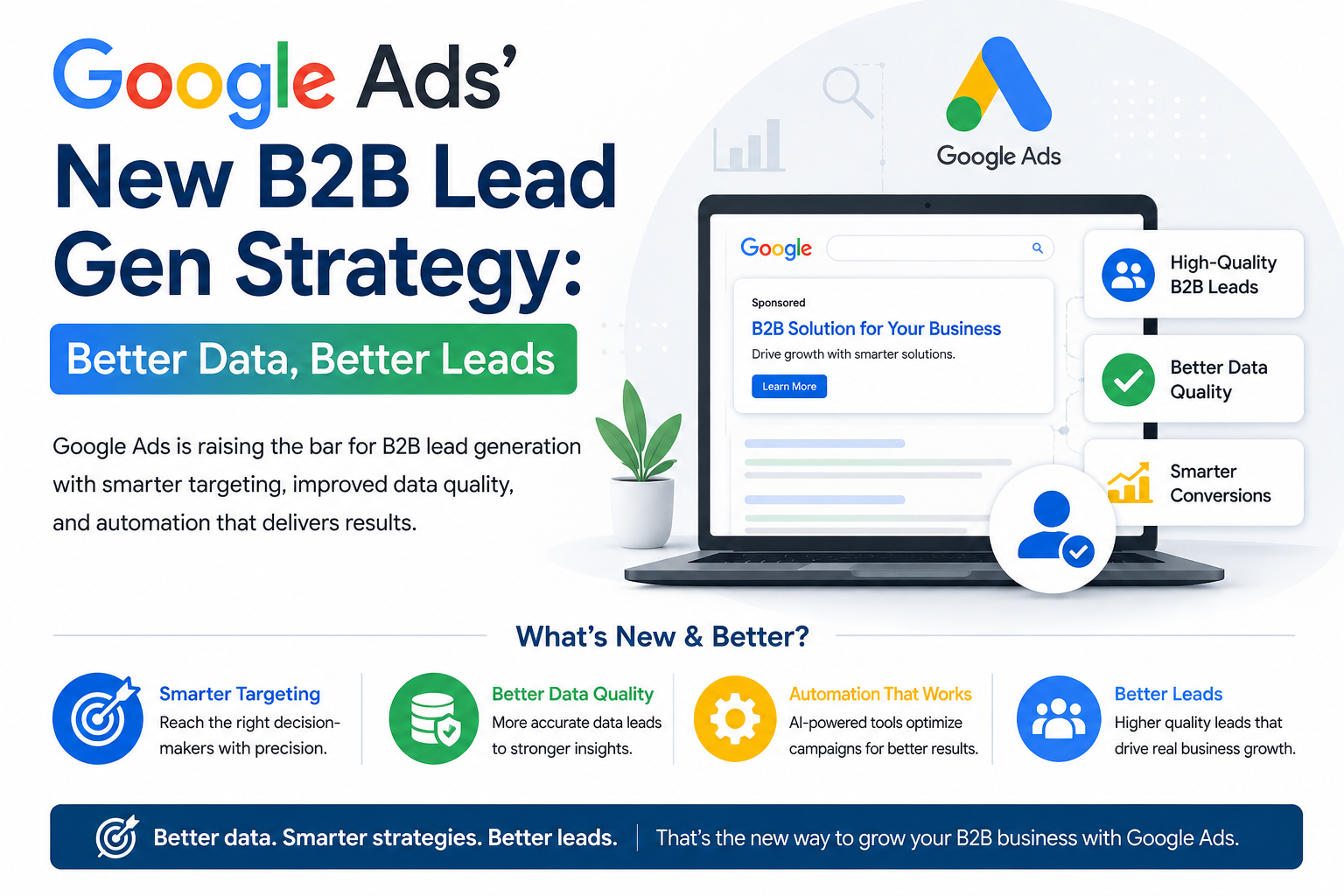
The platform’s recent developments around first-party data, offline conversion measurement, enhanced conversions for leads, lead-generation formats, automation, and AI-powered campaign optimization are creating a stronger foundation for B2B advertisers. Instead of treating every form submission as an equally valuable conversion, marketers can increasingly connect advertising activity with what happens later in the sales funnel.
Google’s own documentation recommends using qualified or converted leads as important optimization goals for enhanced conversions for leads, allowing advertisers to feed offline qualification information back into Google Ads. (Google Help)
That shift changes the fundamental question B2B marketers should ask:
Are we generating more leads, or are we teaching Google Ads how to find better customers?
The second question is becoming far more important.
What Is Changing in B2B Google Ads?
Traditional B2B PPC campaigns often follow a relatively simple model:
Keyword → Ad → Landing Page → Form → Lead
The problem is that the process does not end when someone submits a form.
A sales team may discover that:
- The prospect is outside the target market.
- The company is too small.
- The person has no purchasing authority.
- The contact information is inaccurate.
- The prospect is only researching.
- The opportunity has no realistic budget.
- The lead never responds.
- The company eventually becomes a qualified opportunity—or a paying customer.
If Google Ads is optimized only around the original form submission, the platform may learn to prioritize users who are good at submitting forms rather than users who are likely to become valuable customers.
Modern B2B advertising requires a deeper feedback loop:
Ad → Click → Lead → Qualified Lead → Sales Opportunity → Customer → Revenue
The more of this journey an advertiser can measure and feed back into advertising systems, the more useful automated optimization becomes.
Recent industry analysis has highlighted the same principle: automation can scale the wrong outcome when the underlying conversion signals are weak. (Search Engine Land)
1. Better Data Is Becoming the Core Competitive Advantage
Google Ads has become increasingly automated.
Campaigns can use machine learning to determine:
- Which searches are valuable
- Which audiences are more likely to convert
- Which creative combinations perform well
- Which users should receive an ad
- How bids should change
- Which conversion patterns deserve more investment
But automation depends heavily on the information it receives.
Think of it this way:
Good data + automation = smarter optimization
Poor data + automation = faster optimization of the wrong thing
For B2B companies, this distinction is critical.
If an account records every form submission as a successful conversion, Google may see 500 conversions.
The sales team might see:
- 300 irrelevant leads
- 100 unqualified leads
- 60 sales-accepted leads
- 25 opportunities
- 8 customers
From a business perspective, those 8 customers matter far more than the original 500 form submissions.
That is why B2B advertisers should increasingly build campaigns around business-quality signals rather than raw conversion volume.
2. First-Party Data Is Becoming More Important
First-party data is information a company collects directly through its own interactions with customers and prospects.
Examples include:
- CRM records
- Lead status
- Customer status
- Sales opportunities
- Purchase history
- Qualified leads
- Revenue data
- Customer lists
- Website interactions
For B2B advertisers, this information can be extremely valuable because the company’s CRM often knows more about lead quality than the advertising platform does.
A Google Ads campaign might know that someone submitted a form.
Your CRM may know that the person:
Submitted → Qualified → Booked a meeting → Became an opportunity → Purchased
That information provides a much stronger definition of success.
Google’s Data Manager ecosystem is increasingly positioned to help advertisers work with first-party data for measurement and audience-related use cases. Google also recommends Data Manager for upgrading existing offline conversion workflows to enhanced conversions for leads. (Google Help)
3. Enhanced Conversions for Leads Can Close the Measurement Gap
One of the most important pieces of the modern B2B strategy is enhanced conversions for leads.
B2B sales often happen outside the website.
For example:
- A prospect searches Google.
- The prospect clicks an advertisement.
- The prospect completes a form.
- The lead enters the CRM.
- A salesperson contacts the prospect.
- The lead becomes qualified.
- A sales opportunity is created.
- The company eventually closes the deal.
Traditional web conversion tracking may stop at step three.
Enhanced conversions for leads help advertisers connect online lead generation with offline outcomes.
Google specifically recommends using goals such as qualified lead or converted lead when configuring enhanced conversions for leads. (Google Help)
This creates a much more useful optimization loop.
Basic tracking
Form submission = conversion
Advanced B2B tracking
Qualified lead = conversion
Revenue-focused tracking
Converted customer = high-value conversion
The second and third models generally provide much stronger business context.
4. Google Ads Is Moving Toward Quality, Not Just Quantity
For years, lead-generation campaigns were often judged by metrics such as:
- Click-through rate
- Cost per click
- Conversion rate
- Number of leads
- Cost per lead
Those metrics are still useful, but they do not tell the entire story.
Consider two campaigns.
| Metric | Campaign A | Campaign B |
|---|---|---|
| Leads | 500 | 180 |
| Cost per lead | $20 | $55 |
| Qualified leads | 30 | 70 |
| Opportunities | 10 | 35 |
| Customers | 3 | 15 |
| Revenue | $30,000 | $180,000 |
Campaign A appears better if you only look at cost per lead.
Campaign B is dramatically better for the business.
This is why B2B marketers should increasingly track:
Cost per qualified lead
Cost per sales opportunity
Customer acquisition cost
Pipeline generated
Revenue generated
Rather than relying exclusively on:
Cost per lead
5. AI Makes Data Quality Even More Important
Google Ads is becoming increasingly AI-driven.
AI can help advertisers discover audiences, match queries with relevant ads, generate creative variations, optimize bids, and identify patterns across large amounts of data.
Google has said that AI Max is designed to expand search opportunities and match ads with more complex searches. The company reported that AI Max and Performance Max campaigns were producing an average lift in conversions or conversion value at similar return on ad spend among relevant advertisers. (Search Engine Land)
But there is an important warning for B2B marketers.
AI does not automatically understand your ideal customer profile.
If the campaign sends unclear signals, the system can pursue the wrong audience.
Recent testing of AI-generated ad assets for B2B campaigns demonstrated this problem. One B2B campaign experienced higher click-through rates but lower conversion rates because automated messaging attracted more consumer-oriented searchers rather than properly qualifying B2B users. (Search Engine Land)
The lesson is important:
More automation does not eliminate strategy. It makes strategy more important.
6. B2B Ad Copy Must Prequalify the Audience
B2B businesses often have a narrower target audience than consumer businesses.
A company may sell software only to:
- Enterprises
- Marketing agencies
- Financial institutions
- Manufacturers
- Healthcare organizations
- Technology companies
- Businesses with 100+ employees
If an advertisement sounds too generic, it can attract large amounts of irrelevant traffic.
For example, instead of:
“Powerful Business Software — Get Started Today”
a B2B company could use:
“Enterprise Workflow Software for Growing Operations Teams”
The second message immediately communicates who the product is intended for.
Strong B2B advertising should answer:
- Who is this for?
- What problem does it solve?
- What type of company needs it?
- Why should the buyer trust you?
- What makes the product different?
- What action should the prospect take?
The goal is not necessarily to maximize clicks.
The goal is to attract useful clicks.
7. Landing Pages Need to Match the Buying Journey
A good B2B campaign cannot compensate for a weak landing page.
B2B prospects often need considerably more information before submitting their details.
A strong landing page may include:
Clear value proposition
Explain exactly what the company provides.
Specific target audience
Tell visitors who the solution is designed for.
Business outcomes
Focus on results rather than simply listing features.
Proof
Include:
- Customer logos
- Case studies
- Testimonials
- Certifications
- Industry experience
- Results
Strong call to action
Examples include:
- Request a Demo
- Talk to an Expert
- Get a Business Assessment
- Book a Consultation
- Request Pricing
Qualification
Where appropriate, ask questions that help identify whether the visitor fits the target customer profile.
This can reduce the number of low-value submissions.
8. Lead Forms Are Becoming More Accessible
Google has also been expanding access to its native Lead Form assets.
In July 2026, Google removed the previously documented $50,000 Google Ads spending requirement associated with certain Lead Form eligibility rules. The documentation also expanded lead-delivery options, including email and Zapier alongside existing methods such as CSV, webhooks, and the Google Ads API. (Search Engine Land)
This matters because native lead forms can reduce friction between an ad interaction and a prospect submitting information.
However, lower friction can have two sides.
It can produce:
More leads
but potentially also:
More low-intent leads
Therefore, B2B advertisers should not judge native lead forms purely by volume.
The real question is:
How many of those leads become qualified opportunities?
9. CRM Integration Becomes a Strategic Requirement
A CRM should not be treated as a separate system from paid advertising.
For sophisticated B2B campaigns, the relationship should look like this:
Google Ads
↓
Website / Lead Form
↓
CRM
↓
Lead Qualification
↓
Sales Pipeline
↓
Closed Customer
↓
Revenue Feedback
↓
Google Ads Optimization
This creates a feedback loop.
Suppose Google generates 1,000 leads.
The CRM identifies:
- 700 unqualified
- 200 marketing-qualified
- 70 sales-qualified
- 25 opportunities
- 10 customers
The advertiser can then begin teaching the advertising system which types of users and interactions correlate with those better outcomes.
Without CRM feedback, Google may optimize around the easiest measurable action.
With CRM feedback, the system can move closer to the actual business objective.
10. Measure the Entire B2B Funnel
A strong B2B Google Ads dashboard should extend beyond clicks and leads.
Consider using a funnel like this:
| Funnel Stage | Important Metric |
|---|---|
| Awareness | Impressions |
| Interest | Click-through rate |
| Traffic | Qualified sessions |
| Lead | Lead conversion rate |
| Qualification | Qualified lead rate |
| Sales | Opportunity rate |
| Revenue | Customer value |
| Efficiency | Cost per opportunity |
| Business impact | Revenue / ad spend |
This makes it easier to identify where the real problem exists.
For example:
High clicks + low leads
Potential landing-page problem.
High leads + low qualification
Potential targeting or messaging problem.
High qualified leads + low opportunities
Potential sales qualification problem.
High opportunities + low closed deals
Potential sales process, pricing, product, or lead-quality problem.
This approach prevents marketers from blaming Google Ads for problems occurring later in the funnel.
11. Don’t Optimize Every Conversion Equally
One of the most common B2B PPC mistakes is treating every conversion as identical.
Imagine these actions:
- Newsletter signup
- Whitepaper download
- Contact form
- Demo request
- Pricing request
- Sales meeting
- Purchase
They clearly do not have equal business value.
A newsletter subscription may be worth very little immediately.
A sales-qualified demo request could be worth thousands of dollars in expected pipeline.
Your conversion strategy should reflect those differences.
A practical hierarchy might look like:
Low intent
Content download
↓
Newsletter signup
↓
General inquiry
↓
Demo request
↓
Qualified lead
↓
Sales opportunity
↓
Customer
The further down the funnel the signal sits, the more closely it represents actual business value.
12. New Customer Measurement Can Improve B2B Reporting
Google Ads has also introduced dedicated reporting for new customer acquisition.
The new “Report on new customers acquired” option allows advertisers to measure new-customer performance without changing campaign bidding behavior. Google says the setting provides access to new-customer and new-customer-value reporting while leaving bidding unchanged. (Search Engine Land)
For B2B organizations, this can help answer an important question:
Are our campaigns producing new business, or are we primarily reaching existing customers?
That distinction becomes increasingly important as acquisition costs rise and companies try to understand incremental growth.
13. B2B Advertisers Need Better Audience Definition
Before launching a campaign, define the ideal customer profile.
An ICP can include:
Company characteristics
- Industry
- Company size
- Annual revenue
- Geography
- Business model
- Technology stack
Buyer characteristics
- Job role
- Seniority
- Department
- Responsibilities
- Business challenges
Purchase characteristics
- Typical budget
- Sales cycle
- Contract value
- Buying triggers
- Decision-making process
The more clearly the advertiser understands the ideal customer, the easier it becomes to create better:
- Keywords
- Ads
- Landing pages
- Offers
- Audience signals
- Conversion goals
14. Search Intent Matters More Than Keyword Volume
B2B marketers should not automatically choose keywords with the highest search volume.
A keyword receiving 50,000 monthly searches may be less valuable than one receiving 500 searches if those 500 searches come from high-intent business buyers.
Compare:
“CRM software”
with:
“enterprise CRM implementation consultant”
The first keyword may generate significantly more traffic.
The second may generate fewer visitors but potentially much stronger commercial intent.
B2B PPC strategy should therefore prioritize:
Intent + relevance + commercial value
rather than:
Search volume alone
15. Negative Keywords Still Matter
Automation does not mean advertisers should abandon campaign controls.
Negative keywords can help prevent campaigns from appearing for irrelevant searches.
For example, a B2B software provider might exclude searches involving:
- Free
- Jobs
- Careers
- Training
- Course
- Certification
- Salary
- Definition
- Consumer
- Personal
The exact negative-keyword strategy depends on the business.
The important principle is to continuously review search-term data and identify patterns that produce irrelevant traffic.
This becomes particularly important as automated matching expands the range of queries that campaigns can reach.
16. Build a Strong Feedback Loop
The modern B2B Google Ads strategy can be summarized as a feedback loop:
Step 1: Capture
Generate leads through Search, Performance Max, Lead Forms, landing pages, or other campaign experiences.
Step 2: Identify
Connect leads to CRM records and capture useful first-party information.
Step 3: Qualify
Determine which leads meet your business criteria.
Step 4: Attribute
Connect qualified leads and opportunities back to their advertising sources.
Step 5: Optimize
Use meaningful conversion signals to improve campaign decisions.
Step 6: Analyze
Compare campaign performance based on pipeline and revenue.
Step 7: Improve
Update targeting, messaging, landing pages, offers, and conversion definitions.
Then repeat the process.
17. Data Quality Should Be Audited Regularly
Even a sophisticated measurement system can deteriorate over time.
Common problems include:
- Broken tracking
- Duplicate conversions
- Incorrect conversion values
- CRM synchronization failures
- Incorrect attribution
- Missing lead identifiers
- Wrong conversion actions
- Unqualified events marked as primary conversions
- Sales-stage data not being passed back
Google’s current documentation notes that offline conversion and enhanced-conversion-for-leads uploads are moving toward the Data Manager API, with legacy Google Ads API upload access being blocked from June 15, 2026. (Google Help)
For B2B marketers, this makes measurement infrastructure something that should be maintained—not configured once and forgotten.
18. A Practical B2B Google Ads Framework for 2026
Here is a simple framework businesses can use.
Phase 1: Define the customer
Identify your ICP, buyer personas, industries, company sizes, locations, and purchasing triggers.
Phase 2: Define valuable outcomes
Separate:
- Lead
- Qualified lead
- Sales opportunity
- Customer
- Revenue
Phase 3: Connect the data
Connect Google Ads with your website analytics, CRM, and relevant first-party data systems.
Phase 4: Improve campaign messaging
Create advertisements that clearly communicate the target customer and business value.
Phase 5: Improve landing pages
Match the landing page to search intent and buying stage.
Phase 6: Feed quality signals back
Where technically appropriate, send qualified or converted lead information back to Google Ads.
Phase 7: Evaluate business outcomes
Review:
- Qualified lead volume
- Cost per qualified lead
- Opportunity rate
- Pipeline value
- Customer acquisition cost
- Revenue
Phase 8: Scale carefully
Increase investment in campaigns that consistently produce high-quality business outcomes—not simply cheap leads.
19. The Biggest Mistake: Chasing Cheap Leads
A low CPL can look impressive in a marketing report.
But imagine:
Campaign A
CPL = $15
Qualified lead rate = 5%
Campaign B
CPL = $60
Qualified lead rate = 40%
Campaign B appears expensive.
But if those qualified leads generate substantially more opportunities and revenue, Campaign B may be the much better investment.
This is why B2B marketers need to move from:
Cost per lead
to:
Cost per business outcome
That means measuring the metrics that matter to executives and sales teams.
20. What B2B Marketers Should Do Now
Businesses that want to strengthen their Google Ads lead-generation strategy should prioritize five areas.
1. Audit conversion tracking
Determine exactly which actions are being counted as primary conversions.
2. Connect advertising with CRM outcomes
Know what happens to leads after they enter the sales system.
3. Define lead quality
Create clear criteria for marketing-qualified and sales-qualified leads.
4. Improve audience qualification
Make ad messaging specific enough to discourage irrelevant prospects.
5. Optimize for business value
Move beyond CPL and begin evaluating qualified leads, opportunities, customers, pipeline, and revenue.
The Future of B2B Google Ads Is About Better Signals
Google Ads is becoming more automated, but automation does not remove the need for strategic input.
It changes where that input matters.
Previously, PPC specialists spent enormous amounts of time managing individual bids, keywords, and campaign settings.
Increasingly, the strategic advantage comes from determining:
What does a valuable customer look like?
What signals indicate buying intent?
Which leads should Google learn from?
Which customers are actually profitable?
How quickly can CRM data return to the advertising system?
These questions will become increasingly important as AI takes on more campaign-management responsibilities.
The strongest B2B advertisers will not necessarily be the companies with the most automation.
They will be the companies with the best data, clearest customer definitions, strongest measurement infrastructure, and most useful feedback loops.
Conclusion
Google Ads is moving toward a more sophisticated model of B2B lead generation.
The future is not simply about producing more form submissions at the lowest possible cost. It is about creating a system that understands the difference between a lead, a qualified prospect, a sales opportunity, and a customer.
First-party data, CRM integration, enhanced conversions for leads, better conversion definitions, stronger audience qualification, and AI-powered optimization can work together to create that system.
The strategic formula is simple:
Better data → Better signals → Better optimization → Better leads → Better opportunities → Better revenue
For B2B marketers, that is the real opportunity behind the next generation of Google Ads.
The goal isn’t to make Google Ads find more people who convert. The goal is to teach Google Ads what a valuable customer actually looks like.
Frequently Asked Questions
What is the biggest change in B2B Google Ads strategy?
The biggest change is the shift from optimizing primarily for lead volume toward optimizing for lead quality, qualified opportunities, customers, and revenue.
Why is CRM data important for Google Ads?
CRM data can show which advertising-generated leads become qualified prospects, opportunities, and customers. That information can provide stronger optimization signals than a basic form submission.
What are enhanced conversions for leads?
Enhanced conversions for leads help advertisers connect online lead-generation activity with offline outcomes. Google recommends qualified or converted leads as important goals for this setup. (Google Help)
Should B2B companies optimize for every form submission?
Not necessarily. If a large percentage of form submissions are irrelevant or unqualified, optimizing exclusively for them can teach automated bidding to pursue low-value prospects.
Is AI replacing B2B PPC managers?
AI is automating more campaign tasks, but human strategy remains important. Advertisers still need to define customer value, conversion goals, business constraints, messaging, and measurement quality.
What is the most important B2B PPC metric?
There is no single universal metric. Depending on the business, qualified lead cost, opportunity cost, pipeline value, customer acquisition cost, and revenue generated may be more meaningful than raw lead volume or CPL.
What should B2B advertisers focus on in 2026?
Focus on first-party data, CRM integration, accurate conversion measurement, qualified-lead optimization, audience qualification, strong landing pages, and careful governance of automated campaign features.
Final takeaway: In the next phase of Google Ads, data quality will increasingly determine advertising quality. B2B companies that build reliable feedback loops between marketing, sales, CRM systems, and advertising platforms will be better positioned to turn automation into measurable business growth.