
The expansion of advertising into conversational AI represents a significant shift in digital marketing. As ChatGPT introduces ads across a broader European footprint, marketers, publishers, businesses, and users will need to understand how sponsored placements fit into an AI-driven search and discovery experience.
Below is a detailed, original article structured for publication, including suggested explanatory images and graph concepts.
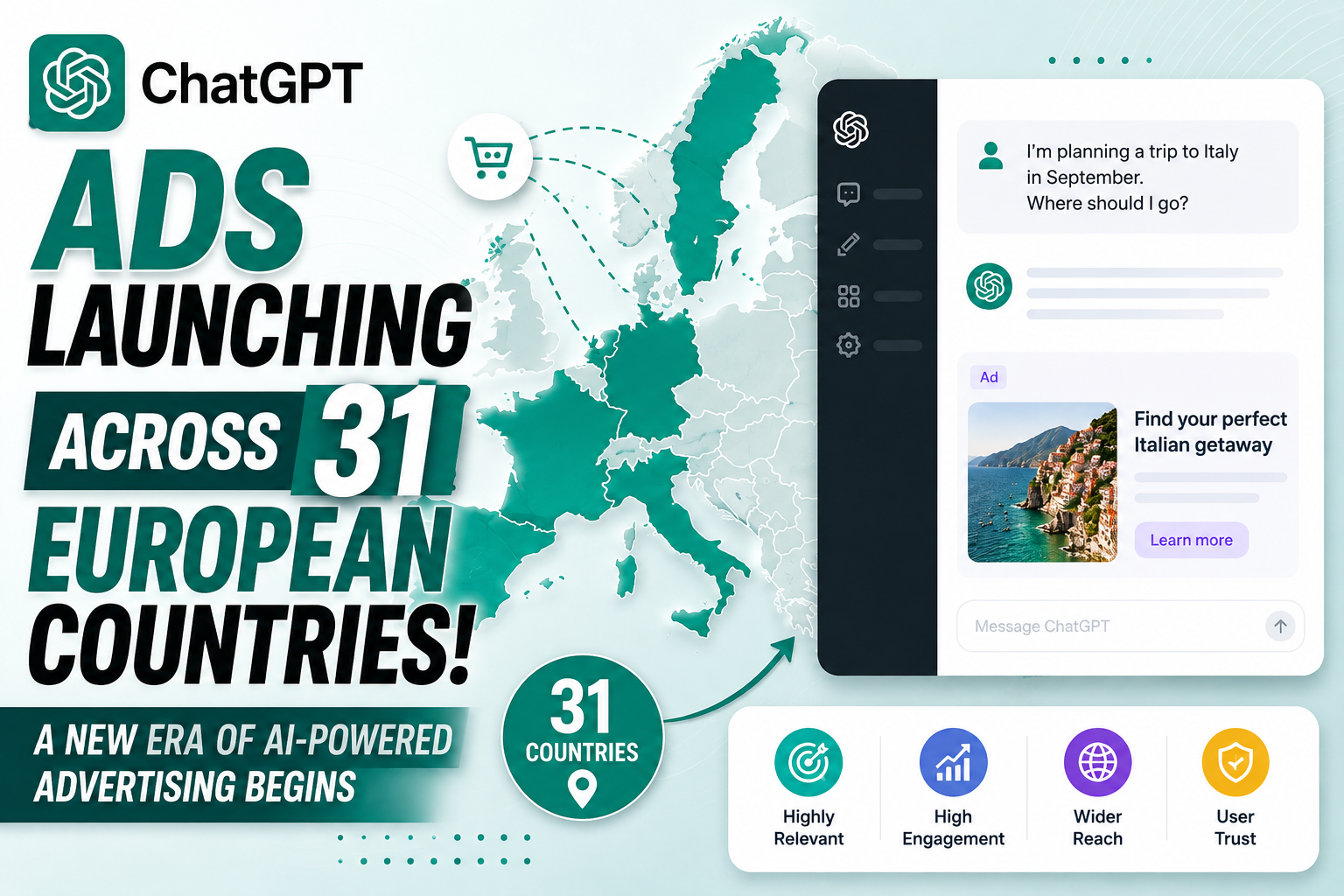
Europe Rollout: ChatGPT Ads Launching Across 31 Countries
A New Phase for Advertising in the AI Era
Digital advertising is entering another major transition. For years, brands have relied on search engines, social media platforms, websites, and mobile applications to reach potential customers. Now, conversational AI is creating a new environment where people discover information, compare products, and make decisions through natural-language conversations.
The rollout of ChatGPT advertising across 31 European countries signals how rapidly this new advertising model is developing.
Unlike conventional display advertising, conversational advertising has the potential to appear alongside moments of active discovery. A user may be researching a product, planning a trip, comparing software, or looking for a solution to a problem. This creates a fundamentally different opportunity for advertisers: reaching people when they are actively seeking useful information.
However, the growth of AI advertising also raises important questions about transparency, user trust, privacy, relevance, and the relationship between sponsored content and AI-generated answers.
This article explores what the European rollout means, why the market matters, how conversational advertising differs from traditional digital advertising, and what businesses should prepare for as AI-powered discovery continues to evolve.
What Does the Europe Rollout Mean?
A rollout across 31 countries represents a significant expansion of the potential advertising market surrounding ChatGPT.
Europe is one of the world’s most diverse digital markets. Businesses operating across the region must work with multiple languages, cultures, regulations, consumer behaviors, and purchasing habits. For advertisers, this makes Europe both an enormous opportunity and a complex environment.
The expansion creates the possibility for businesses to explore a new type of digital visibility based on conversation rather than simply keywords, feeds, or web pages.
Traditional digital advertising often follows this pattern:
Search query → Search results → Click → Website → Conversion
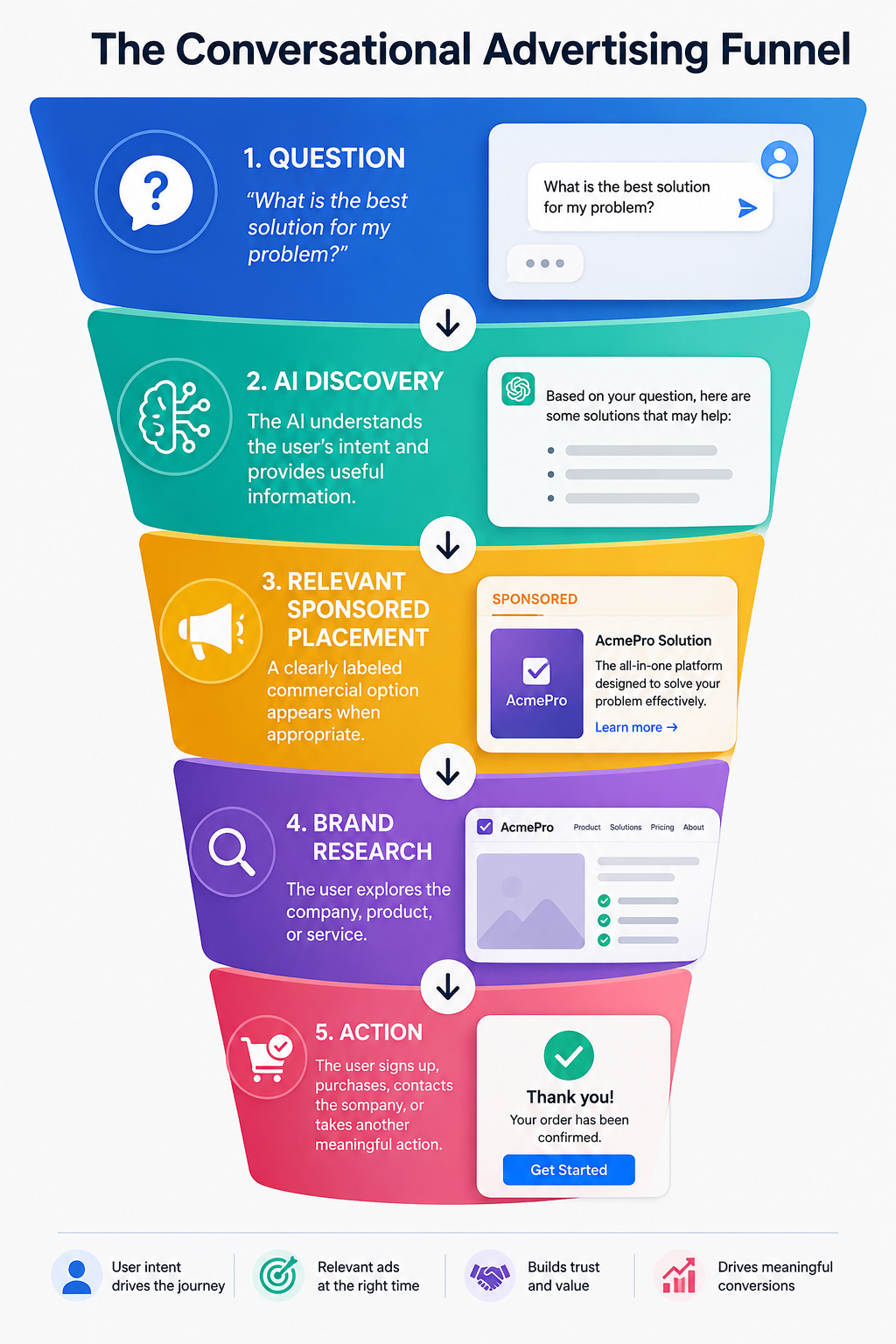
Conversational discovery may look more like this:
Question → AI conversation → Information and recommendations → Brand discovery → Action
That difference is important.
The user may not begin with a specific brand in mind. Instead, they may describe a problem:
“What is the best project management software for a small remote team?”
Or ask:
“Where should I stay in Europe if I want a quiet coastal vacation?”
Or:
“What tools can help me automate my company’s customer support?”
These questions represent moments of intent. The future of advertising in AI environments may increasingly focus on understanding that intent and presenting relevant commercial information without interrupting the usefulness of the conversation.

How Conversational Advertising Differs From Traditional Ads
Traditional advertising platforms generally depend on a few familiar formats:
- Search ads
- Display banners
- Social media promotions
- Video advertisements
- Sponsored posts
- Native advertising
Conversational advertising introduces another layer.
Instead of browsing through pages or scrolling through feeds, users interact directly with an AI system. Their questions provide context about what they are trying to understand or accomplish.
This could make advertising more context-driven.
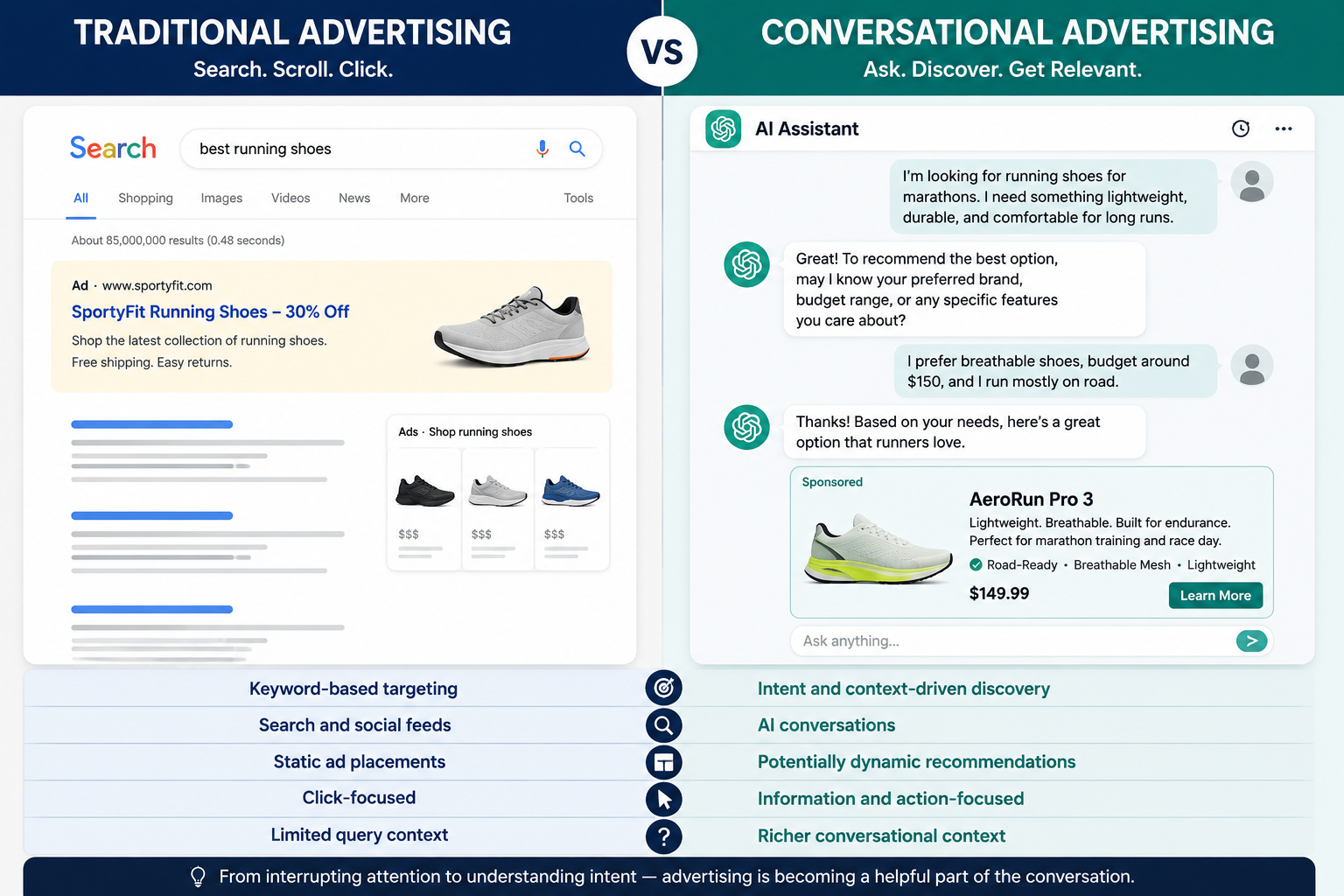
Example
A traditional search advertisement may target:
Keyword: “best running shoes”
A conversational system may receive a more detailed request:
“I need comfortable running shoes for long-distance training. I have wide feet and usually run on roads.”
The difference is substantial. The conversation contains additional context about the user’s needs.
The potential value for advertisers is obvious: more relevant recommendations could lead to better engagement.
But this model must also be handled carefully. Users need to understand when commercial content is sponsored and when information is an independent AI-generated response.
Clear labeling and transparency are essential for maintaining trust.
The 31-Country Opportunity (ChatGPT Ads)
Europe contains highly developed digital economies, major technology markets, and millions of consumers who regularly use online platforms to research products and services.
A broad rollout could provide opportunities for:
1. Small Businesses
Smaller companies often struggle to compete with major brands on traditional advertising platforms.
Conversational discovery may provide new opportunities if useful, relevant, and high-quality businesses can become more visible to users researching specific problems.
2. E-Commerce Brands
Online retailers could potentially benefit from users asking detailed questions about products.
For example:
“What type of laptop is best for video editing under a specific budget?”
The more specific the need, the more valuable relevant product information becomes.
3. Travel Companies
Europe’s travel industry is enormous. Travelers frequently ask AI systems about:
- Destinations
- Hotels
- Flights
- Activities
- Restaurants
- Transportation
- Travel itineraries
This creates a natural environment for carefully integrated commercial recommendations.
4. SaaS Companies
Software buyers increasingly use AI to compare:
- CRM platforms
- Project management tools
- Accounting software
- Marketing platforms
- Cybersecurity solutions
- AI productivity tools
Brands that provide clear, useful information may gain an advantage in AI-powered discovery.
Traditional Advertising vs Conversational Advertising (ChatGPT Ads)
| Traditional Advertising | Conversational Advertising |
|---|---|
| Keyword-based targeting | Intent and context-driven discovery |
| Search and social feeds | AI conversations |
| Static ad placements | Potentially dynamic recommendations |
| Click-focused | Information and action-focused |
| Limited query context | Richer conversational context |
Why Europe Is a Critical Market
Europe is not a single digital market.
A successful advertising strategy must account for differences in:
- Languages
- Local regulations
- Consumer behavior
- Purchasing power
- Privacy expectations
- Industry preferences
- Cultural attitudes toward advertising
This complexity means that a one-size-fits-all strategy is unlikely to work.
For example, a campaign that performs well in one market may require significant adaptation in another.
Brands expanding into AI-powered advertising should think beyond simple translation.
Localization should include:
- Local language
- Cultural context
- Regional customer needs
- Market-specific offers
- Local pricing
- Relevant examples
- Country-specific regulations
The brands that understand local audiences are likely to have a stronger advantage than those simply running identical campaigns across every market.
Illustrative Growth of Conversational Discovery
Illustrative Trend
AI-Assisted Discovery Growth
│
│                              ████████████ 2028
│                        ██████████
│                  ████████ 2027
│            ██████
│       █████ 2026
│  ████ 2025
│██ 2024
└────────────────────────────────
  2024   2025   2026   2027   2028
User Trust Will Determine the Success of AI Advertising
Technology alone will not determine whether conversational advertising succeeds.
Trust may be the most important factor.
Users expect AI systems to be helpful. If advertising becomes intrusive, misleading, or difficult to distinguish from independent recommendations, it could damage the user experience.
A successful model should focus on three principles.
1. Clear Sponsored Labels
Users should immediately understand when content is an advertisement or sponsored placement.
Transparency protects both users and advertisers.
2. High Relevance
An irrelevant advertisement inside a conversation can feel more disruptive than a banner on a webpage.
For example, if a user is researching business accounting software, an advertisement for an unrelated consumer product would provide little value.
Contextual relevance is critical.
3. Separation Between Advertising and Core Responses
Users should be able to trust that answers are not secretly manipulated by advertisers.
Sponsored content needs clear boundaries.
The future of AI advertising may depend on maintaining a balance between commercial opportunities and genuinely useful conversations.
What Makes an AI Recommendation Useful?

The Rise of AI Search and Brand Visibility
The growth of AI assistants is also changing how brands think about visibility.
For years, the dominant question was:
“How can my website rank higher in Google?”
Now, another question is becoming increasingly important:
“How can my brand become visible when users ask AI systems for recommendations?”
This shift connects several important disciplines.
SEO — Search Engine Optimization
SEO focuses on improving visibility in traditional search engines.
GEO — Generative Engine Optimization
GEO focuses on improving how brands and content are discovered, understood, and potentially referenced by generative AI systems.
ASO — AI Search Optimization
ASO can refer to strategies designed to improve visibility within AI-powered search and conversational discovery environments.
Together, these approaches represent a broader shift toward multi-surface brand visibility.
A company may need to optimize for:
- Search engines
- AI assistants
- Social platforms
- Marketplaces
- Recommendation systems
- Voice assistants
- Traditional media
ChatGPT advertising adds another possible channel to this evolving ecosystem.
Graph 3: The New Brand Visibility Ecosystem
                     BRAND
                        │
        ┌───────────────┼───────────────┐
        │               │               │
       SEO             GEO             ASO
        │               │               │
   Search Engines   AI Responses    AI Discovery
        │               │               │
        └───────────────┼───────────────┘
                        │
                 Brand Visibility
                        │
        ┌───────────────┼───────────────┐
        │               │               │
     Traffic         Trust          Conversion
What Businesses Should Do Before Investing
Businesses do not need to wait until every aspect of AI advertising becomes fully mature.
They can begin preparing now.
1. Understand Your Customer Questions
The foundation of conversational marketing is understanding what customers actually ask.
Build a database of questions related to:
- Problems
- Product comparisons
- Pricing
- Alternatives
- Use cases
- Industry challenges
- Beginner questions
- Purchase decisions
For example, instead of optimizing only for:
“CRM software”
Also explore questions such as:
- Which CRM is best for a small business?
- What is the easiest CRM for beginners?
- Which CRM integrates with email marketing?
- What CRM is affordable for startups?
These are natural conversational queries.
2. Create Content That Actually Helps
AI-powered discovery rewards useful information.
Brands should invest in content that clearly explains:
- What a product does
- Who it is for
- Who it may not be suitable for
- Key benefits
- Limitations
- Pricing considerations
- Alternatives
- Real-world use cases
Generic promotional content may become less effective when users can ask highly specific questions.
Useful, detailed, and trustworthy content is likely to become more valuable.
3. Build a Strong Brand Entity
AI systems need to understand what a company is and what it offers.
Brands should maintain consistent information across:
- Official websites
- Product pages
- Business profiles
- Social platforms
- Press coverage
- Industry publications
- Structured data
- Customer reviews
Consistency helps create a clearer digital identity.
4. Prepare for Measurement Changes
Traditional advertising often focuses on metrics such as:
- Impressions
- Click-through rate
- Cost per click
- Conversion rate
- Return on ad spend
Conversational advertising may introduce additional measurements.
Businesses may eventually need to evaluate:
- Conversation relevance
- Recommendation visibility
- Assisted conversions
- Brand mentions
- AI-driven referral traffic
- Downstream conversions
- Engagement after discovery
The measurement framework will likely evolve as the advertising format develops.
The Conversational Advertising Funnel
Challenges the Europe Rollout May Face
The opportunity is substantial, but the European market also presents challenges.
Privacy Expectations
European consumers and regulators generally place strong emphasis on data protection and privacy.
Advertising systems must operate within applicable privacy and data protection requirements.
Businesses should avoid assuming that traditional tracking models will automatically translate into AI-powered environments.
Regulatory Complexity
Europe contains a complex regulatory environment.
Advertising, consumer protection, competition, and AI-related rules may influence how platforms develop and deploy commercial features.
Companies entering this space should monitor regulatory developments rather than relying on outdated advertising strategies.
User Acceptance
Not every user will welcome advertising inside an AI assistant.
The user experience must remain useful.
If ads become excessive or irrelevant, users may simply look for alternative platforms.
This creates a powerful incentive for advertising systems to prioritize quality over quantity.
The Competitive Advantage of Early Adopters
Early adoption can offer advantages, particularly when a new advertising channel is still developing.
Brands that experiment early may gain:
- Experience before competition increases
- Better understanding of conversational intent
- New customer acquisition opportunities
- Stronger AI visibility strategies
- More data about emerging customer behavior
However, early adoption should not mean uncontrolled spending.
Businesses should test carefully.
A practical testing framework could include:
- Start with a limited budget.
- Select one or two high-value customer segments.
- Focus on highly relevant conversational scenarios.
- Measure traffic and conversion quality.
- Compare performance with search and social advertising.
- Improve targeting and messaging.
- Scale only when meaningful results appear.
Europe Could Become a Major Testing Ground for AI Advertising
The European rollout is important not simply because of the number of countries involved.
It is important because Europe offers a diverse environment for understanding how conversational advertising performs across different markets.
The lessons learned could influence the future development of:
- AI advertising formats
- Sponsored recommendations
- Brand discovery
- Conversational commerce
- AI search
- Performance marketing
- Digital privacy standards
Businesses should watch not only whether advertising is introduced, but also how users interact with it.
Engagement patterns will reveal whether conversational advertising becomes a major marketing channel or simply another extension of existing digital advertising.
The Future of AI-Powered Advertising

“From Search Results to Conversations: The Next Evolution of Digital Advertising”
Final Thoughts
The expansion of ChatGPT advertising across 31 European countries represents a broader transformation in how people may discover brands online.
The internet is gradually moving from a model based primarily on searching and clicking toward one where users increasingly ask, discuss, compare, and decide through AI conversations.
For businesses, this creates a new challenge.
Ranking in search engines may no longer be enough.
Brands will increasingly need to think about how they appear across multiple discovery environments, including:
- Google and traditional search engines
- Generative AI platforms
- Conversational assistants
- Social networks
- Online marketplaces
- Recommendation systems
The winners in this next phase of digital marketing may not simply be the companies with the largest advertising budgets.
They may be the brands that provide the most useful information, understand customer intent, build genuine trust, and adapt quickly to the changing way people discover products and services.