
Introduction
Local search is entering a new era.
For years, local SEO was largely about getting a business into Google’s local results, optimizing a Google Business Profile, building citations, collecting reviews, and targeting keywords such as “near me” or “best [service] in [city].”
Those fundamentals still matter. But the search environment surrounding them is changing rapidly.
Google is increasingly combining traditional Search with artificial intelligence, conversational queries, Maps, business information, reviews, products, services, and other contextual signals. In May 2026, Google described a new generation of AI-powered Search that brings more advanced AI capabilities and agents into the search experience. (blog.google)
That creates the need for a broader approach.
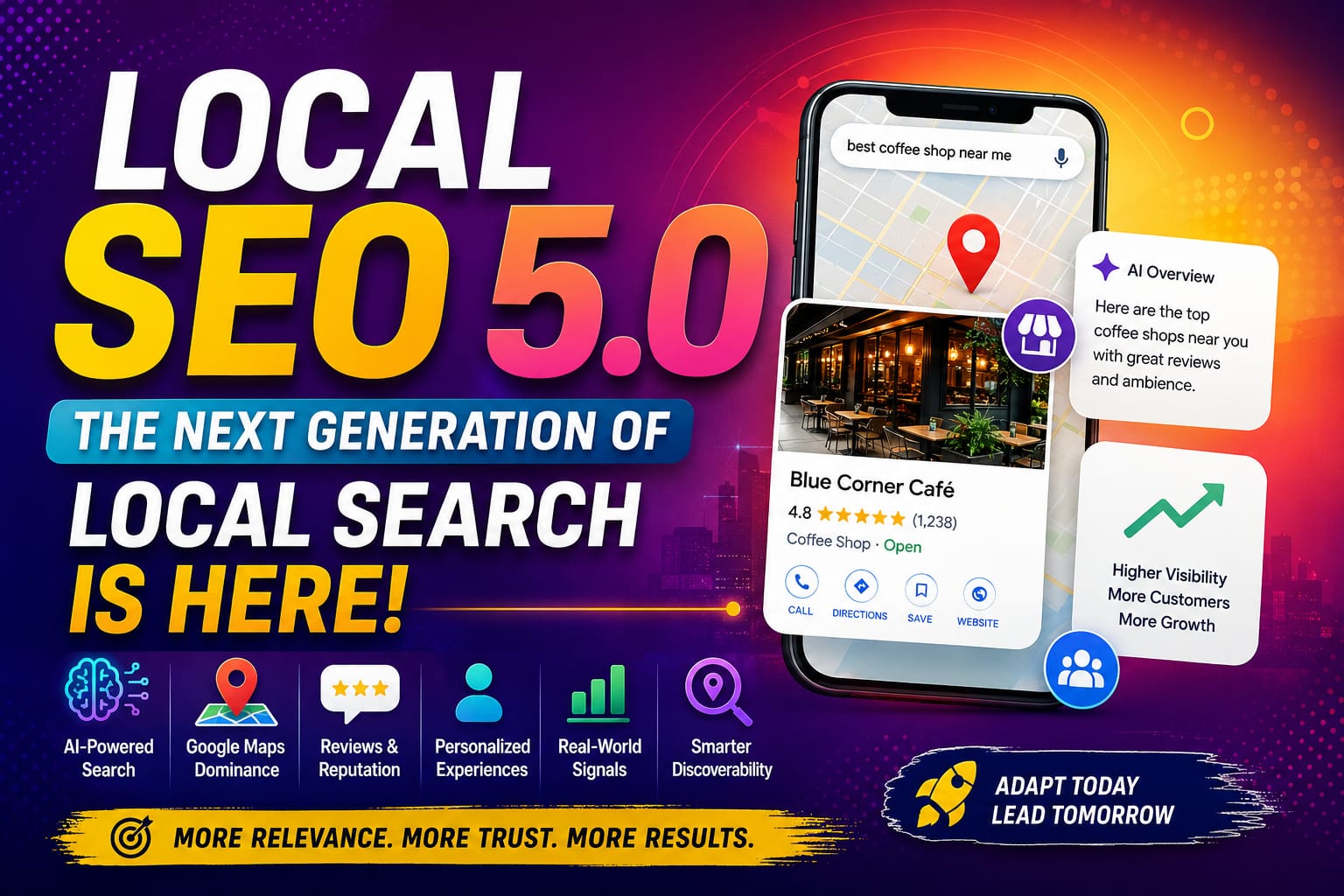
This is what we can call Local SEO 5.0: a modern local-search strategy designed around intent, relevance, trust, AI visibility, personalization, and real-world customer actions.
It is not an official Google product or ranking system. Rather, it is a strategic framework for understanding where local search is heading.

What Is Local SEO 5.0?
Local SEO 5.0 is the evolution of local search optimization from keyword-focused visibility toward comprehensive digital and real-world relevance.
Traditional local SEO asks:
“How can I rank this business for a local keyword?”
Local SEO 5.0 asks a much bigger question:
“How can search engines and AI systems understand that this business is the best local answer for a specific customer, situation, location, and need?”
That difference is important.
A business may now need to be discoverable through:
- Google Search
- Google Maps
- Google Business Profile
- AI-powered search experiences
- Conversational queries
- Voice search
- Local landing pages
- Reviews
- Business directories
- Social platforms
- Product and service information
- Local news and publications
- Customer-generated content
- Real-world reputation
Google still states that local results are primarily influenced by relevance, distance, and prominence. Google explains that relevance measures how well a Business Profile matches the search, distance considers the searcher’s location, and prominence reflects how well-known a business is, including signals such as links and reviews. (Google Support)
Local SEO 5.0 does not replace these principles.
It builds a larger strategy around them.
The Evolution of Local SEO
Local SEO has gone through several major stages.
Local SEO 1.0: Keywords and Directories
The early stage focused heavily on:
- Business directories
- Local keywords
- Basic website optimization
- Address and phone information
- Simple location pages
- Traditional link building
The primary objective was to tell search engines:
“This business exists in this location.”
Local SEO 2.0: Google My Business and Maps
The introduction and development of Google’s business listing ecosystem transformed local search.
Businesses began focusing on:
- Google Business Profiles
- Google Maps
- Categories
- Opening hours
- Phone numbers
- Photos
- Reviews
- Local citations
The question became:
“Can customers find this business on Google Maps?”
Local SEO 3.0: Mobile and “Near Me”
Smartphones changed local discovery.
Customers could search while walking, driving, shopping, traveling, or standing outside a business.
Searches such as:
- “restaurant near me”
- “plumber near me”
- “coffee shop open now”
- “dentist near me”
- “car repair near me”
became increasingly important.
Local search also became strongly connected with immediate action.
Google research published by Think with Google found that 18% of local smartphone searches resulted in a purchase within a day, compared with 7% for non-local searches. (Google)
This demonstrates why local search should not be treated simply as a traffic-generation channel.
It can be a high-intent customer acquisition channel.
Local SEO 4.0: Voice, Reviews and Experience
The next stage expanded beyond traditional keywords.
Users increasingly asked complete questions:
- “Where can I get a good family dentist?”
- “What’s the best Italian restaurant nearby?”
- “Which mechanic is open tonight?”
- “Who repairs air conditioners in my area?”
At the same time, reviews became increasingly important for customer decision-making.
Local SEO therefore became more connected with:
- Conversational search
- Voice assistants
- Reviews
- Reputation
- User experience
- Mobile performance
- Helpful content
Local SEO 5.0: AI Changes the Game
The biggest difference today is the growing role of artificial intelligence.
Google’s 2026 Search updates describe a more AI-powered search experience, including AI capabilities, agents and more conversational ways of interacting with Search. (blog.google)
This changes the optimization challenge.
A user may no longer search:
“best dentist Lahore”
Instead, they might ask an AI-powered search system:
“I need a dentist near Lahore who accepts new patients, has strong reviews, offers evening appointments and specializes in dental implants. Which options should I consider?”
That is a much more complex search.
The system needs to understand:
- Location
- Service
- Business type
- Customer preferences
- Reviews
- Availability
- Reputation
- Specific expertise
- Potential alternatives
This means local businesses need to provide much richer information.
The 7 Core Pillars of Local SEO 5.0
1. AI-Powered Search Visibility
The first pillar is becoming understandable to AI systems.
Businesses should make their information:
- Accurate
- Consistent
- Specific
- Structured
- Current
- Easy to interpret
Your website and Business Profile should clearly explain:
- Who you are
- What you offer
- Where you operate
- Who you serve
- What makes you different
- Which services you specialize in
- How customers can contact you
Google has also been expanding AI capabilities for businesses. In 2026, Google announced tools connecting Google Business Profiles with Gemini so businesses can work with information about their brand and customer data. (blog.google)
The broader lesson is clear:
Structured and accurate business information is becoming increasingly valuable in an AI-driven search environment.
2. Search Intent Becomes More Important Than Keywords
Traditional SEO often starts with keywords.
Local SEO 5.0 starts with intent.
Consider these searches:
Search A
“plumber Lahore”
Intent:
Find a local plumber.
Search B
“emergency plumber Lahore open now”
Intent:
Find an available plumber immediately.
Search C
“best plumber for water heater repair near me”
Intent:
Find a specialist with a particular service.
The keywords overlap, but the intent is different.
Your content should therefore answer the complete customer problem rather than simply repeating the location keyword.
3. Google Business Profile Becomes a Local Knowledge Hub
Your Google Business Profile should not be treated as a directory listing.
It should function as a public business information hub.
Make sure it contains accurate:
- Business name
- Category
- Address
- Service area
- Phone number
- Website
- Opening hours
- Holiday hours
- Services
- Products
- Photos
- Attributes
- Descriptions
Google specifically recommends providing complete and detailed business information because it helps Google determine relevance for local searches. (Google Support)
Regularly review the profile for outdated information.
A business that moved, changed its phone number, added a service, or changed opening hours should update its online information quickly.
4. Reviews Become Reputation Data
Reviews are no longer simply stars displayed beneath a business name.
They provide contextual information about customer experiences.
For example, imagine a restaurant with reviews mentioning:
- Family dining
- Outdoor seating
- Fast service
- Vegetarian meals
- Quiet atmosphere
Those reviews provide much more information than a simple 4.7-star rating.
Businesses should therefore encourage genuine, detailed customer feedback.
Do not manufacture reviews.
Instead:
- Deliver a strong customer experience.
- Ask customers for honest feedback.
- Respond professionally.
- Address legitimate complaints.
- Look for recurring problems.
- Use customer feedback to improve operations.
Google says prominence can be influenced by information such as links, reviews and positive ratings. (Google Support)
5. Real-World Signals Matter
One of the most important ideas behind Local SEO 5.0 is that local search connects the digital world with physical behavior.
Consider a customer journey:
Search → Map → Website → Call → Visit → Purchase → Review
Local SEO should support the entire journey.
Your goal isn’t simply to produce an impression.
You want to create useful interactions that lead to real customers.
For example:
A customer searches for “AC repair near me.”
They find your profile.
They:
- Read reviews.
- Check services.
- View photos.
- Visit your website.
- Call your business.
- Book a technician.
- Receive service.
- Leave a review.
That is a complete local-search funnel.
6. Hyperlocal Content
Generic city pages are becoming less useful.
Instead of creating hundreds of nearly identical pages such as:
- Dentist in Lahore
- Dentist in Lahore City
- Best Dentist Lahore
- Dentist Near Lahore
create genuinely useful location-based resources.
For example:
A dental clinic could publish:
“Dental Implant Costs and Treatment Options in Lahore”
A restaurant could publish:
“Best Family Dining Options Near DHA Lahore”
A real-estate company could publish:
“Guide to Buying an Apartment in Bahria Town Lahore”
The content should contain genuine local information, not keyword stuffing.
Good hyperlocal content can include:
- Neighborhood information
- Local transportation
- Parking
- Nearby landmarks
- Local regulations
- Customer questions
- Local pricing context
- Service availability
- Area-specific problems
7. Multi-Platform Local Visibility
Google is extremely important, but modern local discovery doesn’t happen in one place.
Customers can discover businesses through:
- Google Maps
- Apple Maps
- Bing
- Social networks
- Review platforms
- Local directories
- YouTube
- Community websites
- AI assistants
This makes entity consistency increasingly important.
Your business information should be consistent across important platforms.
Pay particular attention to:
Name + Address + Phone + Website + Services
Avoid creating conflicting information across the web.
Why Local SEO 5.0 Matters for Small Businesses
Small businesses have a major opportunity.
Large companies may have enormous marketing budgets, but local businesses have something powerful:
local relevance.
A neighborhood restaurant can be more relevant to a customer 1 kilometer away than a national restaurant chain located much farther away.
Google explicitly identifies distance as one of its primary local-ranking considerations. (Google Support)
This means local businesses should focus on dominating their real service area, rather than trying to rank everywhere.
Local SEO 5.0 and AI Overviews
AI-powered search is changing how people discover information.
Google has stated that AI in Search creates new opportunities for businesses to be discovered through AI Overviews and AI Mode. (blog.google)
For local businesses, this means visibility may increasingly occur inside an answer rather than only through a traditional blue link.
For example:
“Here are three highly rated electricians in your area…”
The user may see business recommendations before visiting a traditional website.
This creates a new optimization objective:
Don’t only optimize for clicks.
Optimize for:
being selected as a useful answer.
That requires strong business information, topical relevance, reputation and trustworthy online signals.
Local SEO 5.0 Content Strategy
A modern local content strategy should contain several layers.
Layer 1: Service Content
Create pages for your actual services.
Examples:
- Emergency Plumbing
- Water Heater Repair
- Kitchen Remodeling
- Dental Implants
- Local SEO Services
Layer 2: Location Content
Create useful pages for genuine service locations.
Examples:
- Plumbing Services in Lahore
- Dental Clinic in Islamabad
- SEO Agency in Karachi
Avoid mass-producing pages with only the city name changed.
Layer 3: Problem-Solving Content
Answer questions customers actually ask.
Examples:
- How much does a water heater repair cost?
- How long does dental implant treatment take?
- What should I do if my AC stops working?
- How often should a business update its Google Business Profile?
Layer 4: Comparison Content
Help customers make decisions.
Examples:
- Repair vs. Replacement
- Invisalign vs. Traditional Braces
- Local SEO vs. Paid Search
- Residential vs. Commercial Solar
Layer 5: Local Authority Content
Create content that demonstrates genuine knowledge of your market.
Examples:
- Local market reports
- Neighborhood guides
- Community events
- Local industry statistics
- Expert interviews
- Case studies
Technical SEO Still Matters
Local SEO 5.0 does not eliminate traditional SEO.
Your website still needs:
- Fast loading speed
- Mobile responsiveness
- Crawlable pages
- Internal links
- Descriptive titles
- Strong headings
- HTTPS
- Structured data where appropriate
- Clear contact information
- Accessible content
A technically weak website can undermine an otherwise strong local strategy.
Local Schema Markup
Structured data can help search engines interpret important business information.
Depending on the business, relevant schema may include:
LocalBusinessOrganizationPostalAddressGeoCoordinatesServiceProductReviewFAQPagewhere eligible and appropriate
Schema is not a magic ranking button.
Its purpose is to communicate information in a machine-readable format.
Local Link Building in SEO 5.0
Backlinks remain useful for building authority.
But local link building should focus on relevance and credibility, not simply quantity.
Potential sources include:
- Local newspapers
- Chambers of commerce
- Community organizations
- Local universities
- Industry associations
- Local suppliers
- Sponsorships
- Community events
- Local bloggers
- Business partnerships
For example, a local construction company might earn links through:
Community project → Local news coverage → Organization website → Business website
That is much stronger than collecting hundreds of unrelated links.
The New Local SEO Funnel
The modern local funnel can be visualized as:
Discovery
↓
AI/Search Recommendation
↓
Maps/Business Profile
↓
Reviews & Reputation
↓
Website/Contact
↓
Call / Visit / Booking
↓
Customer Experience
↓
Review / Mention / Recommendation
↓
More Visibility
This creates a cycle.
Better experiences can create stronger reviews and word-of-mouth.
Stronger reputation can improve customer confidence.
Better visibility can create more opportunities for customers.
Common Local SEO 5.0 Mistakes
Mistake 1: Keyword Stuffing
Using a phrase like:
“Best dentist in Lahore best dentist Lahore dentist near Lahore…”
doesn’t create a good customer experience.
Write naturally.
Mistake 2: Fake Reviews
Fake reviews can destroy trust.
Build genuine reputation through excellent service.
Mistake 3: Duplicate Location Pages
Creating 100 pages with identical text and changing only the city name provides little value.
Create pages only when you can offer unique local information.
Mistake 4: Ignoring Business Profile Updates
An outdated phone number or opening time can send customers to the wrong place.
Keep information current.
Mistake 5: Focusing Only on Rankings
A ranking isn’t the final goal.
Measure:
- Calls
- Directions
- Website visits
- Leads
- Bookings
- Store visits
- Revenue
- Reviews
The objective is business growth, not just position #1.
Local SEO 5.0 Measurement Framework
Create a monthly dashboard containing:
| Metric | What It Tells You |
|---|---|
| Local impressions | Visibility |
| Map interactions | Local discovery |
| Website clicks | Interest |
| Phone calls | High-intent demand |
| Direction requests | Physical intent |
| Leads | Business opportunities |
| Bookings | Conversions |
| Reviews | Reputation |
| Average rating | Customer satisfaction |
| Local organic traffic | SEO performance |
| Revenue from local leads | Business impact |
Don’t judge your strategy using one metric.
A business ranking third but generating more calls may be performing better than a business ranking first with very few conversions.
How to Implement Local SEO 5.0
Step 1: Audit Your Business Information
Check every major platform.
Make sure your:
- Name
- Address
- Phone
- Website
- Hours
- Services
are accurate.
Step 2: Optimize Your Google Business Profile
Complete the profile.
Add relevant services, categories, photos, business information and other available details.
Step 3: Build a Review Strategy
Create a simple process for requesting honest customer feedback.
Respond to both positive and negative reviews professionally.
Step 4: Create Better Local Content
Build content around:
service + location + customer problem + intent
rather than simply:
keyword + city
Step 5: Improve Your Website
Create strong service pages and useful local landing pages.
Make contact information easy to find.
Step 6: Build Local Authority
Develop relationships with:
- Local organizations
- News publications
- Businesses
- Associations
- Community groups
Step 7: Prepare for AI Search
Write content that directly answers complex questions.
Make your business information consistent and detailed.
Explain your services clearly.
Demonstrate expertise.
Build trust.
Step 8: Measure Real Business Results
Track leads, calls, bookings and revenue—not only rankings.
Local SEO 5.0 Checklist
- Complete and verify your Google Business Profile
- Select accurate primary and secondary categories
- Add relevant services and products
- Keep business hours updated
- Publish high-quality business photos
- Maintain consistent business information
- Build genuine customer reviews
- Respond to reviews
- Create useful service pages
- Build genuinely useful local landing pages
- Publish problem-solving content
- Improve website speed and mobile usability
- Build relevant local backlinks
- Strengthen your local reputation
- Monitor Google Maps and Search visibility
- Track calls, leads and bookings
- Test AI-search visibility
- Update important information regularly
The Future of Local Search
The future of local search will likely become increasingly conversational and contextual.
Instead of simply typing:
“coffee shop near me”
customers may ask:
“Find a quiet coffee shop nearby where I can work for two hours, has Wi-Fi, good reviews and is open right now.”
That search requires significantly more understanding.
The search engine needs to connect:
location + intent + preferences + business information + reputation + current context.
This is why Local SEO 5.0 is less about manipulating rankings and more about making a business genuinely understandable, relevant and trustworthy.
Final Thoughts
Local SEO 5.0 represents a major mindset shift.
The old approach focused heavily on keywords, citations and rankings.
The new approach combines:
AI + Search Intent + Maps + Business Profiles + Reviews + Content + Reputation + Real-World Experience.
Google continues to emphasize relevance, distance and prominence as core components of local ranking. At the same time, its search products are becoming increasingly AI-driven and conversational. (blog.google)
For businesses, the lesson is straightforward:
Don’t optimize only for search engines. Optimize your entire local customer experience.
Make your business easy to understand.
Make your information accurate.
Make your services useful.
Build genuine trust.
Create excellent customer experiences.
And make sure your business can be discovered wherever modern customers search.
Local SEO 5.0 isn’t simply about ranking locally. It’s about becoming the most relevant and trusted local answer.
Sources
- Google: Tips to improve your local ranking
- Google: A new era for AI Search
- Google: How AI is powering small business growth
- Think with Google: Local search research
Local SEO 5.0
Local searches can drive faster action
Google research found that 18% of local smartphone searches led to a purchase within a day, compared with 7% of non-local searches.
| searchType | purchaseRate |
|---|---|
| Local search | 18 |
| Non-local search | 7 |