
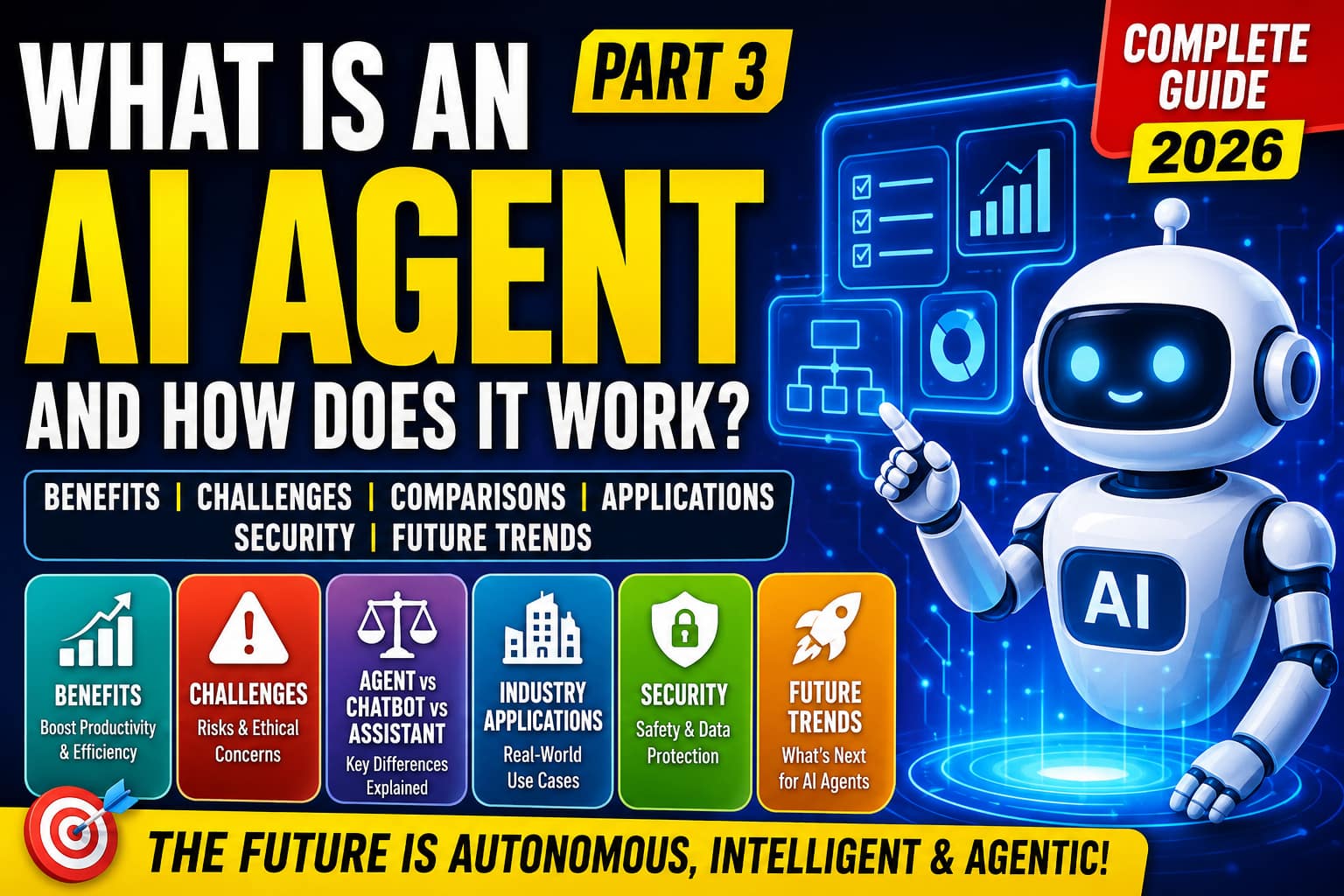
Part 3: Benefits, Challenges, AI Agent vs Chatbot vs AI Assistant, Industry Applications, Security, and Future Trends
Benefits of AI Agents
AI agents are transforming the way organizations and individuals work by automating tasks, improving decision-making, and increasing efficiency. Unlike traditional software, AI agents can adapt to changing situations, learn from experience, and work with minimal human intervention.

1. Increased Productivity
One of the biggest advantages of AI agents is their ability to perform repetitive and time-consuming tasks automatically.
Examples include:
- Managing emails
- Scheduling meetings
- Processing invoices
- Generating reports
- Organizing files
- Updating databases
By automating routine work, employees can focus on creative, strategic, and high-value activities.
2. 24/7 Availability
Unlike humans, AI agents do not require breaks, vacations, or sleep.
They can:
- Answer customer inquiries at any time
- Monitor systems continuously
- Detect unusual activities instantly
- Process requests around the clock
This improves customer satisfaction and ensures uninterrupted business operations.
3. Faster Decision-Making
AI agents analyze large amounts of data within seconds.
They can quickly:
- Identify patterns
- Compare alternatives
- Predict outcomes
- Recommend the best solution
This speed is especially valuable in industries such as finance, healthcare, cybersecurity, and logistics.
4. Reduced Human Error
Manual processes often lead to mistakes caused by fatigue or oversight.
AI agents help reduce errors by:
- Following consistent procedures
- Validating data automatically
- Detecting anomalies
- Performing calculations accurately
5. Personalized User Experiences
Modern AI agents learn from user preferences and past interactions.
They can personalize:
- Product recommendations
- Learning materials
- Marketing campaigns
- News feeds
- Entertainment suggestions
- Customer support responses
This creates a more engaging and relevant experience for users.
6. Cost Savings
Organizations use AI agents to reduce operational costs by automating repetitive work.
Cost savings come from:
- Lower labor requirements
- Faster workflows
- Improved resource utilization
- Fewer operational mistakes
- Better planning
7. Scalability
AI agents can handle thousands or even millions of tasks simultaneously.
For example:
- An e-commerce AI agent can respond to thousands of customer questions during a major sale.
- A cybersecurity AI agent can monitor millions of network events every hour.
8. Continuous Learning
Unlike traditional software, learning AI agents improve over time.
They continuously refine their performance using:
- New data
- User feedback
- Historical outcomes
- Machine learning models
Challenges of AI Agents
Although AI agents offer significant advantages, they also present technical, ethical, and operational challenges.
1. Data Privacy
AI agents often process sensitive information such as:
- Personal details
- Financial records
- Medical information
- Business documents
Organizations must implement strong privacy controls and comply with data protection regulations.
2. Security Risks
If compromised, AI agents could:
- Leak confidential information
- Execute unauthorized actions
- Become targets of cyberattacks
- Spread inaccurate information
Robust authentication, encryption, and monitoring are essential.
3. Bias in AI Models
AI agents learn from data.
If the training data contains bias, the agent may produce unfair or inaccurate results.
Reducing bias requires:
- Diverse datasets
- Careful testing
- Regular model evaluation
- Human oversight
4. Limited Understanding
Even advanced AI agents may:
- Misinterpret ambiguous requests
- Lack common-sense reasoning
- Struggle with unfamiliar situations
- Produce incorrect or incomplete responses
Human review remains important for high-stakes decisions.
5. High Development Costs
Building sophisticated AI agents often requires:
- Large datasets
- Skilled AI engineers
- Cloud infrastructure
- Continuous maintenance
- Ongoing model improvements
Small organizations may face budget constraints when adopting advanced AI systems.
6. Ethical Concerns
Questions surrounding AI agents include:
- Who is responsible for AI decisions?
- How transparent should AI systems be?
- Should AI replace certain jobs?
- How can fairness be ensured?
Responsible AI governance is becoming increasingly important.
AI Agent vs Chatbot vs AI Assistant
Although these terms are sometimes used interchangeably, they refer to different technologies.
| Feature | AI Agent | Chatbot | AI Assistant |
|---|---|---|---|
| Goal-oriented | Yes | Limited | Yes |
| Understands natural language | Yes | Usually | Yes |
| Learns from experience | Often | Rarely | Often |
| Plans multi-step tasks | Yes | Limited | Yes |
| Uses external tools | Yes | Limited | Yes |
| Makes autonomous decisions | Yes | Minimal | Moderate |
| Executes workflows | Yes | Rarely | Yes |
Chatbot
A chatbot mainly answers predefined questions and follows conversation flows.
Example:
- Website FAQ bot
AI Assistant
An AI assistant helps users perform personal or professional tasks.
Examples include:
- Scheduling appointments
- Setting reminders
- Searching for information
- Managing emails
AI Agent
An AI agent goes beyond assistance by:
- Planning
- Reasoning
- Using tools
- Accessing external systems
- Completing complex workflows
- Learning from feedback
Industries Using AI Agents
Healthcare
Applications include:
- Disease detection
- Patient monitoring
- Medical imaging analysis
- Drug discovery
- Virtual health assistants
Banking and Finance
AI agents support:
- Fraud detection
- Loan evaluation
- Investment analysis
- Customer support
- Risk management
E-Commerce
Retail businesses use AI agents for:
- Personalized recommendations
- Dynamic pricing
- Inventory forecasting
- Order tracking
- Customer engagement
Manufacturing
Factories deploy AI agents for:
- Predictive maintenance
- Quality inspection
- Production optimization
- Robotics coordination
- Supply chain management
Education
Educational AI agents provide:
- Personalized tutoring
- Automated grading
- Learning recommendations
- Student performance analysis
- Interactive study support
Marketing
Marketing teams use AI agents to:
- Analyze customer behavior
- Generate content
- Optimize advertising campaigns
- Improve SEO
- Automate email marketing
Cybersecurity
Security-focused AI agents help:
- Detect threats
- Analyze suspicious behavior
- Monitor network traffic
- Identify malware
- Respond to incidents in real time
Human Resources
HR departments use AI agents to:
- Screen resumes
- Schedule interviews
- Answer employee questions
- Support onboarding
- Analyze workforce trends
Security Best Practices for AI Agents
Organizations should follow these best practices when deploying AI agents:
- Encrypt sensitive data.
- Use strong authentication and access controls.
- Monitor AI decisions and logs.
- Regularly update models and software.
- Restrict access to critical systems.
- Validate AI-generated outputs.
- Keep humans involved in high-risk decisions.
- Conduct regular security audits and testing.
The Future of AI Agents
AI agents are expected to become increasingly autonomous, collaborative, and capable.
Emerging trends include:
1. Multi-Agent Systems
Multiple AI agents will work together to solve complex problems by sharing information and coordinating tasks.
2. Autonomous Business Operations
Future organizations may use AI agents to manage entire workflows, including customer support, scheduling, reporting, procurement, and analytics with minimal human intervention.
3. Smarter Personal Assistants
Personal AI agents will become more proactive by:
- Understanding long-term preferences
- Managing calendars and finances
- Planning travel
- Coordinating daily activities
4. AI-Powered Robotics
Robots equipped with AI agents will become more common in:
- Warehouses
- Hospitals
- Agriculture
- Construction
- Disaster response
- Space exploration
5. Scientific Research
AI agents will assist researchers by:
- Reviewing literature
- Designing experiments
- Analyzing datasets
- Identifying new discoveries
- Accelerating innovation
6. Responsible AI
Future AI development will focus on:
- Transparency
- Fairness
- Privacy
- Security
- Human oversight
- Regulatory compliance
Organizations that prioritize responsible AI practices will build greater trust and improve long-term adoption.
Part 3 Summary
AI agents provide significant advantages through automation, intelligent decision-making, scalability, and continuous learning. They are already transforming industries such as healthcare, finance, education, manufacturing, marketing, and cybersecurity. However, organizations must also address challenges related to privacy, security, bias, ethics, and governance. As AI technology evolves, future AI agents will become more autonomous, collaborative, and deeply integrated into business processes and everyday life.
If you’re publishing this on WordPress, Part 4 will tie everything together with SEO-focused finishing elements and publishing assets.


