
Part 2:Types of AI Agents, Architecture, and Real-World Examples
How Does an AI Agent Work?
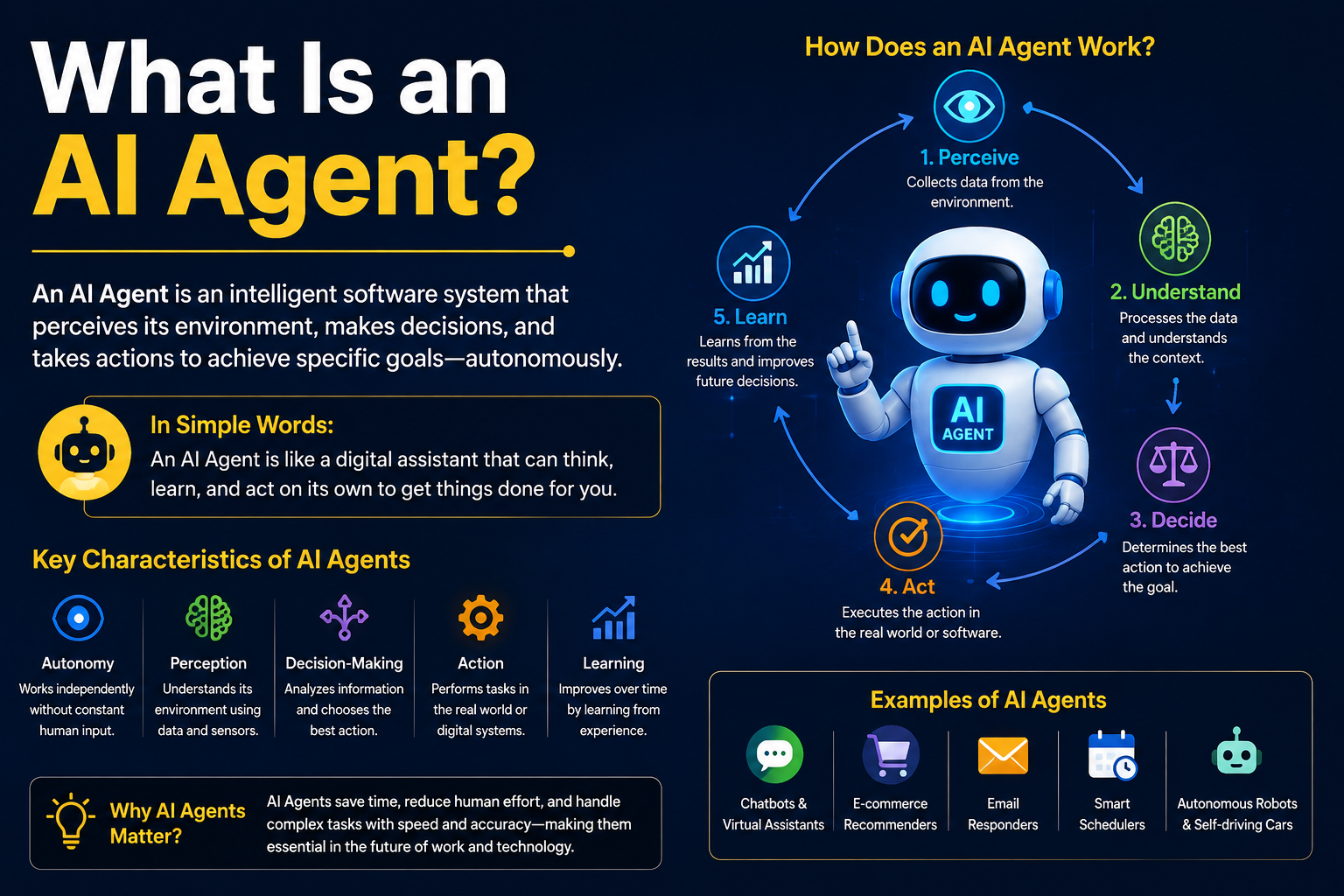
An AI agent operates by following a continuous cycle of observing, reasoning, deciding, acting, and learning. Instead of simply responding to commands, it actively works toward achieving a specific goal by analyzing its environment and choosing the best possible action.
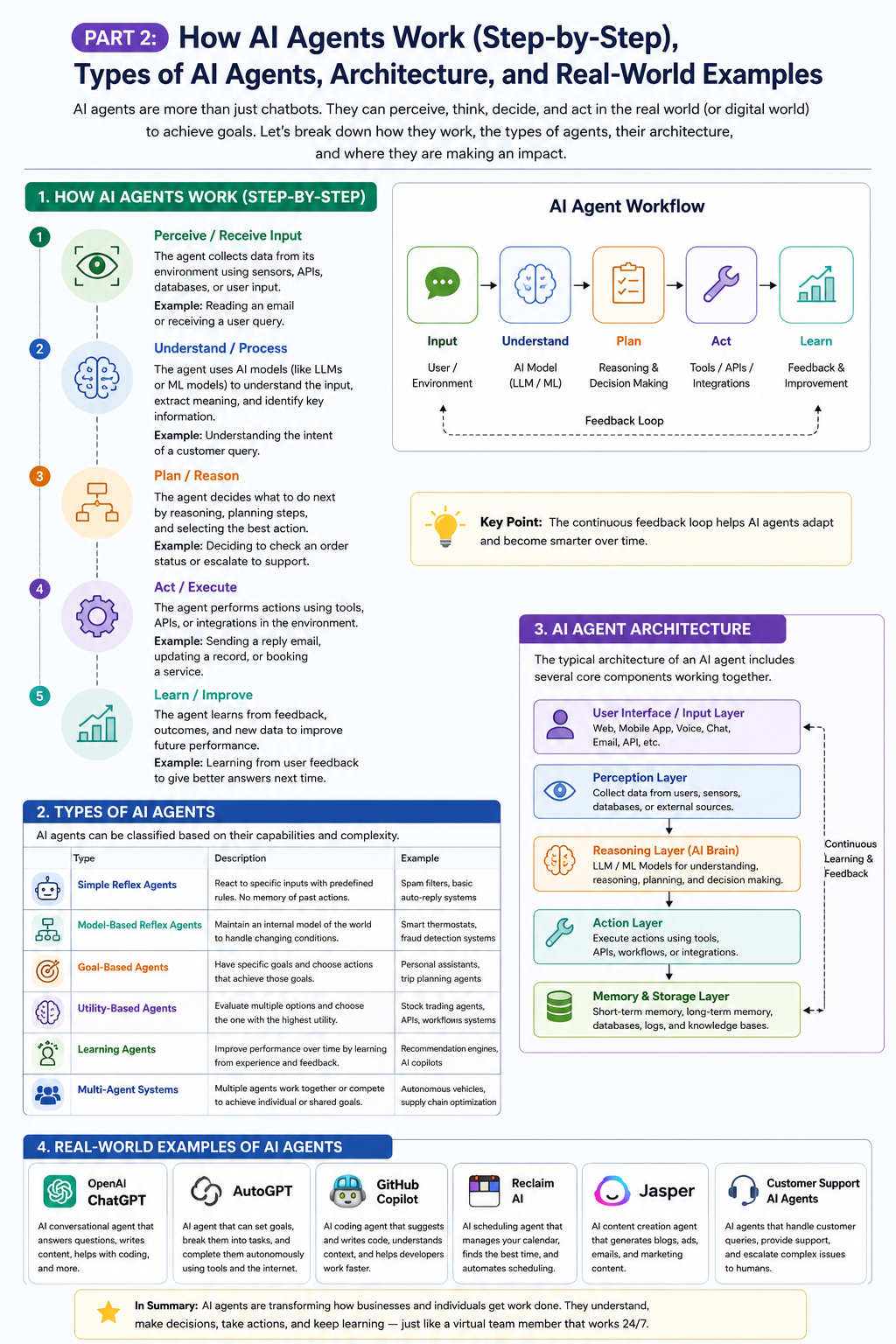
The general workflow of an AI agent consists of the following stages:
Step 1: Receive Input
Every AI agent begins by collecting information from its environment. This information may come from:
- User prompts or voice commands
- Cameras and computer vision systems
- Microphones
- Sensors and IoT devices
- Websites and databases
- APIs
- Emails and documents
For example, when you ask an AI assistant, “Schedule a meeting for tomorrow at 2 PM,” your request becomes the agent’s input.
Step 2: Understand the Input
After receiving information, the AI agent interprets it using artificial intelligence techniques such as:
- Natural Language Processing (NLP)
- Computer Vision
- Speech Recognition
- Data Analysis
The agent identifies the user’s intent, extracts important details, and determines what task needs to be completed.
Example:
Input:
“Book the cheapest flight from Riyadh to Dubai next Friday.”
The AI extracts:
- Departure: Riyadh
- Destination: Dubai
- Date: Next Friday
- Goal: Lowest price
Step 3: Gather Additional Information
Many AI agents need more information before making a decision.
They may:
- Search databases
- Access cloud storage
- Query search engines
- Retrieve company records
- Read documents
- Call external APIs
This allows the agent to work with current and relevant information instead of relying only on previously stored knowledge.
Step 4: Reason and Plan
Once enough information has been collected, the AI agent evaluates possible solutions.
It may compare:
- Cost
- Speed
- Accuracy
- Risk
- User preferences
- Available resources
The planning system breaks large objectives into smaller tasks.
For example, planning an international business trip might include:
- Checking the calendar
- Finding available flights
- Comparing hotel prices
- Booking transportation
- Creating an itinerary
- Sending confirmation emails
Step 5: Make a Decision
Using reasoning algorithms and machine learning models, the AI agent selects the most appropriate action.
The quality of the decision depends on:
- Available information
- Training data
- Business rules
- Experience
- Performance objectives
Some AI agents also estimate confidence levels before acting.
Step 6: Perform the Action
The AI agent then executes the chosen action.
Examples include:
- Sending an email
- Generating a report
- Recommending products
- Translating text
- Booking appointments
- Controlling a robot
- Answering customer questions
- Detecting fraudulent transactions
Step 7: Learn from Results
Advanced AI agents analyze the outcome of every action.
They may evaluate:
- Was the task completed successfully?
- Did the user accept the recommendation?
- Could the result be improved?
This feedback is used to improve future performance.
AI Agent Workflow
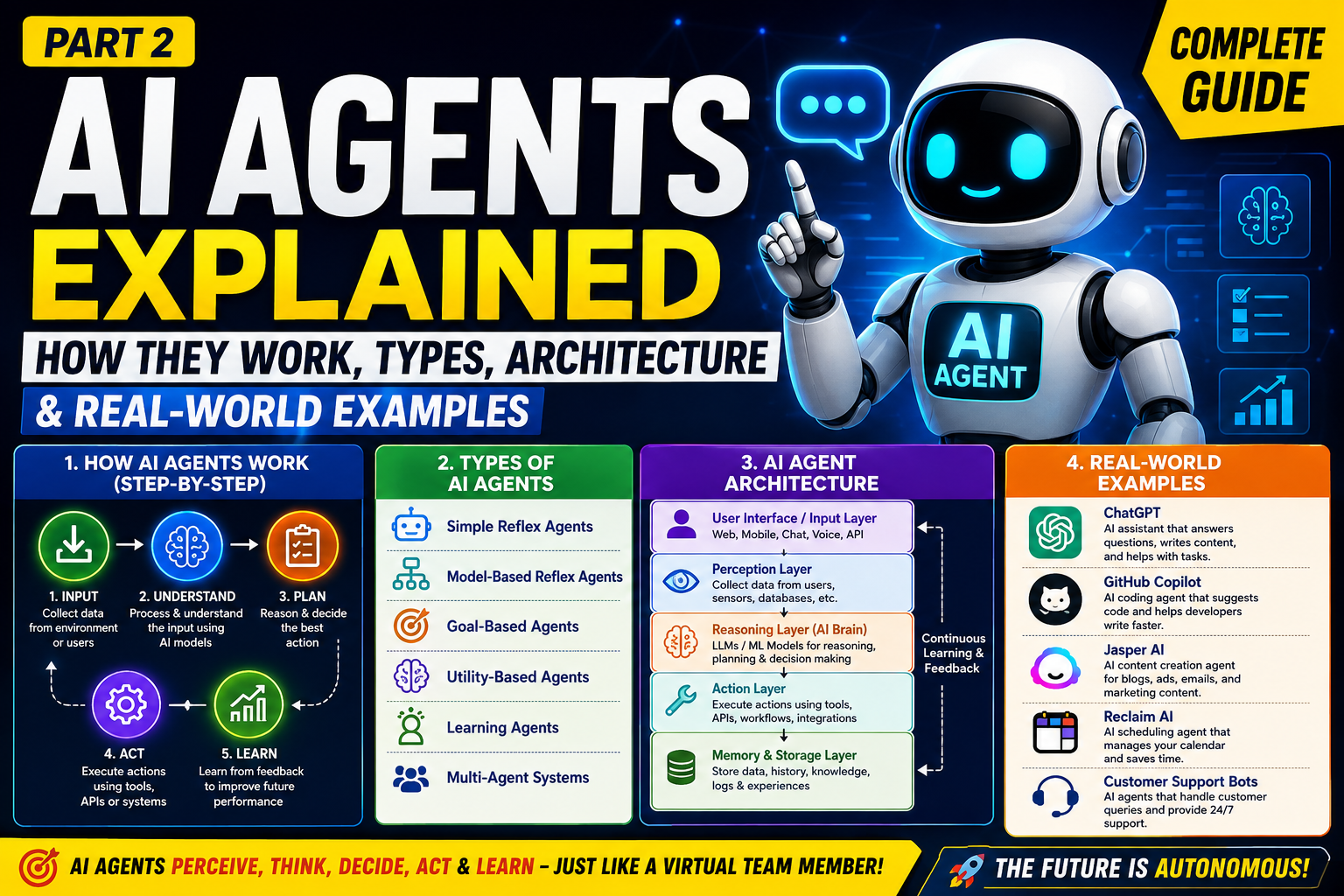
A simplified workflow looks like this:
- Observe the environment.
- Receive input.
- Understand the task.
- Collect relevant information.
- Plan the solution.
- Make a decision.
- Execute the action.
- Learn from feedback.
- Repeat the cycle.
This continuous loop enables AI agents to improve over time and adapt to changing situations.
AI Agent Architecture
Although implementations vary, most AI agents share a common architecture.
Input Layer
Collects data from users, sensors, applications, APIs, and external systems.
Perception Layer
Processes raw information using technologies such as natural language processing, speech recognition, or computer vision.
Knowledge Layer
Stores facts, rules, documents, historical records, and learned information.
Reasoning Layer
Analyzes information, compares alternatives, predicts outcomes, and chooses the best solution.
Planning Layer
Breaks complex goals into manageable steps and determines the sequence of actions.
Action Layer
Executes tasks through software, APIs, robots, or other connected systems.
Learning Layer
Continuously improves the agent using new data, user feedback, and previous experiences.
Types of AI Agents
AI agents are commonly classified based on how they make decisions.
1. Simple Reflex Agents
These agents respond directly to current conditions using predefined rules.
Characteristics:
- No memory
- No learning
- Fast responses
- Suitable for simple environments
Example:
An automatic door opens when someone approaches.
2. Model-Based Reflex Agents
These agents maintain an internal representation of the environment.
They can remember previous states and make better decisions than simple reflex agents.
Example:
A robotic vacuum remembers which rooms have already been cleaned.
3. Goal-Based Agents
These agents choose actions that help achieve a defined objective.
Instead of following fixed rules, they evaluate different paths to reach the desired outcome.
Example:
A navigation app selecting the fastest route to a destination.
4. Utility-Based Agents
Utility-based agents evaluate multiple possible outcomes and select the option that provides the greatest overall benefit.
They consider factors such as:
- Cost
- Time
- Risk
- Efficiency
- User satisfaction
Example:
An investment assistant recommending the portfolio with the best balance of risk and return.
5. Learning Agents
Learning agents continuously improve through experience.
Their capabilities include:
- Learning from mistakes
- Adapting to new situations
- Improving accuracy
- Optimizing future decisions
Examples:
- Personalized recommendation systems
- Fraud detection platforms
- Modern AI assistants
- Autonomous vehicles
Real-World Examples of AI Agents
Healthcare
AI agents assist healthcare professionals by:
- Analyzing medical images
- Detecting diseases
- Monitoring patients
- Scheduling appointments
- Supporting clinical decision-making
Finance
Banks and financial institutions use AI agents for:
- Fraud detection
- Credit scoring
- Investment recommendations
- Customer support
- Risk assessment
Customer Service
AI-powered support agents can:
- Answer frequently asked questions
- Resolve common issues
- Track orders
- Process refunds
- Escalate complex cases to human agents
E-Commerce
Online retailers use AI agents to:
- Recommend products
- Personalize shopping experiences
- Forecast demand
- Optimize inventory
- Improve pricing strategies
Manufacturing
Factories deploy AI agents to:
- Monitor equipment
- Predict maintenance needs
- Improve quality control
- Optimize production schedules
- Reduce downtime
Transportation
AI agents enhance transportation by:
- Optimizing traffic flow
- Managing delivery routes
- Assisting autonomous vehicles
- Predicting arrival times
- Improving fleet management
Education
Educational platforms use AI agents to:
- Recommend personalized learning paths
- Answer student questions
- Grade assignments
- Track learning progress
- Provide adaptive tutoring
AI Agents and Large Language Models (LLMs)
Modern AI agents often integrate Large Language Models (LLMs) to understand and generate human language. While an LLM can answer questions and create content, an AI agent extends these capabilities by planning tasks, using external tools, accessing databases, calling APIs, and remembering context across multiple steps.
For example, an AI agent can:
- Read an email
- Identify action items
- Check your calendar
- Schedule a meeting
- Send invitations
- Summarize the results
This ability to combine reasoning with action makes AI agents far more powerful than standalone conversational models.
Part 2 Summary
AI agents work through a continuous cycle of perception, reasoning, planning, action, and learning. Depending on their design, they may use simple rules or advanced machine learning to solve problems and achieve goals. Their flexible architecture and ability to interact with real-world systems make them valuable across industries such as healthcare, finance, manufacturing, education, and e-commerce.
In the next part, I’ll cover Benefits, Challenges, AI Agent vs Chatbot vs AI Assistant, Industry Applications, Security, and Future Trends in the same detailed format.