

Part 1: Introduction, Definition, History, and Core Components (Detailed Guide)
What Is an AI Agent?
Artificial Intelligence (AI) has transformed the way people interact with technology. From voice assistants like Siri and Google Assistant to self-driving cars and intelligent customer support systems, AI is becoming an essential part of everyday life. Among the most exciting developments in artificial intelligence is the AI agent.
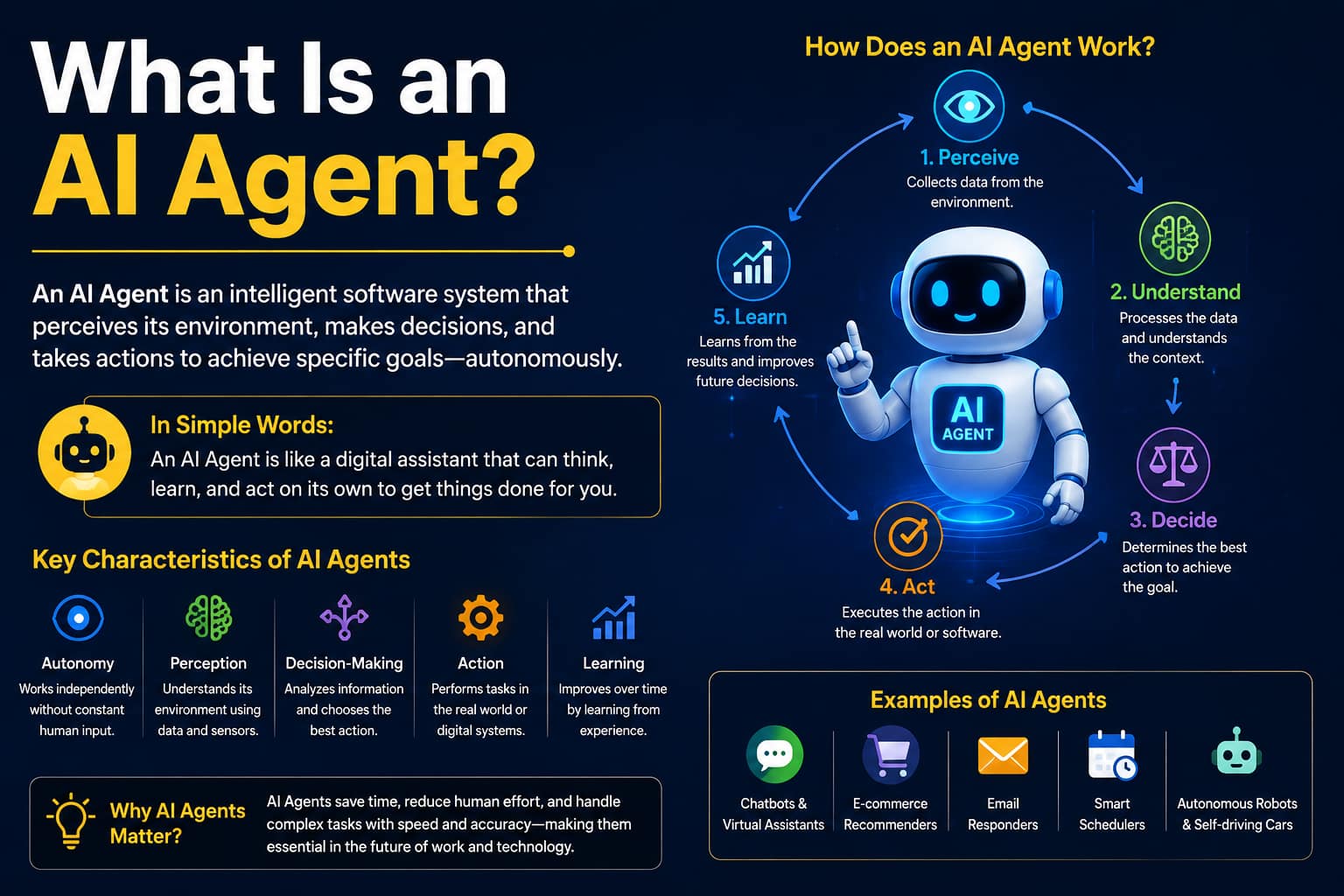
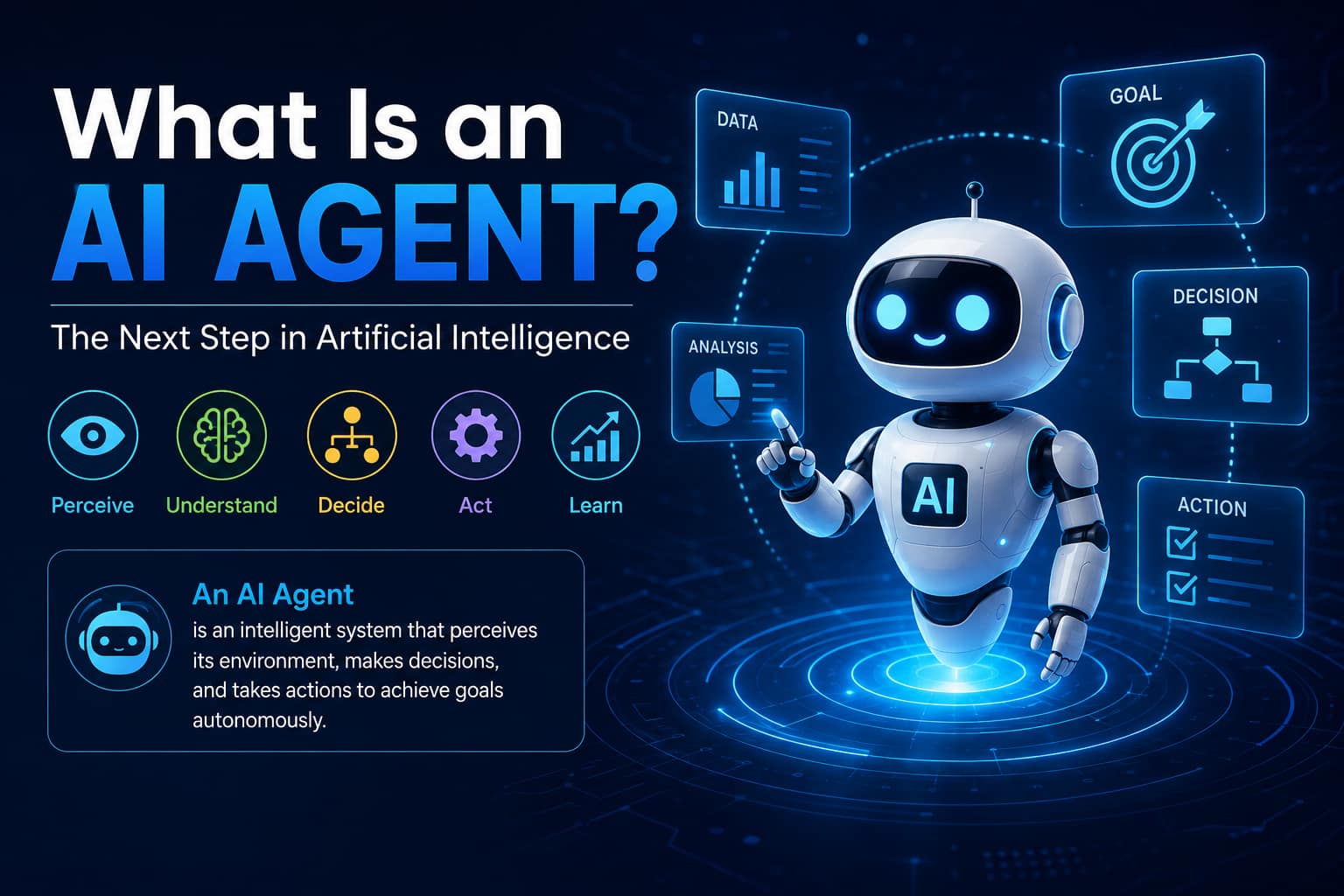
An AI agent is much more than a chatbot that answers questions. It is an intelligent software system that can perceive its environment, understand information, make decisions, perform tasks, learn from experience, and achieve specific goals with little or no human intervention.
Modern AI agents are used in businesses, healthcare, education, finance, cybersecurity, software development, robotics, marketing, and many other industries. They help automate repetitive work, improve decision-making, reduce operational costs, and increase productivity.
As AI technology continues to evolve, AI agents are expected to become even more capable, autonomous, and integrated into our daily lives.
Simple Definition of an AI Agent
An AI agent is an intelligent computer program that:
- Observes its environment
- Collects information
- Understands the situation
- Makes decisions
- Takes appropriate actions
- Learns from previous experiences
- Improves over time
Unlike traditional software, which follows fixed instructions, AI agents can adapt to changing conditions and solve problems dynamically.
AI Agent Definition in Technical Terms
From a computer science perspective:
An AI agent is an autonomous entity that perceives its environment using sensors, processes information using artificial intelligence algorithms, and acts upon the environment through actuators to achieve predefined objectives while maximizing performance.
This definition applies to both software agents and physical robots.
Why Are AI Agents Important?
The world generates enormous amounts of data every second. Humans cannot analyze everything quickly enough.
AI agents help organizations by:
- Processing massive datasets
- Finding hidden patterns
- Making intelligent recommendations
- Automating repetitive work
- Responding instantly
- Learning continuously
- Operating 24/7
This makes businesses faster, smarter, and more efficient.
Real-Life Examples of AI Agents
You may already use AI agents every day without realizing it.
Examples include:
Virtual Assistants
Examples:
- Siri
- Google Assistant
- Alexa
These agents understand voice commands and perform actions such as:
- Setting alarms
- Sending messages
- Searching the internet
- Playing music
- Controlling smart devices
Navigation Systems
Google Maps and similar navigation apps are AI agents because they:
- Analyze traffic
- Predict travel times
- Recommend better routes
- Learn traffic patterns
Netflix Recommendations
Netflix uses AI agents that:
- Analyze viewing history
- Learn user preferences
- Recommend movies
- Suggest TV shows
Every recommendation is generated by intelligent algorithms.
Shopping Websites
Amazon and online stores use AI agents to:
- Recommend products
- Detect fraud
- Manage inventory
- Predict customer behavior
Customer Support Bots
Modern customer service systems can:
- Answer FAQs
- Solve technical problems
- Process refunds
- Escalate complex issues to humans
These intelligent systems are AI agents designed to assist customers efficiently.
Brief History of AI Agents
The idea of intelligent machines has existed for decades.1950s
Alan Turing proposed the famous Turing Test, introducing the concept of machine intelligence.
Researchers began asking:
Can machines think?
1960s
Scientists developed rule-based systems.
These systems followed predefined logic but could not learn.
1980s
Expert systems became popular.
These programs could solve specialized problems using knowledge databases.
Examples:
- Medical diagnosis
- Engineering design
- Financial analysis
1990s
Machine learning emerged.
Computers started learning from data instead of relying solely on hardcoded rules.
2000s
The internet provided massive datasets.
AI improved dramatically through:
- Big data
- Cloud computing
- Faster processors
2010s
Deep learning revolutionized AI.
Neural networks achieved breakthroughs in:
- Image recognition
- Speech recognition
- Language understanding
- Autonomous driving
2020s
Generative AI and Large Language Models (LLMs) enabled AI agents to:
- Write articles
- Generate code
- Analyze documents
- Conduct research
- Use tools and APIs
- Complete complex workflows
- Collaborate with humans
Today’s AI agents are significantly more capable than earlier generations.
Difference Between Traditional Software and AI Agents
| Traditional Software | AI Agent |
|---|---|
| Uses fixed rules | Learns from data |
| Limited flexibility | Adapts to new situations |
| Requires manual updates | Can improve automatically |
| Executes commands | Makes informed decisions |
| Cannot reason | Can analyze and plan |
| Static behavior | Dynamic behavior |
This adaptability is what sets AI agents apart from conventional software.
Characteristics of an AI Agent
A true AI agent generally exhibits the following characteristics:
1. Autonomy
An AI agent operates independently without requiring constant human supervision.
Example:
A warehouse robot moving products automatically.
2. Intelligence
It uses AI techniques such as machine learning, reasoning, or natural language processing to make decisions.
3. Perception
It gathers information from its environment through inputs like:
- Cameras
- Microphones
- Sensors
- User messages
- Databases
- APIs
4. Decision-Making
The agent evaluates available information and determines the most suitable action based on its goals.
5. Learning
Many AI agents improve over time by learning from data, user interactions, and feedback.
6. Goal-Oriented Behavior
Every AI agent is designed with one or more objectives, such as:
- Reducing delivery times
- Increasing sales
- Detecting fraud
- Answering customer queries
- Optimizing routes
7. Adaptability
AI agents can adjust to changing environments without requiring extensive reprogramming.
Core Components of an AI Agent
Every AI agent typically includes several key components.
1. Environment
The environment is everything the AI agent interacts with.
Examples:
- A website
- A mobile app
- A factory
- A smart home
- A hospital
- The internet
The environment provides the context in which the agent operates.
2. Sensors (Inputs)
Sensors collect information from the environment.
Examples include:
- Cameras
- Microphones
- GPS
- Temperature sensors
- Keyboards
- User prompts
- Database queries
- API responses
Without inputs, an AI agent cannot understand its surroundings.
3. Knowledge Base
The knowledge base stores information the AI agent uses to make decisions.
It may include:
- Facts
- Rules
- Historical data
- User preferences
- Company policies
- Machine learning models
A richer knowledge base often leads to better decisions.
4. Reasoning Engine
The reasoning engine is the “brain” of the AI agent.
It analyzes information, evaluates options, predicts outcomes, and chooses the best course of action.
For example, an AI customer support agent might determine whether to answer a question directly or escalate it to a human representative.
5. Memory
Memory enables the AI agent to retain information across interactions.
Different forms include:
- Short-term memory for the current task
- Long-term memory for historical data
- Context memory for ongoing conversations
Memory allows AI agents to provide more personalized and coherent experiences.
6. Planning Module
The planning module breaks complex goals into manageable steps.For example, if the goal is to organize a business trip, the agent may:
- Check calendars.
- Search for flights.
- Compare hotel options.
- Book reservations.
- Send confirmation emails.
Planning helps AI agents tackle multi-step tasks effectively.
7. Learning Module
The learning module improves the agent’s performance over time by analyzing outcomes and incorporating new data.
Common learning approaches include:
- Supervised learning
- Unsupervised learning
- Reinforcement learning
- Transfer learning
Continuous learning enables the agent to adapt to changing environments and user needs.
8. Action Module (Outputs)
After processing information, the AI agent performs actions such as:
- Sending emails
- Answering questions
- Creating reports
- Controlling robots
- Recommending products
- Booking appointments
- Generating code
These outputs allow the agent to achieve its intended goals.
Summary
An AI agent is an intelligent system capable of perceiving its environment, reasoning about available information, making decisions, taking actions, and learning from experience. Unlike traditional software, AI agents are adaptive, goal-driven, and capable of handling complex tasks with minimal human intervention.
In Part 2, we’ll explore how AI agents work step by step, the AI agent workflow, different types of AI agents, and real-world architecture and examples in greater detail.


